
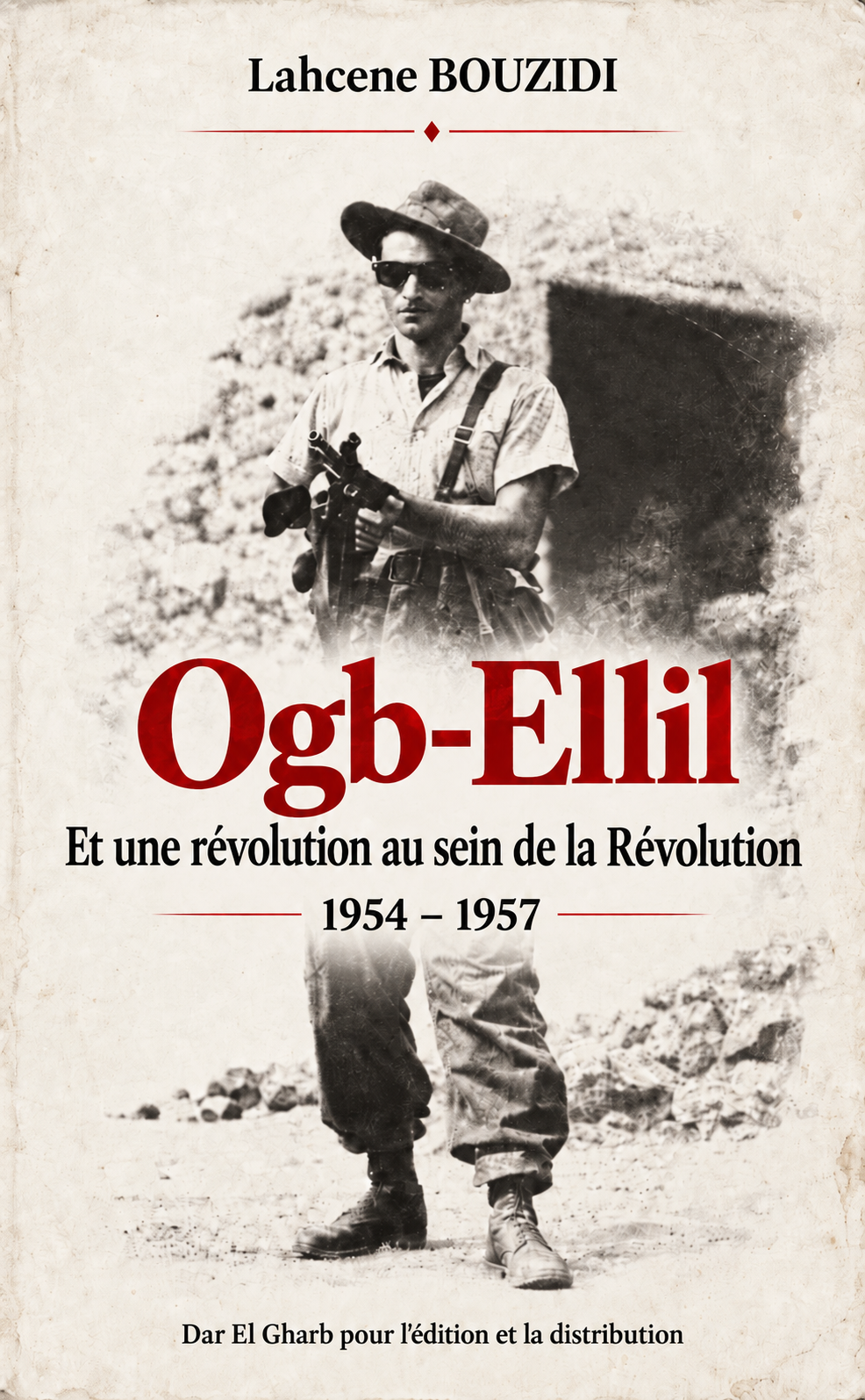
Dedication
To every Algerian family that gave a martyr for the liberation of
Algeria. I dedicate this bright and pure image of struggle and
sacrifice, the one drawn and embodied by the martyr Bouzidi Mohamed,
“Ogb-Ellil”.
| Introduction | 1 |
|---|---|
| The Contradictions of the Revolution | 2 |
| A Distinctive Revolutionary Personality | 4 |
| Ogb-Ellil | 17 |
| Si Ahmed El Bouzidi | 24 |
| Essaïem Abdelkader | 25 |
| Si Ben Yahia El Bouzidi | 26 |
| Essaïem Essaïem | 26 |
| Hamdaoui El Mamoun | 27 |
| Joining the Liberation Revolution and Commanding the Fifth Sector |
29 |
| Organization of the Sectors | 35 |
| Organization of the Fifth Sector and the Launch of Revolutionary Operations |
37 |
| Moutas Center | 40 |
| Zegdouna Center | 40 |
| Wassar Center | 41 |
| Tlemcen, Stronghold of the Fedayeen Groups | 46 |
| Bekhti Abderrazak | 51 |
| The Martyr Bouzidi Ahmed | 53 |
| Battles and Exploits | 57 |
| Sidi Yahia Operation (El Kef) | 59 |
| Wassar Attack | 59 |
| Es-Souiq Ambush | 60 |
| Train Sabotage Operation | 60 |
| Battle of Sadd En-Nemr | 61 |
| Berbata Ambush and Siege of Sabra | 63 |
| Battle of Er-Raha | 69 |
| Battle of Aïn El Ban (9-11 August 1956) | 74 |
| The Plot and the Martyrdom | 80 |
| Mohamed Boudiaf | 102 |
| Abdelhafid Boussouf | 104 |
| Houari Boumediene | 107 |
| CONCLUSION – The Revolution and the Criminals of the Revolution | 110 |
Introduction
This book is a brief attempt to make known the personality of a hero
of the Liberation Revolution and a valiant fighter whom the Oujda
leadership, headed by Boussouf and Boumediene, sought to erase and make
disappear from the memory of the Revolution, without succeeding. This
man’s name continued to be on everyone’s lips, and his life and exploits
continued to be told and passed down from generation to generation.
On the other hand, it is also a call for the need to investigate and
examine closely the events and history of the Liberation Revolution, and
to lift the veil from its different men, in order to distinguish its
true leaders and heroes from those who merely claim to be such, from the
falsifiers and conspirators, because all of this will remain closely
connected to Algeria’s future and will exert a profound influence on the
course of its people, either toward decline or toward something
better.
The Contradictions of the Revolution
Every general revolution whose events bring radical and sweeping
changes is characterized, regardless of its historical circumstances and
the nature of its aims and purposes, by the formation, amid its events,
battles and bitter struggles, and from the very outset, of three
fundamental categories of people. These reach such a degree of clarity
and differentiation that they ultimately become distinct and sometimes
opposed, different in their human nature and contradictory in their
orientations, then in their intentions and objectives.
The first category is that of leaders and heroes. They are men
sincere in the commitments they have made, firm in their faith and
principles, eager to put them into practice, hold fast to them and
uphold them. Neither horrors nor difficulties turn them away from this;
their qualities are sincerity, devotion and sacrifice.
The second category is that of conspirators and schemers. They are
men of hypocrisy and ostentation; their positions are not clear, but
twisted and obscure. In all their actions, they display what belongs
neither to their nature nor to their conviction. To them applies the
meaning of the Quranic verse that says: “It is greatly hateful in the
sight of God that you say what you do not do.” Such men lie in wait for
others and withdraw to the rear lines in order to avoid danger and spare
themselves the horrors of the Revolution. With cunning and skill, they
make plans for a day they believe must inevitably come. For this reason,
they resort to intrigues and plots against anyone who stands up to them
and opposes this nature or this suspicious orientation.
The third category is that of traitors. These openly and publicly
oppose the Revolution and its purposes; they believe neither in its aims
nor in its orientations. They therefore do not hesitate to join the
enemy camp, to which their fate is tied and upon which their interests
rest. Above all, they see this position as a sound decision and a wise
choice, and perhaps even as evidence of insight and great
intelligence.
If it is natural for individuals belonging to these three categories
to be found in every place of the Revolution and at every level, among
the general public as well as among the elite and the leadership, the
essential point is that each individual, whatever his position, should
act and be imbued with what corresponds to the nature of one or another
of these categories.
It is perhaps necessary to point out, in this context, that the
Algerian Revolution of 1954 ranks among the most important liberation
revolutions of the twentieth century in which these three fundamental
categories took shape. It can even be said that, from the outbreak of
the Algerian Revolution, the exploits of heroes arose alongside the
plots and intrigues of conspirators and the betrayal of faltering
traitors. All of this crystallized at the same time and took form on one
common ground: the ground of the Revolution. Some men devoted themselves
to fighting colonialism and embraced sacrifice; others devoted
themselves to plots and intrigues; still others persisted in betrayal
and clung to a defeatist spirit.
It should be pointed out in this regard that, while these three
categories were distinct and clearly identifiable during the Liberation
Revolution, their situation became confused during the period of
independence and grew deeply intertwined, particularly between the
category of heroes and that of conspirators. This latter category
managed to take control and infiltrate the centers of power, then to
tamper with the interests of Algerian society after establishing a
political system founded on plots, intrigues and assassinations, amid
the almost complete absence of those true leaders and heroes who
genuinely represented the hopes and aspirations of the nation during the
Liberation Revolution. The reality confirms that the overwhelming
majority of them died and fell as martyrs. As for those who lived to see
independence, they suffered persecution and abuse to such an extent that
they withdrew from events, leaving Algeria’s fate to the actions of
troublemakers and the plots of conspirators.
These three categories within the Algerian Revolution were never
closed and absolute categories, without increase or decrease: there were
errors and shortcomings among leaders and heroes, just as there were
positions of moderation among conspirators,
as well as an awakening of conscience among traitors. Despite this,
nothing prevented the fate of the Algerian Revolution from being closely
tied to the condition of these three categories. Nor did it prevent the
fate and future of independent Algeria from being tied to the
orientations of the category that seized power and succeeded in
governing. From these contradictions, we can certainly understand, in
one way or another, why the condition of Algerian society deteriorated
in every field and why the political system failed to rise to the level
of the Revolution’s aspirations and hopes through the various
transformations it underwent after Algeria’s independence.
A Distinctive Revolutionary Personality
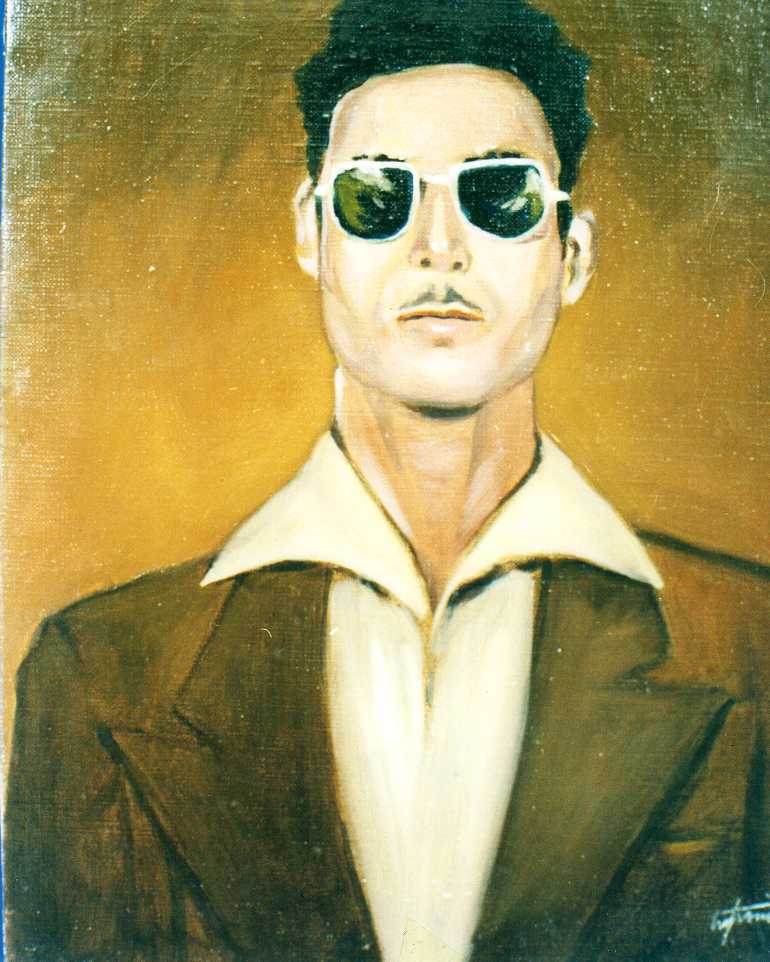
The martyr Bouzidi Mohamed “Ogb-Ellil”
“Ogb-Ellil” was one of those Algerians belonging to the first
generation of leaders and heroes who were able to launch the Liberation
Revolution with absolute sincerity and devotion. He fought the colonial
army with courage and bravery, confronted the conspirators and the
faltering elements and stood up to them as they fled and withdrew toward
the rear lines. He also tracked the traitors and took notable positions
in this regard. In this way he forged his distinctive revolutionary
personality, until he became known to everyone for his courage and
boldness in struggle and sacrifice. He faced danger after danger without
evasion, hesitation or retreat. For this reason he was loved by
everyone, and his standing rose and distinguished itself on the field of
the Revolution and its battles.
The man who possessed this revolutionary personality was firm and
strict; his face bore sharp, penetrating looks that seemed to probe the
depths. Everywhere, his name evoked firmness, determination and
discipline. He was a source of terror in the ranks of the colonial army
and among the settlers. In the countryside, mothers often frightened
children when they cried at night by telling them: “Stop crying, or
Ogb-Ellil will hear you.” In Tlemcen, where his name had become common
since the outbreak of the Revolution, some imagined that this man could
be everywhere at any time. Stories were told about him: some were based
on established fact, while others were exaggerations or products of the
imagination. The reason for all this was no doubt simply his fame, after
he had become highly proficient in all the revolutionary operations he
carried out alongside the mujahideen. In this connection, one of the
heroes of the Revolution in western Algeria, the martyr Bousif,
commander of the third sector, once declared, addressing1 a
group of mujahideen: “All of us sector commanders carry out operations
and ambushes against the colonial army from time to time; despite that,
the one who wins fame and whose name is mentioned among the people is
none other than Ogb-Ellil.” Most heroic actions were attributed to him,
whether he himself had carried them out or whether they had been
accomplished by other mujahideen.
I do not know of any man of the Liberation Revolution who, in so
short a period of struggle, bore so many names. This man was known by
the following names: “Mohand Lahcène,” “Si Mokhtar,” “Ogb-Ellil,”
“Abdou,” “Abbadi.” It is clear that this multiplicity of names for this
revolutionary figure necessarily served a purpose: to conceal himself
from the colonial administration as well as from the harkis and the
sellouts. It also strongly demonstrates the determination of the
colonial police and their intelligence services to follow his tracks and
search for him in order to kill or arrest him.
How could it have been otherwise when the mujahideen under his
command inflicted heavy losses on the colonial army in successive
attacks and operations that most often ended in victory and superiority
over the enemy? The colonial administration’s relentless determination
to eliminate this authentic revolutionary became clear when it took a
measure unprecedented throughout the region: toward the end of 1956, it
offered a financial reward estimated at about thirty-five million
francs, generously promised to anyone who, in one way or another,
provided information on his whereabouts. This came after the mujahideen
under his command had besieged and then entered the village of
Sabra.
Thus Ogb-Ellil was a revolutionary in the true sense of the word. The
meanings and foundations of the Revolution were embodied in his
personality and even in all his behavior and attitudes, whatever the
circumstances. He often said to the mujahideen, when they thought about
the fate of their children and remembered them while hardships and
dangers surrounded them on every side: “Our children are like any of the
Algerians… On the first day, it was not to our children that we
pledged ourselves; it was to the Algerian people that we pledged
ourselves, so that we might liberate them…” I wonder whether there are
words more eloquent than these to express the sincerity of sacrifice and
devotion to the homeland! Whatever the case, all honor is due to
Ogb-Ellil and to martyrs like him.
To pay tribute to his standing, it is enough to point out that people
still remember his exploits despite the passage of decades. This love
reached in their hearts a degree that one rarely hears of elsewhere.
This man was known for putting the mujahideen before himself in
everything. He was often seen giving his favorite weapon to one of the
mujahideen simply because that man wanted to possess a weapon of that
type. On many occasions he also took off his shirt and gave it to
another mujahid after noticing that the other man’s shirt was torn
somewhere. Through such simple gestures he shaped his positions, giving
his personality an unmatched effectiveness and boldness. Some mujahideen
who accompanied him and lived through the struggle with him recount that
one day, in the summer of 1955, while he was passing through the region
of Ouled Riah, an area between Zenata and Sabra, he encountered an old
man overcome by sadness and distress, looking over his field of barley
whose ears had begun to fall even though harvest season had arrived. He
greeted him and then asked: “…Why have you left this barley to fall
without harvesting it yet?” The old man replied that there was no man in
the entire region who could help him with the harvest; all he had around
him were women and children. Ogb-Ellil left the place, leaving the old
man in his state of uncertainty and anguish. But how great was the old
man’s surprise when, the next day, he returned to his field and saw a
group of mujahideen, sickles in their hands and rifles on their
shoulders, absorbed in harvesting in broad daylight. They did not leave
until they had completed their work in the best possible manner.
There is no doubt that the qualities of this revolutionary man were
numerous, to the point that people continued to recount them tirelessly
both during and after the Revolution. They ranged from his extreme
concern for safeguarding the Revolution – in this respect resembling the
first generation of Algerian revolutionaries – to his firmness as a
revolutionary commander, as well as the purity of his intentions and the
goodness of his character, especially in his dealings and relations with
the mujahideen. Alongside this, he was hard and quick-tempered; he
neither hesitated nor retreated before revolutionary missions, however
dangerous they might be. His revolutionary positions were a “sharp
sword” that he embodied in the field; even in the face of difficulty,
nothing was more important than the interest of the Revolution. For this
reason his reactions were often severe and decisive toward certain
revolutionary elements who hesitated or failed to carry out some
operations. During one of his visits to Tlemcen, in the first or second
month of 1956, he met several local officials of the city: Ibrahim El
Arbi, Bouayad, Brikci Rqiq Abdelhamid and Mustapha Ben Yelles. He
confronted the latter harshly and reprimanded him severely because of
his hesitation in carrying out certain revolutionary orders. From that
time on, this man, disturbed by the incident, began writing secret
reports about his commander to the “Oujda group,” with which Ogb-Ellil
had entered into a serious dispute because it had transferred the
leadership of the Revolution to the Moroccan city of Oujda.
There are many stories and many positions concerning this. For
example, he used to say to all those who weakened or were afraid in such
situations: “You must carry out the orders of the Revolution, even if
they put your life in danger… As for you, if you are afraid of dying,
know for certain that we will all die one day. What matters is that the
life of the Revolution should continue and endure, because there will
necessarily, at all times, be Algerians to succeed us.” Among the
examples that reveal another aspect of this revolutionary’s personality
is what the mujahid Antar relates. 2This mujahid, who had
fled the colonial army, joined the mujahideen at the beginning of 1956.
At the time of his escape, the martyr Larbi Ben M’hidi, leader of the
Revolution in western Algeria, was meeting with Ogb-Ellil on the
territory of Zegdouna. He was then recruited into 3the
organization of the fifth sector in the presence of both men, before
later becoming an intrepid leader of many successful revolutionary
operations against the colonial army and its positions.
This mujahid recounts that after joining the Revolution, he
discovered, contrary to what he had imagined, that the mujahideen in the
structures of the fifth sector were militarily organized in a way that
was in no respect inferior to the organization of the colonial army. He
also saw that the fighters possessed many automatic and heavy weapons.
From time to time, their commander Ogb-Ellil gathered them to give them
what, in the language of the Revolution, was called “the lesson,”
meaning a short address intended to instruct and guide the mujahideen in
a way that strengthened their revolutionary enthusiasm. As was his
custom, he would then finish his remarks by informing them of all the
latest developments concerning the progress of the Revolution. In
particular, he would read out the names of the mujahideen who had fallen
on the field of honor, then conclude by reciting the Fatiha and reading
the Quranic verse: “Do not think that those who have been killed in the
path of God are dead; rather, they are alive with their Lord and receive
their sustenance.”
This mujahid also recounts that Ogb-Ellil remained suspicious and
uneasy about him during the first days after he joined the Revolution,
because he had come directly from the French army without any prior
contact. He therefore secretly put in place a system to watch him and
follow his movements. His suspicions ceased only after he tested him
through a daring offensive operation that he himself planned and carried
out. The operation aimed to burn and destroy the Giron farm near Remchi
in May 1956; the colonial press of the time mentioned it in the
newspaper “L’Écho 4d’Oran.” The operation ended with the
complete destruction of the site, the death of three members of the
French army and the capture of several automatic weapons.
The mujahid Antar still remembers all of this with pride, especially
since, following the success of this operation, Ogb-Ellil appointed him
commander of a group of mujahideen in the fifth sector. From then on he
played a role in training newly joined mujahideen in the use of
different weapons. He also gained wide renown through his participation
in many battles and revolutionary operations.
It can also be said that the courage and nobility of this authentic
revolutionary, “Ogb-Ellil,” were displayed not only in his battles
against the colonial army, but also in his support for the mujahideen,
in his defense5 of them by every means, and in
raising their morale, sometimes through guidance and sometimes through
firm positions. It is therefore no wonder that throughout the western
border region he became
a model of sacrifice and attachment to the principles, inviolability
and sacred character of the Revolution. When he reprimanded and
threatened “Houari Boumediene” in a critical situation, this precisely
expressed the firmness of his revolutionary positions and reflected his
great sensitivity toward the sacred things of the Revolution and jihad,
which he would not allow to be violated, whatever the circumstances.
After Abdelhafid Boussouf, who was himself deputy to the martyr Larbi
Ben M’hidi, entrusted Houari Boumediene with the responsibility of
inspector general of the army in October 1955, Boumediene remained for
several weeks in the area of the fifth sector, commanded by “Ogb-Ellil,”
in order to carry out this mission. While teaching military movements to
a group of beginners who had just joined the ranks of the mujahideen, at
a place between the mountains of Moutas and Ahfir, one of the mujahideen
became confused and made a mistake while executing the about-face
movement. Houari Boumediene became angry and, unable to contain himself,
shouted at him in agitation: “Your Lord! I told you: about-face!” This
insult fell like a thunderbolt on the simple rural soldier. He had never
heard anything like it among the mujahideen, who were all bound together
by a spirit of tolerance and jihad. Nor could he understand how such
behavior could come from an official of the Revolution of that rank. The
mujahid withdrew from the ranks, isolated himself in one place and
remained there without moving or speaking to anyone, in a state of deep
distress and great tension.
It was not long before news of this incident reached Ogb-Ellil, who
immediately joined this group of mujahideen, since he was at a nearby
place while Boumediene was still there. As soon as he saw him, he
scrutinized him with his sharp gaze, then said to him in a harsh and
severe tone: “Do you know, Boumediene, that this mujahid whom you
insulted by invoking the Lord left his wife and children and joined the
mountains in order to liberate Algeria, and that we have given him
nothing in return, until you came along, I do not know from where, to
reward him with all this insolence by insulting the Lord? By God, and
again by God, if I hear you do that again in the face of a single
mujahid, I will make you disappear into a ravine,” meaning: I will dig
your grave in one of the ravines. Naturally, Boumediene knew perfectly
well Ogb-Ellil’s attitudes, which were dominated by severity and
firmness. He was also convinced that this man never uttered a threat
without carrying it out. He knew all this because he had observed him
closely in comparable situations, whether in his firmness against the
colonial army and traitors or in the need to impose discipline and
decisiveness in managing the requirements of the Revolution.
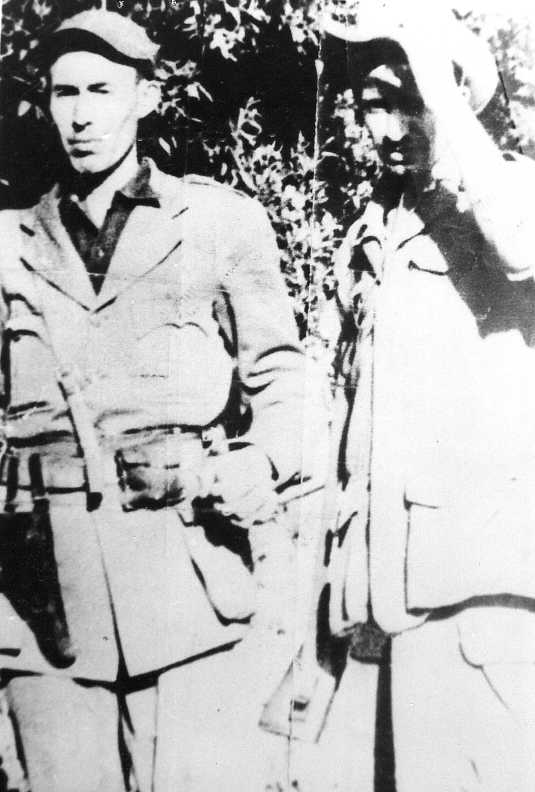
Houari Boumediene with the mujahid Ben Dahmane Mohamed in the
Moutas region, within the fifth sector, at the end of 1955
This incident, and the humiliation it had inflicted on Boumediene
before a group of mujahideen, were enough for resentment and hatred to
build within him from that moment onward, and for him to harbor ill
intentions toward Ogb-Ellil. He became imbued 6with
a spirit of revenge to the point that he thereafter took the greatest
care not to be in the same place as Ogb-Ellil. These feelings gradually
grew within him, especially after his departure for Oujda as part of the
“Oujda group,” until his chief concern became to work, by every means
and every route, to get rid of this valiant revolutionary hero.
Thus, the revolutionary and decisive reactions of this mujahid were
the cause of his fame and ascendancy among the mujahideen, and even
among the population as a whole. But they were also, on the other hand,
the cause of resentment and bitterness in the minds of those whose
personal qualities did not enable them to attain such standing or such
exploits in the field. They ended by withdrawing into themselves in the
city of Oujda, then devoting themselves to preparing plots against the
true heroes of the Revolution, before settling for an administrative
leadership of the Revolution from outside the Revolution, sheltered from
every danger and far removed from any risk.
It can be said that the positions and exploits recounted about this
steadfast revolutionary commander inspire admiration. They were often
situations in which great severity was joined with a remarkable
gentleness. Here is one example:
In the countryside around the village of Sabra, one person was not
convinced that a revolution against colonialism had begun a few months
earlier. It did not occur to him that there were trained and armed
mujahideen confronting the colonial army, because he had never yet seen
any of them. This man therefore spread much doubt and uncertainty among
the inhabitants of his “dechra,” especially when he began saying openly
to the people: “How could these fugitives in the mountains, who are few
in number and possess only hunting rifles and daggers, possibly confront
tanks and warplanes? This is surely something that calls for
astonishment and ridicule!”
In order to deal with this situation and confront these rumors, some
mujahideen proposed that the man should be eliminated and made an
example for anyone tempted to spread such demoralizing rumors and
doubts. Ogb-Ellil, however, did not accept this proposal and held a
different view. He ordered that the different groups of mujahideen be
assembled and put in a state of alert and readiness, equipped with every
available military means, light weapons as well as heavy weapons, and
that they enter the dechra at sunset. In this way, all the inhabitants,
including the man spreading these rumors, would see the reality of the
mujahideen: their extreme discipline, their full preparedness, their
will and the variety of their weapons, which would clearly demonstrate
their ability to confront the colonial army, however great its power and
resources might be.
It was a striking sight for the inhabitants of the dechra when they
saw what they saw of the mujahideen and observed the extent of their
equipment and readiness to enter war and combat. This demonstration was
no doubt enough to convince everyone of the seriousness of the
Revolution and the reality of the mujahideen’s capabilities, especially
since these inhabitants had never before seen any of their groups with
such an appearance, such organization, such strength and such
determination.
Another incident bears witness at once to the severity and
flexibility of this revolutionary man. One day, one of the valiant
mujahideen named “Belarbi El Wahrani,” who belonged to the special group
that accompanied him permanently, spoke with him alone. This courageous
man had been captured by the colonial army following a sudden ambush,
but shortly afterward he managed to escape from them in a wholly
dramatic manner, even though his hands and feet were tied and a “Jeep”
was dragging him by a rope tightened around his neck. Despite this, he
escaped death and returned to the ranks of the mujahideen. This mujahid
therefore withdrew alone with his commander, hesitant and perplexed, and
finally said to him directly: “Do you not think, Ogb-Ellil, that when
Algeria becomes independent, other people will come, perhaps from among
the traitors or from among those who direct the Revolution from beyond
the borders – the Oujda group – and that they will take control of
everything in the name of the martyrs and compete for seats and
positions, while we, the true mujahideen, will find ourselves like
spectators watching the ‘feast’ from afar? What then will become of us
and our children, and what place will we have in free and independent
Algeria?”
Ogb-Ellil was astonished by what he heard from his companion in
jihad. He looked at him for a long time, then said in a very angry and
severe tone, yet at the same time mingled with gentleness and
tenderness: “I think what you say is right. I can even assure you that
many cowards and pseudo-mujahideen, who have not fired a single bullet
against the enemy and have not taken part in a single battle, will
become heroes and leaders overnight after Algeria’s independence, not to
mention the lies and claims they will tell people about their own
exploits. But despite all of that, listen to me carefully: praise be to
God that you told me this when there is no one else with us. I swear by
God the Most High, and I swear by the blood of the noble martyrs, that
if you repeated such words in front of another mujahid, I would kill you
with my own hand, even though you know that your place with me and the
affection I have for you are greater and dearer than those I have for my
own children.”
This mujahid left with a measure of distress within him, feeling as
though he had committed a sin or a grave fault. But as the days passed
and his experiences and observations accumulated, he grasped and
understood the meaning and purpose of what his companion in jihad had
wanted to tell him by addressing him in so harsh a tone, to the point of
not hesitating to threaten him with death. He understood that, whatever
the reality of those who might take control of Algeria in the future,
and whatever changes in circumstances might allow cowards and
conspirators to leap from the obscure rear lines to the forefront and
command, none of that should under any circumstances justify spreading
such suppositions, ideas or suspicions among the mujahideen. Their ardor
must not be weakened, nor their determination dulled, in achieving their
fundamental and sole objective: to liberate the Algerian people, and
nothing else.
Circumstances allowed this mujahid to live long enough to see
independent Algeria and to see the “Oujda group” and “other groups” rush
to the capital at lightning speed in order to take control of the
centers of power, relying for this on the strength of the army and
intelligence services. He saw them fight and compete to seize power and,
for that purpose, declare war on all the other parties. They wove plots,
an art in which they had been thoroughly trained during the years of the
Revolution in Oujda under the direction and formation of Abdelhafid
Boussouf. They assassinated every opponent and every dissenter, inside
the country and abroad, wherever he might be. From this was established
and formed the core of the political system, under the cover of the
socialist system. He also lived through the period when those who, only
a short time earlier, had been integrated into the colonial
administration soon occupied the leading ranks in governing and
administering independent Algeria. More than that, a few years before
his death, he witnessed how President Houari Boumediene, after the
military coup of 19 June, undertook by every means to remove mujahid
officers from the ranks of the National Liberation Army, including
through material inducements, and then to replace them with Algerian
officers who had had ties to the colonial army, under the pretext of the
need to transform the Liberation Army, until then merely a traditional
army trained only in guerrilla warfare, into a modern and developed
army.
As for Ogb-Ellil, his path, like that of the other sincere mujahideen
throughout the national territory, was the path of sacrifice and
martyrdom. For him, the Revolution meant nothing other than the
necessity of liberating the Algerian people from French colonialism, and
he aspired to nothing beyond that. He was the one who constantly said to
his mujahid companions on every occasion: “Whoever among us dies, dies a
martyr; whoever lives, lives happily. 7”
How sincere this man was in this quest! It is therefore no wonder
that the meanings of the Revolution were truly embodied in all his
orientations and all his actions. His sister “Sakina,” who came to see
him during a very dark night and noticed his fatigue and exhaustion,
said to him: “Do not worry, son of my mother, my dear brother, do not be
sad. Algeria will gain freedom with God’s help, you will be one of its
heroes, and God, by His grace, will reward you with every good, you and
all the mujahideen.” He looked at her as a brother looks at his sister,
with a gaze full of compassion and tenderness, then said: “I expect
nothing, my sister. When Algeria gains freedom, it will belong to other
people. And besides, what more could I want, when God has enabled me to
obtain everything I wished for? I forced the settlers who had enslaved
and humiliated the Algerians to live in fear and terror; I even forced
some of them, humiliated, to walk barefoot through the countryside, and
I made them taste humiliation and abasement.”
Then he began telling her the story of the ambush he had laid alone,
during the summer of 1956, on a bend in the road linking Tlemcen and
Maghnia, near the dechra of Wassar. In broad daylight, he stopped a car
carrying settlers and forced them to remove their shoes and return the
way they had come, without harming them in any way, solely because they
were civilians. He then remained for a while watching them flee,
barefoot and terrified.
After finishing the story for his sister, he said to her again: “What
could I want, my sister, after all this? Nothing other than sacrifice
and martyrdom for the liberation of Algeria.”
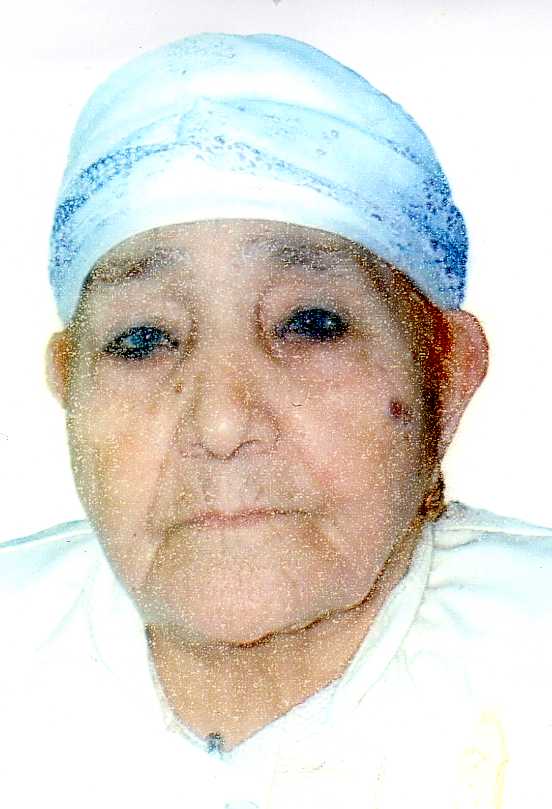
“Al-Khansa,” Sakina, sister of Ogb-Ellil
It was with this extreme simplicity and nobility that he addressed
his sister “Sakina,” who continued to weep for him after his martyrdom
and still weeps for him, although she has reached an advanced age and a
state of great frailty. This “Al-Khansa,” who lost four brothers, each
with a striking story of martyrdom, still sees her tears flow like those
of children whenever her brother’s name is spoken or one of his very
many revolutionary stories is told in her presence, as though she had
not yet understood or felt that decades had passed since his
martyrdom.
This is the revolutionary man, and the revolutionary made man. These
are some of his qualities and revolutionary characteristics, which
people continue to recount from generation to generation. This is one of
God’s graces, attained only by noble martyrs. This is Ogb-Ellil, or Si
Mokhtar, whose name terrified the colonial army and was on every tongue,
from the oldest to the youngest, as one of his mujahid companions
described him. What a man, what a revolutionary, and what a martyr!
Ogb-Ellil
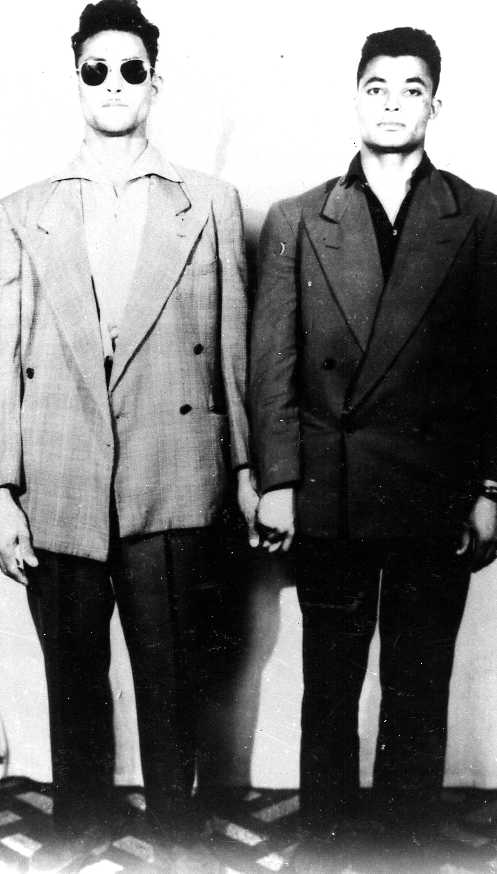
The martyr Maarouf Abderrazak (right)
The martyr Bouzidi Mohamed “Ogb-Ellil” (left)
The martyr Bouzidi Mohamed, son of Lahcène, was born in 1918 in the
douar of Temkessalet. It was formerly, that is several decades ago, the
principal place of settlement of the Bouzidi families in the wilaya of
Tlemcen. The douar lies south of the two villages of Sabra and Bouhlou,
on the edge of the mountainous zone and forest lands that extend to the
heights of Moutas. It is an isolated dechra whose inhabitants reach
other areas only by traveling certain distances. It goes without saying
that this dechra no longer exists: the colonial army bombarded it with
tank artillery at the end of 1955, after considering it a source and a
stronghold of the “outlaws.” It bombarded it again during the summer of
1956. This time, its inhabitants were ordered to evacuate; only women
and children were there then, the men being either in the ranks of the
Liberation Army or in prisons and detention camps. They all left their
homes without knowing where to go.8
His parents died within a short interval, in 1944 and 1945, a period
known among the inhabitants of the region as the “year of hunger.” Very
early, because of the circumstances, he had to assume responsibility for
providing for and caring for his large family, since he was the eldest
brother and already married. He took in his brothers and sisters in
addition to his own small family of six children. Despite the extreme
poverty and hardships of life at that time, this man of the countryside
shouldered this family responsibility without ever evading it. Then came
the outbreak of the Liberation Revolution in 1954, whose events spread
throughout the country. He quickly found himself at the heart of those
events, among the principal driving forces and prominent names in the
revolutionary milieu of the region where he lived. He truly was that man
overflowing with vitality who drew everyone with him, his brothers and
the men of the dechra, one after another, all of similar 9ages, and led them, at the head of
the first ranks, toward the path of jihad, sacrifice and then martyrdom.
At the time of freedom and independence, the only ones among them still
alive were those who had still been children, or those whose fate had
been different because they had been arrested and detained in prisons
and camps; they were few, very few.
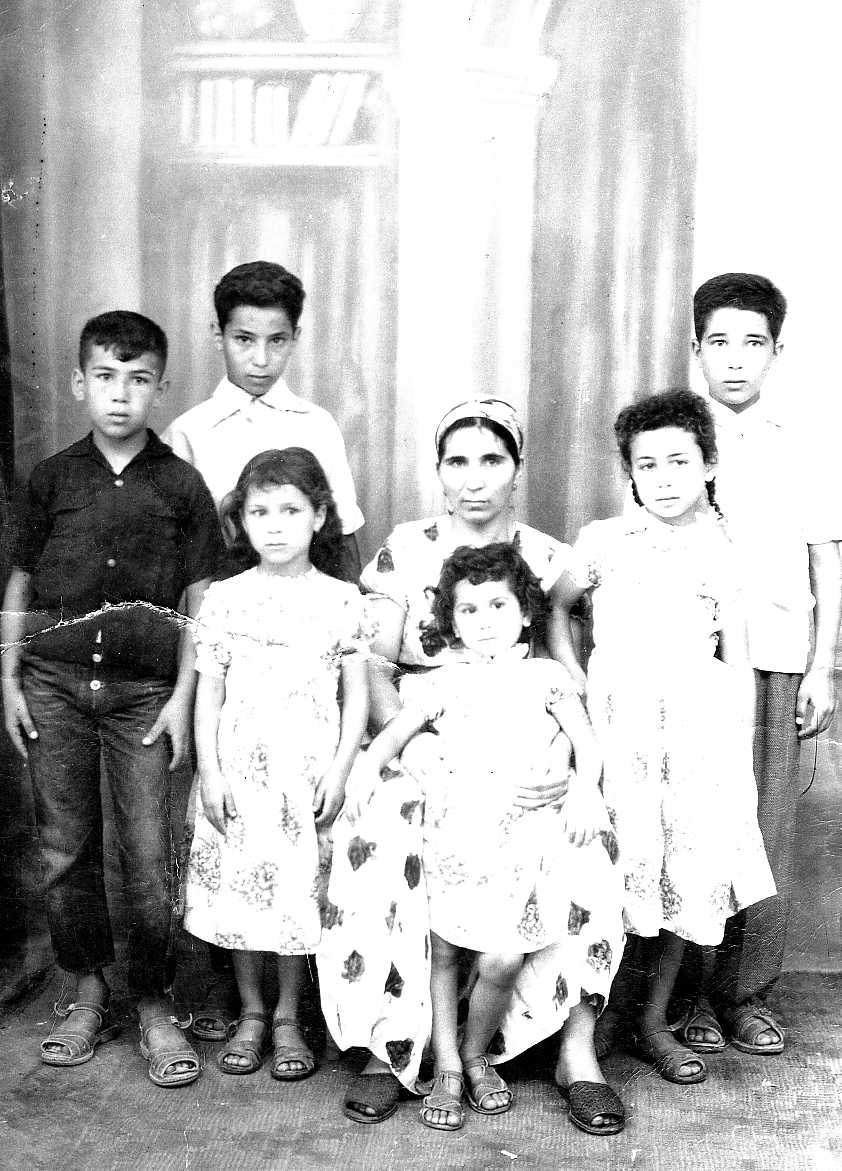
The family of the martyr “Ogb-Ellil”
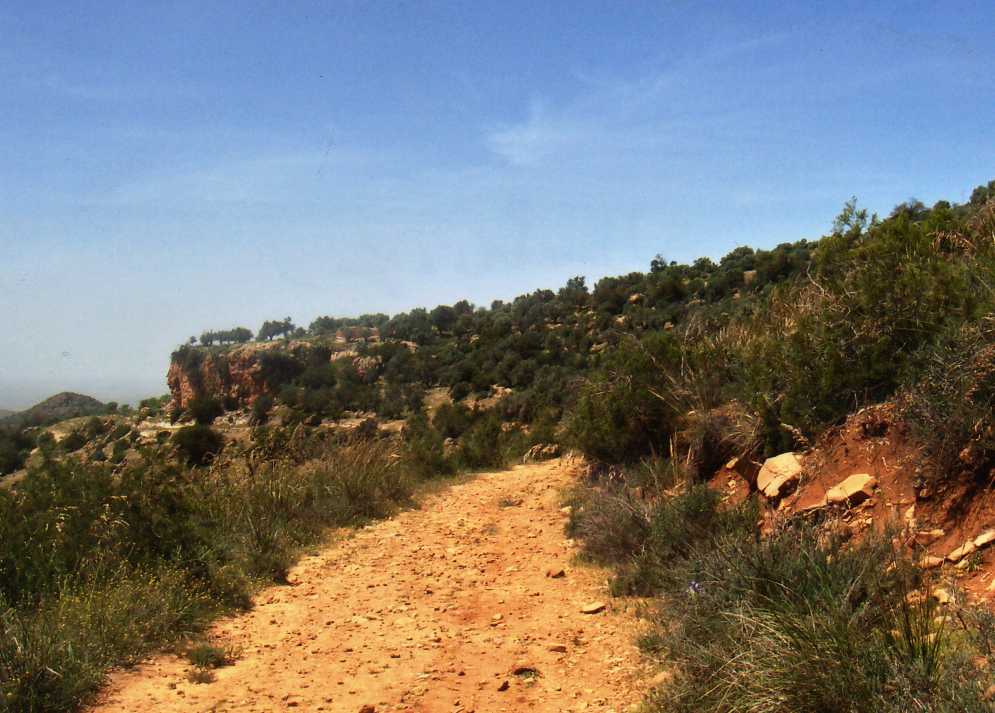
The dechra of Temkessalet, birthplace of Ogb-Ellil
From the beginning, this man’s activity was tied to working the land,
despite its limited area and low yield because of its mountainous
nature. Faced with living conditions that were generally very poor, he
often resorted to day labor – without even knowing whether he would work
the next day – on the many settler farms in the region. The situation
continued in this way: unstable work at some times, complete absence of
work at others, and conditions growing more difficult day by day, with
material means that were almost nonexistent. This lasted until he had
the opportunity to work for the public works company “Scoma” in 1947,
the same period in which he joined the ranks of the “Algerian People’s10 Party.” He then truly became an
active militant, animated by ardent national enthusiasm. He immediately
and deeply involved himself in the concerns and questions of the
national movement and, like the other nationalists, found the domination
and hegemony of the settlers increasingly difficult to bear, not to
mention the authoritarianism of the colonial administration, its
encirclement and its contempt for Algerians. From then on, all his
hopes, like those of the other nationalists, came down to preparing and
making himself ready to resist colonialism and drive it from the
country.
In these circumstances, his relationships multiplied and his contacts
diversified with many men of the national movement, especially militants
in the ranks of the “Algerian People’s Party” or the “Association of
Muslim Ulama.” Among them were sincere nationalists, both in the region
where he lived and throughout the western border areas. This diversity
of social relationships that characterized the man, together with his
contacts with certain active militants of the national movement and his
strong, skillful and well-regarded personality, was one of the reasons
that quickly enabled him to occupy a prominent place in
national-movement activity and militancy during the years preceding the
outbreak of the Liberation Revolution. This became apparent in
particular when he was entrusted with responsibility for a number of
cells of the “Algerian People’s Party,” first in the area of the village
of Sabra and then in Tlemcen. This city quickly became the main base of
his activities and an essential field for his militant relationships and
movements, especially after his contacts strengthened with many
nationalists belonging to the family of the leader of the national
movement, Messali Hadj.
It can be said, after all this, that this man reached the height of
his militancy and national action when he clandestinely joined the
Special Organization in 1948, which formed the military11
wing of the organization of the “Algerian People’s Party” and within
which practical preparations were being made for the outbreak of armed
struggle against the colonial presence. It is known that the members of
this secret organization were surrounded by special precautions, to the
point that one member barely knew the others. The same applied to
training and preparation operations and to the designation of centers
for storing weapons and supplies, which necessarily took place under
directives of extreme secrecy. No one knew more than he needed to know,
and no one knew the origin of these directives or the officials who
directed them. Despite this, there is no doubt that “Ogb-Ellil”
maintained clandestine contacts with certain members of this Special
Organization, at least in the western border region, such as Moqaddem
Bouziane, Kediri Hocine and Cadi Okacha, known figures of the
revolutionary movement in the region. It was perhaps because of these
contacts and his clandestine movements in connection with the activities
of this organization that he was arrested several times by the colonial
police. Each time, however, he was released without any significant
charge being brought against him.
It is known that police arrests of this kind, which the colonial
administration was careful to carry out against active nationalists,
were intended to monitor and follow their different militant activities,
which took place on a wide scale within the organizations and cells of
the “Algerian People’s Party.”
It is certain that this militant’s fame first took shape within the
area of the village of Sabra, which under colonial rule bore the name
“Turenne.” Although it12 was inhabited for the most part by
settler families and groups, it was not entirely without Algerian
families. Its nearer and more distant surroundings consisted of decheras
and douars scattered in different directions. Just as the village was
distinguished by movement and activity during its weekly market, held
every Thursday, so it was wrapped in monotony and calm on the other days
of the week, to the point that the lives of all the inhabitants had come
to be organized around the rhythm of this market. They met there in good
times and bad, bought and sold, formed whatever relationships and
contacts might arise, and then everyone went their separate ways at the
end. It was also a commercial, social and political gathering for the
militants of the national movement. It returned and repeated its scenes
every Thursday of the week, each time bringing its noisy share of events
and news, whether concerning the lives of individuals, their families
and their public or private affairs, or questions of the national
movement and the state of political struggle in the ranks of the
“Algerian People’s Party,” as well as calls for social and religious
reform within the “Association of Muslim Ulama.”
In this context, Ogb-Ellil, alongside other militants, worked to
spread awareness among the people: awareness of the tragedy of colonized
Algeria, warnings against the authoritarian colonial system and the
domination of the settlers, and calls to recruit and show solidarity in
the ranks of the “Algerian People’s Party.” This party attracted and
convinced more Algerians because of its clearly national orientations
and its lack of hesitation in demanding freedom and calling for
independence.
I return to this point to say that all of this activity often took
place under the cover of commercial buying and selling relationships,
mingled with the ordinary activities of people within the market. This
made it possible to conceal and shield this political activity, hostile
to the colonial presence, from the surveillance of the colonial
police.
Thus, this nationalist man from the countryside became one of the
well-known and distinctive figures among the population. Everyone who
knew or met him, especially at the weekly market, had become accustomed
to calling him “Cherif,” as an expression of regard and esteem for his
sharifian lineage, since at that time it was customary to distinguish
sharifian families from others. At times he was also called by his first
name joined to his father’s name, “Mohand Lahcène,” pronounced in this
way to distinguish him from all those named “Mohamed,” who were very
numerous at the time, especially in rural and Bedouin regions. This was
also the image of his personality in the minds of his acquaintances and
friends: that of a valiant man, proud of himself and skillful in his
dealings with everyone. His speech was marked by seriousness and an
ability to persuade; his personality by a strong presence, power of
attraction and influence. The courage, firmness and determination that
marked his life through his dealings and relations with people, both in
his attitudes toward difficulties and in those required by joys and
sorrows, were perhaps what gave him this popular image and shaped his
character, preparing him to occupy that distinctive position of command
immediately after the outbreak of the Liberation Revolution. His name
then became the title of one of the legends of the Revolution and a
specter that often spread terror among the soldiers of the colonial
army. This man was also known as a horseman, among the horsemen of the
region who took part in horse races on special occasions. He was also
trained in the use of weapons even before he joined the Special13 Organization, for he ranked among
the most skilled hunters. His mastery of accurate shooting inspired
admiration. It is therefore no surprise that this ability had its
importance in the battles he fought against the colonial army. There
were many episodes in which his mujahid companions witnessed his skill
and the vigor of his fighting, to the point of acquiring the conviction
– as though it were self-evident – that when Ogb-Ellil aimed his rifle,
it was impossible for a bullet to leave it at random or be wasted
without hitting its target.
Praise of the qualities of this revolutionary man would perhaps
remain incomplete in its meanings and lessons if one did not mention the
qualities and positions of other men to whom he was bound by close and
direct ties, each exerting a very strong influence on the other. Some
were men of his family and his douar, such as Si Ahmed El Bouzidi, Si
Ben Yahia El Bouzidi, Essaïem Essaïem and Essaïem Abdelkader. Others
were men of the region, such as Kediri Hocine, Moqaddem Bouziane, Cadi
Okacha and Hamdaoui El Mamoun. All were animated by an authentic
national spirit. They watched the colonial enemy and eagerly awaited the
arrival of the promised day and the flare of the first spark of uprising
against colonialism. This was the general feeling that prevailed and
spread among all nationalists throughout the country. Among these
sincere and devoted men, it seems necessary to me to mention briefly a
few by way of example.
Si Ahmed El Bouzidi
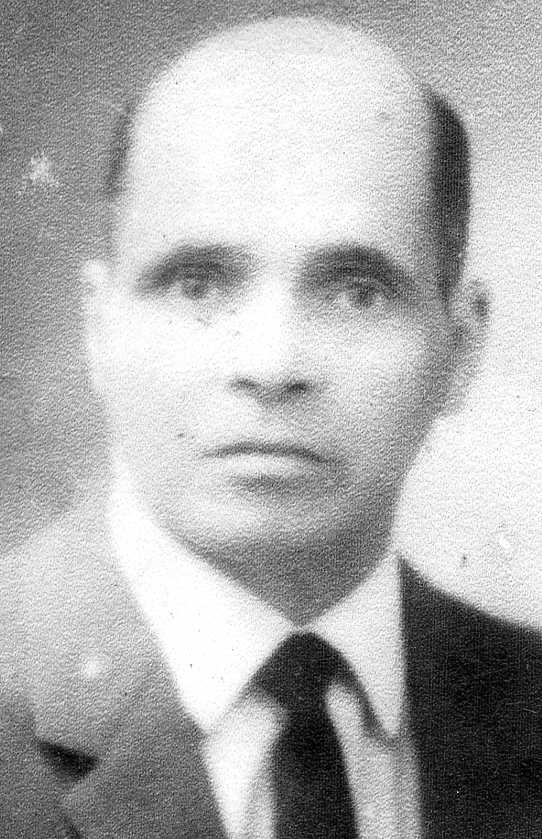
The mujahid Si Ahmed El Bouzidi, commander of the sixth sector
(1954-1955)
A nationalist, he received training in religious sciences at
Al-Qayrawan University in Fez. Considered one of the oldest men of the
national movement in the region, he was appointed by the leadership of
the Revolution in western Algeria, from the outbreak of the Liberation
Revolution,14 as the first commander of the sixth
sector. When he was arrested by the colonial army at the end of 1955,
the martyr “Ferraj,” known as “Abdelmoumen,” succeeded him as commander
of this sector.15
After his release from prison at the beginning of independence, this
leader immediately assumed responsibility for the “National Liberation
Front” in the wilaya of Tlemcen. He remained in this post for only a few
months, then submitted his resignation following a misunderstanding
between him and the “members of the bureau.” This led him to withdraw
permanently from political activity and settle in Sidi Bel Abbès, near
his ancestor “Sidi Bel Abbès El Bouzidi.” From then on he worked as a
teacher until his death in 1974. It is necessary to specify here that
this mujahid lived in integrity and purity. He never asked for a
“certificate of membership” and died with his revolutionary intention
intact, at a time when people were rushing to obtain such certificates,
sometimes in sincerity and sometimes through lies and falsification. He
was therefore not stained by what stained the falsifiers among the
mujahideen, leaders and heroes – I mean the stain of the blood of the
martyrs. His standing remained high. The best proof is that an immense
crowd of mujahideen and citizens came from everywhere to attend his
funeral. Even the mujahid “Hadj Ben Alla,” who was then under house
arrest in the city of Aïn El Turk following the military coup of 19 June
1965, had, as a mujahid cadre of the “National Liberation Front,” to
request special authorization to travel and attend the funeral of his
companion in struggle in Sidi Bel Abbès.
Essaïem Abdelkader
He was called “Si Aïssa.” His lineage goes back to the Bouzidi
family, and he was among the most prominent national figures in the
ranks of the “Algerian People’s Party.” At the beginning of the
Liberation Revolution, he was appointed commander of the seventh sector,
which included the city of Sidi Bel Abbès and its surroundings. After
his martyrdom in 1959,16 several mujahid commanders
succeeded him. This mujahid17 took part in several
battles against the colonial army, known to everyone, specialists and
ordinary people alike, in the region of the seventh sector.
Si Ben Yahia El Bouzidi
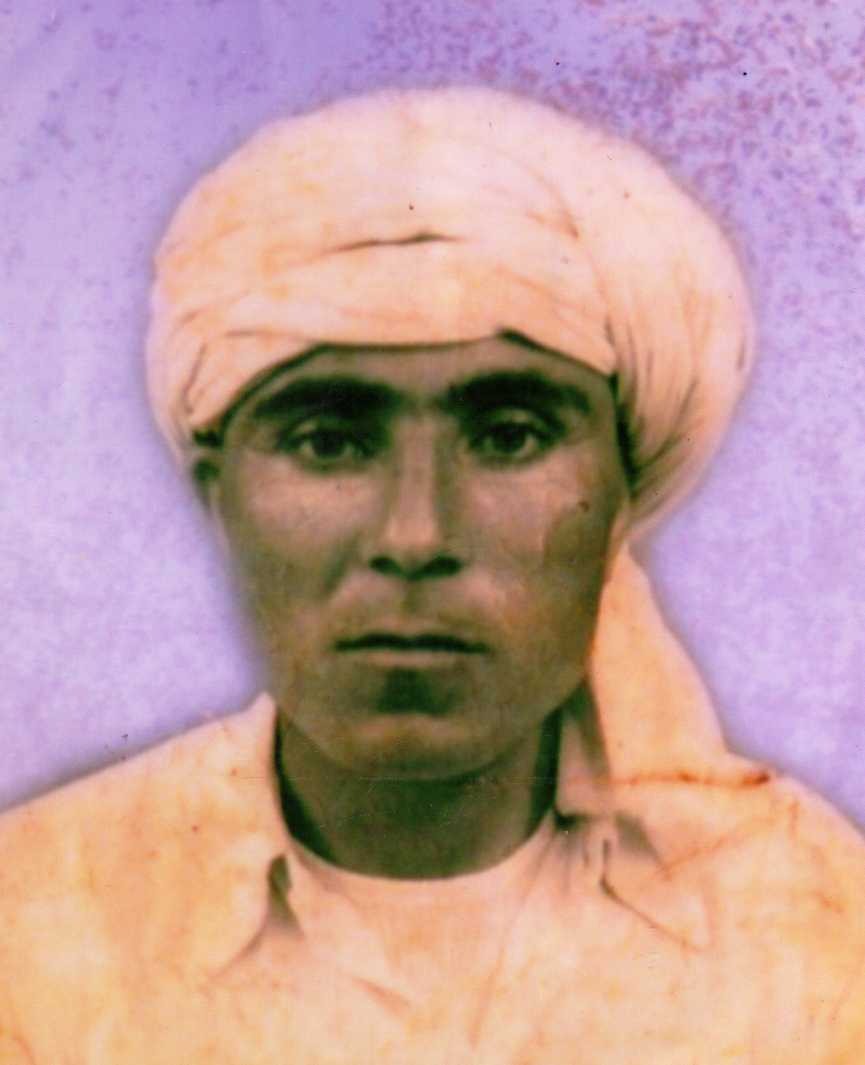
The martyr Si Ben Yahia El Bouzidi
A young religious jurist, he studied at Al-Qayrawan University in Fez
and taught the Quran and fiqh in 18Quranic schools. He was
among the first martyrs of the region. He was martyred at the beginning
of 1955 after being abducted by the colonial gendarmes and then shot in
front of the entire population. This martyr played an active and
continuing role in spreading national awareness among rural people. He
never ceased calling for the need to resist colonialism and never
hesitated to spread the virtues of jihad. For this reason the colonial
authority arrested him and killed him immediately, without any
trial.
Essaïem Essaïem
This valiant mujahid also belonged to the “Bouzidi” family and was
among its most prominent men. From the beginning he was known for his
boldness and dynamism in the Revolution. He participated as an essential
element in the organization of the fifth sector, supervised by
“Ogb-Ellil.” During the final months before his martyrdom, he was based
in the region of “Aïn El Hout,” near Tlemcen, as commander of a group of
mujahideen. He took part with great bravery in several battles against
enemy soldiers, especially the fierce battle in which he was martyred in
1958. The colonial army surrounded him in an agricultural area while he
was moving with a group of mujahideen to another location. The enemy
encircled them with a large army supported by dozens of tanks. When this
commander understood the seriousness of the situation, he ordered his
men to disperse in all directions and each to try to force his way
through the enemy ranks, where the soldiers stood tightly shoulder to
shoulder, in a difficult attempt to break out of the encirclement. It
was a dangerous attempt in which the mujahideen fought fiercely and gave
the enemy no possibility of dominating the battle. This forced the enemy
army to fall back; “napalm” bombs and tank fire then took over and set
the place, the “battlefield,” ablaze with everything it contained, human
beings, animals and vegetation. About seventy mujahideen and civilians
were thus martyred. Their commander, “Essaïem Essaïem,” was then
captured half dead and suffering from severe burns. They tied him to the
front of a tank and drove him around everywhere, displaying him before
the civilian population. This barbaric act ended with his killing and
the mutilation of his body. Thus this hero was martyred with a group of
mujahideen after inflicting dozens of dead and wounded on
colonialism.
Hamdaoui El Mamoun
An intimate friend of “Ogb-Ellil,” each of the two rarely stayed away
from the other during the period preceding the outbreak of the
Liberation Revolution. They therefore shared similar attitudes, whether
in manliness, generosity or hostility to colonialism.
“El Mamoun” lived with his large family, made up of several married
couples and more than twelve children, on land called “Manakher” in the
mountains of “Moutas.” His house was surrounded by forest and high
ground on every side. He lived in complete isolation, devoting himself
to livestock raising and beekeeping. Besides being a man with an
exceptional and distinctive personality, he was physically strong and
handsome. His face was adorned with a well-trimmed blond beard. Anyone
who saw him might have felt that he stood before one of those vigorous
Arabs of old, such as those mentioned or described in ancient Arabic
poetry.19 Although this man, who had a
special relationship with “Ogb-Ellil,” as I said earlier, died a few
months after the outbreak of the Revolution, his house, which had been a
place of generosity and hospitality, quickly became a principal and
strategic center of the Revolution. Ogb-Ellil in particular made it a
major center within the organization of the “fifth sector.” The place
truly became a gathering point and headquarters for revolutionary
leaderships, to which mujahideen came from every direction.
Most of his sons fell as martyrs, his house was destroyed, his land
devastated and all his possessions disappeared, although at the time he
was considered one of the well-to-do men of the region. All of this was
sacrificed in order to support the Revolution, by giving what he held
precious and dear, even his family and children, for the liberation of
the Algerian people.
Such were the bonds of sacrifice and selflessness that united these
men; such was their image of devotion and self-denial in the service of
the national cause.
Joining the Liberation Revolution and Commanding the Fifth Sector
It is known that during the years preceding the outbreak of the
Liberation Revolution, Ogb-Ellil remained among those who believed most
strongly in the national leadership embodied by the exceptional
personality of Messali Hadj and who were most attached to him throughout
his leadership of the national movement. Like the majority of Algerians,
he became attached to his national personality. They saw in his
positions an embodiment of the national spirit and were convinced by his
unequivocal political orientations in opposition to colonialism. This
was evident in his demand for freedom and independence for Arab and
Muslim Algeria, a position by which he distinguished himself from and
surpassed all movements and parties, 20whether assimilationist or
reformist. Ogb-Ellil maintained without hesitation or weakness this
inner feeling that bound him to the leader of the national movement, as
embodied in the Algerian People’s Party and later in the Movement for
the Triumph of Democratic Liberties, even after conflicts and divisions
clearly appeared within the structures of the Union of Democratic
Liberties at the congress of April 1953. The congress discussions
revealed deep and acute disagreements within the “Central Committee,”
both on ideological questions and on matters related to the form of the
organization and the way the party was managed. Naturally, this conflict
and divergence – whose true secrets are still absent from or kept away
from historians of the national movement – intensified. Like many men
and militants of the party of the “Union of Democratic Liberties,”
Ogb-Ellil remained watchful while events within the party continued to
develop and change. He was neither influenced nor swept along by the
rumors and accusations that a group of centralists, including
individuals from the left and the Communist International, continued to
circulate and spread among all militants against the personality of the
leader of the national movement. These disagreements and 21claims soon came to be invoked as
justification for feeding tendencies characteristic of a regionalist
mentality, and also became a source of increasing sterile controversies
and debates among militants.
For this reason, this militant’s position underwent no obvious
change, despite his participation in the important meeting held on 15
October 1954 at the home of the mujahid and prominent figure of the
national movement “Kediri Hocine.” This meeting took place in the
village of “El Khemis” under the 22supervision of the
martyr “Larbi Ben M’hidi,” who had come carrying a message from “Ahmed
Ben Bella” recommending that special care be taken of this hero, “Larbi
Ben M’hidi,” and that people rally around him in order to study how to
prepare for the outbreak of the Liberation Revolution in the western
region. Nationalists took part in this meeting: some had joined the
Special 23Organization of the People’s Party,
while others were active in the national movement in one way or another.
These men had come as representatives of different areas of the region.
They were, in order: Kediri Hocine, Mokhtari Abdelkader, Bouguiren
Ramdane, Hansali Messaoud, Mostaghanemi Ahmed, Belkheir Ben Seddik,
Chaabane El Kurd, Bouzidi Mohamed “Ogb-Ellil,” Bouzidi Ahmed “Si Ahmed”
and Essaïem Abdelkader “Si Aïssa.”
What was to happen took place at this local meeting supervised by the
martyr “Larbi Ben M’hidi.” Only a few days passed before the Liberation
Revolution erupted dramatically across the country, as planned by the
national leadership represented by the “National Revolutionary Committee
for Unity and Action,” a committee that crystallized and took the name
“National Liberation Front” immediately after the outbreak of the armed
Revolution on 1 November 1954. Its beginnings consisted of offensive and
sabotage actions against dozens of colonial centers in the different
regions of the country. Naturally, on that same day the first mujahideen
of the western border region set fire to and destroyed the “Fernane”
forest, which was exploited for timber production in the “Ahfir” region,
heights located south24 of the village of “Sabra” and
between the Tlemcen mountains and those of “Moutas.” A few days passed
after this revolutionary national event of very great importance. During
this time, “Ogb-Ellil” remained in a state of waiting and observation,
like many men of the Special Organization who, 25in
practice and for several years, had been preparing for the outbreak of
an armed revolution against colonialism. It was not easy for them, it
seems, to abandon the old revolutionary system and join a new, broad and
general revolutionary system without hesitating or first ascertaining
the situation concretely and in reality.
During this period, the martyr “Larbi Ben M’hidi,” then known as
“Essadek,” went to the dechra of “Temkessalet.” He was the principal
official responsible for the leadership of the Revolution in the western
region of the country, while “Hadj Ben Alla” was his first deputy in
this mission and “Abdelhafid Boussouf” his second deputy. I return to
the account: he arrived in this dechra accompanied by “Abdelhafid
Boussouf” and a large group of pioneers of the Revolution in the region,
including Si Ahmed El Bouzidi, Moqaddem Bouziane, Essaïem Abdelkader, El
Wahrani Ahmed, Ben Halilem Boucharb, Essaïem Essaïem, Bouzidi Belabbès
and other mujahideen. They met in a “hut” belonging to a militant named
Moulay El Mehdi El Bouzidi, on land called El Aïrsa. The first and only
objective of this meeting was to convince “Ogb-Ellil” of the need to
join the new revolutionary system, the “National Liberation Front.” The
meeting continued for several consecutive hours. One group was inside,
made up of members of the leadership of the Revolution, while another
group waited outside, made up of ordinary mujahideen and militants.
During this time, the discussions often grew heated, voices rose and the
debate became intense, giving those waiting outside the hut the
impression that disagreements were worsening and viewpoints were
opposed. At other moments, calm and silence set in, suggesting that
understanding and agreement were near. I do not think that what caused
the divergence and disagreement among these mujahideen in those
circumstances was anything other than questions connected with the
reality of the Revolution and its future, then with its repercussions
and the organization of its structures, as well as the relationship of
all this to the new situation reached by the national movement and to
its leader “Messali Hadj.”
The meeting eventually came to an end. Everyone emerged full of hope,
with signs of understanding and agreement on opinions and positions
visible on their faces. Immediately afterward, it was announced on the
spot, before everyone, that the leadership of the Revolution in the
western region was appointing “Ogb-Ellil” commander of the “fifth
sector.” The mujahideen and militants present received this event with
joy and satisfaction because of the place this man held in their minds
and because of his militant personality, known to all. I must
nevertheless point out in this connection that one of the mujahideen
present at this appointment did not refrain 26from commenting on it, addressing
all the members of the leadership present: “How can you so quickly
appoint ‘Mohand Lahcène’ as the person responsible for all of us, when
until27 recently he was still opposed to
you, displayed before all of you a harsh and uncompromising position,
and joined the ‘National Liberation Front’ only after great efforts?”
Whatever the case, this decision undoubtedly stemmed from these leaders’
knowledge of the man’s revolutionary personality and from their
certainty as to the extent of his abilities and resources, both in
persuading people to join the Revolution and in regard to his courage
and readiness to make the greatest sacrifices. Their assessment of the
man also came from their full awareness that they were dealing with an
active member of the clandestine Special Organization, an organization28 whose members had received a degree
of training and preparation that enabled them to enter war and face the
horrors and difficulties of the armed Revolution even before the birth
of the “National Liberation Front.” None of the mujahideen present knew
this, including of course the one who had raised the objection and
remark. In this way, and on the basis of these considerations, Ogb-Ellil
was officially appointed commander of the “fifth sector” within the
first general revolutionary organization established after the outbreak
of the Liberation Revolution. This organization divided the national
territory into three large zones, each of which was in turn divided into
several sectors, varying in number according to 29the circumstances and possibilities
of each region. It is useful to point out that this first organization,
applied at the beginning of the Liberation Revolution and maintained
until the system of “wilayas” was introduced at the beginning of 1957,
was characterized essentially by the principle of decentralization in
organization and management, as well as in the conduct of revolutionary
activities and actions, based on the principle of initiative according
to the local conditions and circumstances of each region and each
sector. During this period, this made the sector commanders genuine
field heroes and leaders, in the front ranks of difficult and sometimes
complex situations, since they directly confronted the difficult
conditions that then existed in organizing and directing the events of
the Revolution, and then in the necessity of giving them concrete form
and asserting them on the ground against the colonial army in each
sector of the different zones throughout the country. It can therefore
be said without hesitation that it was these sector commanders, the
“pioneers,” who had, beyond dispute, the foremost merit during this
critical period in the life of the Liberation Revolution of making it a
tangible reality and a general phenomenon spread across the whole
country.
It was precisely during this difficult and critical stage that
“Ogb-Ellil” shone on the revolutionary field. He truly became one of its
masters. He deservedly forged his revolutionary personality, and his
fame spread as that of a valiant fighter. He became a symbol cited as an
example of heroism, self-denial and devotion. Just as this man was known
for his steadfastness, firmness and purity of intention and purpose, he
embodied and demonstrated all of this from the first moment through his
remarkable ability and talent in organizing the “fifth sector,” which he
commanded for a short period not exceeding a few months. The sector thus
acquired a solid basic structure, both in the military sphere and in
civil organizations, as well as in communications and supply. This
continuous effort effectively prepared the launching of revolutionary
action in the different regions. These revolutionary actions were
decisive and influential, bearing witness to exceptional courage, and
brought “Ogb-Ellil” and his mujahid companions wide renown throughout
the western region. This took place despite the fundamental problems and
real, difficult obstacles that the Algerian Revolution was confronting
precisely during this period, especially the problem of military
organization and that of arms and supply. These were the same problems
that “Ogb-Ellil” succeeded in overcoming at the level of the “fifth
sector” through his repeated attacks on colonial centers, as I have
already indicated.
Organization of the Sectors
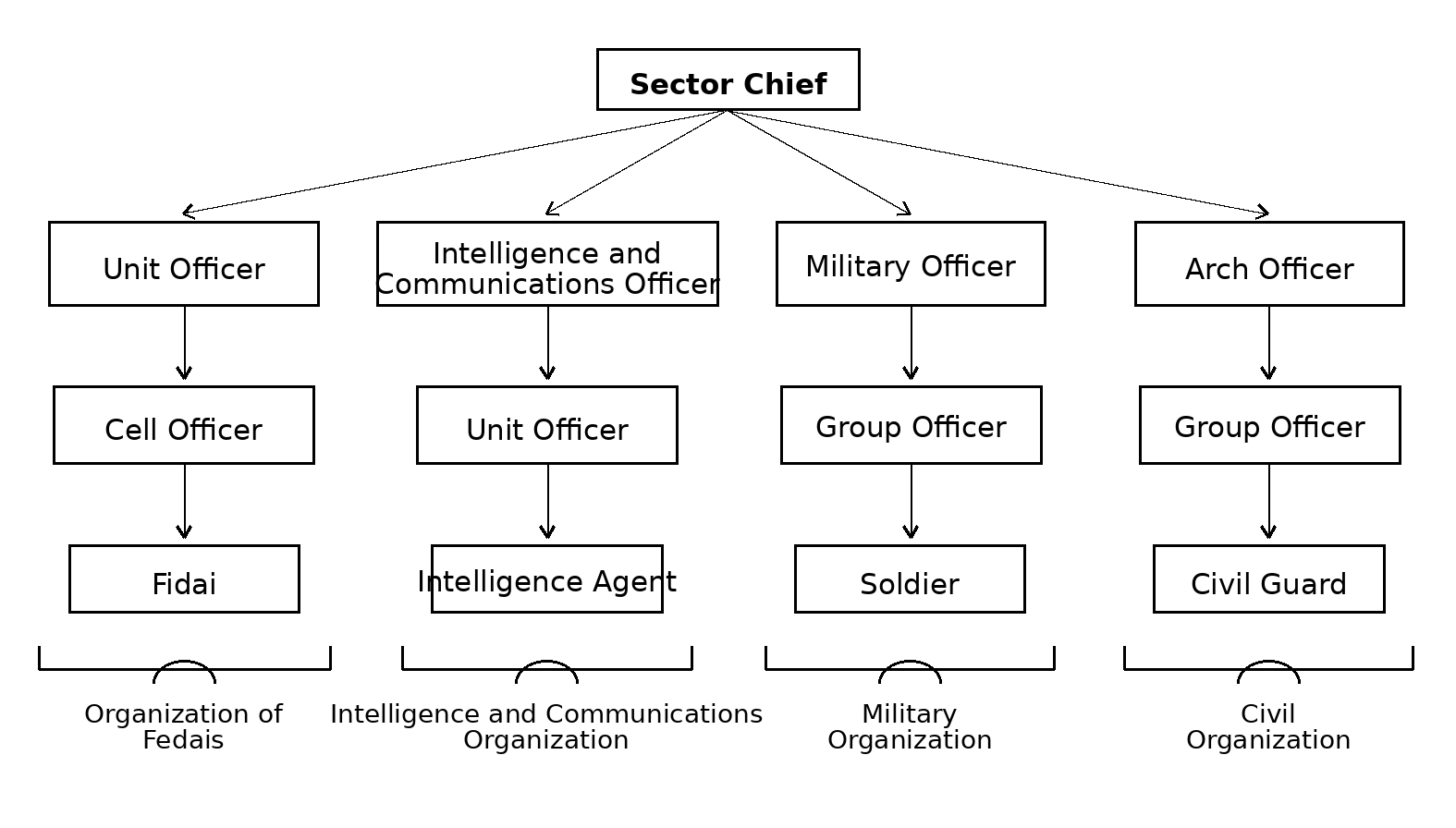
Structure of the Fifth Sector (1954-1957)
It is known that the western region, like the other regions of
Algeria, was divided after the outbreak of the Liberation Revolution,
within the framework of the first general revolutionary organization,
into several30 sectors extending from the
different western border zones toward the east. Each sector covered a
defined geographical area, with clear boundaries to the north and south,
while its extent generally remained undefined toward the east. Thus,
within this first strategic geographical plan, seven sectors were
established in the western region.
First Sector
It extended from Marsa Ben M’hidi on the coast to Oued El Mouilah in
the south, and also included the arch of the Maaziz, a region comprising
the north of Hammam Bougrara. It was commanded by “El Hansali.”
Second Sector
It included the region of Nedroma with its different archs: Djebala,
Souahlia, Beni Meshel, Beni Abed and Beni Khaled. It was commanded by
the martyr known as “Belhassen.” After his martyrdom, Si Abdelkader
Chenouf succeeded him.
Third Sector
It consisted of the archs of Beni Ouarsous, Lahassa, Beni Saf and
Sidi Safi, extending as far as El Maleh, Oran and Mostaganem to the
east. It was commanded by the martyr Arafoui Mohamed Salah, known as
“Bousseif.” Among the best-known leaders who lived in this sector were
Hadj Ben Alla and Colonel Othmane.
Fourth Sector
The starting boundary of this sector was Oued El Mouilah toward
Mecheria in the south. It included the arch of Beni Ouassine, including
the city of Maghnia, then the arch of Beni Boussaïd and the region of El
Khemis, in addition to Ouled Nhar. The command of this sector was held
by the martyr Mataïch Abdelkader, known as “Djaber.”
Fifth Sector
It began at the village of Tafna in the west and extended eastward.
Its organizational relations and militants reached as far as the regions
of Tiaret. It included Sidi Moudjahid as far as the douar of Boussedra,
the Kef region, and then extended eastward from there to include the
mountains of Moutas and Tlemcen as far as Ouled Mimoun. In the north, it
included the southern outskirts of Bougrara, then the region of Ouled
Riah, Remchi and Ben Sekrane as far as the village of “Ogb-Ellil” in the
southern region of Aïn Témouchent. The central zone of this sector
included the regions of Sabra, Zelboun, Beni Mester and Beni Ournid. The
city of Tlemcen remained the strategic area of this sector, whose
commander until 1957 was the martyr Bouzidi Mohamed, known as “El
Mokhtar” and “Ogb-Ellil.”
Sixth Sector
It included the arch of Beni Bahdel toward Beni Hediel. Its principal
center was at Aïn Ghoraba, then it extended eastward between the
southern mountains of Tlemcen and Ouled Ouriach, as far as the regions
of Ouled Mimoun toward Sidi Bel Abbès. The command of this sector was
held by Bouzidi Ahmed, known as “Si Ahmed.” When he was arrested by the
colonial army in 1955, his deputy known as Abdelmoumen, the martyr
“Ferraj,” took his place.
Seventh Sector
It generally included the surroundings of Sidi Bel Abbès in every
direction and reached the outskirts of the city of Saïda. The commander
of this sector was the martyr Essaïem Abdelkader, known as Si Aïssa. In
this region, command was later held by Tayebi Larbi and other
leaders.
This, then, was how the sectors were distributed in the western
region of the country at the beginning of the Liberation Revolution.
These were the names of the first mujahideen and pioneer commanders who
launched the Liberation Revolution in this region and gave concrete form
to its events on the ground under extremely difficult conditions. It is
remarkable that three of these commanders – Si Ahmed, Si Aïssa and
Ogb-Ellil – came from the same douar and even belonged to the same
family and lineage.31
Organization of the Fifth Sector and the Launch of Revolutionary Operations
It can be said that the “fifth sector,” commanded by Ogb-Ellil, was
transformed within a short time into a theater of various revolutionary
operations against the colonial army after all the sector’s basic
structures had been created and put in place in both military and
civilian spheres. This included providing the means necessary for
revolutionary actions. This continuous effort led, in a first phase, to
the formation of eight groups of the Liberation Army, each comprising 35
to 40 mujahideen. At the head of this organization was placed the
military deputy to the sector commander, the mujahid El Wahrani Ahmed,
known as “Si Lakhdar.” At the same time, the civilian organization was
formed and soon included dozens of groups and cells, in addition to
groups of “mouhajirine” and “mousabiline.” Responsibility for 32this organization was entrusted to
the civilian deputy to the sector commander, the mujahid Slimani Madani.
Then an intelligence and communications system was put in place, for
which the martyr Ben Abderrahmane El Aïd, known as “Brikci,” took 33responsibility. In addition to the
organizations already mentioned, a fedayeen system was established in
Tlemcen under the supervision of the “fifth sector.” It continued to
expand effectively and within a short time included dozens of cells
whose number grew day by day.
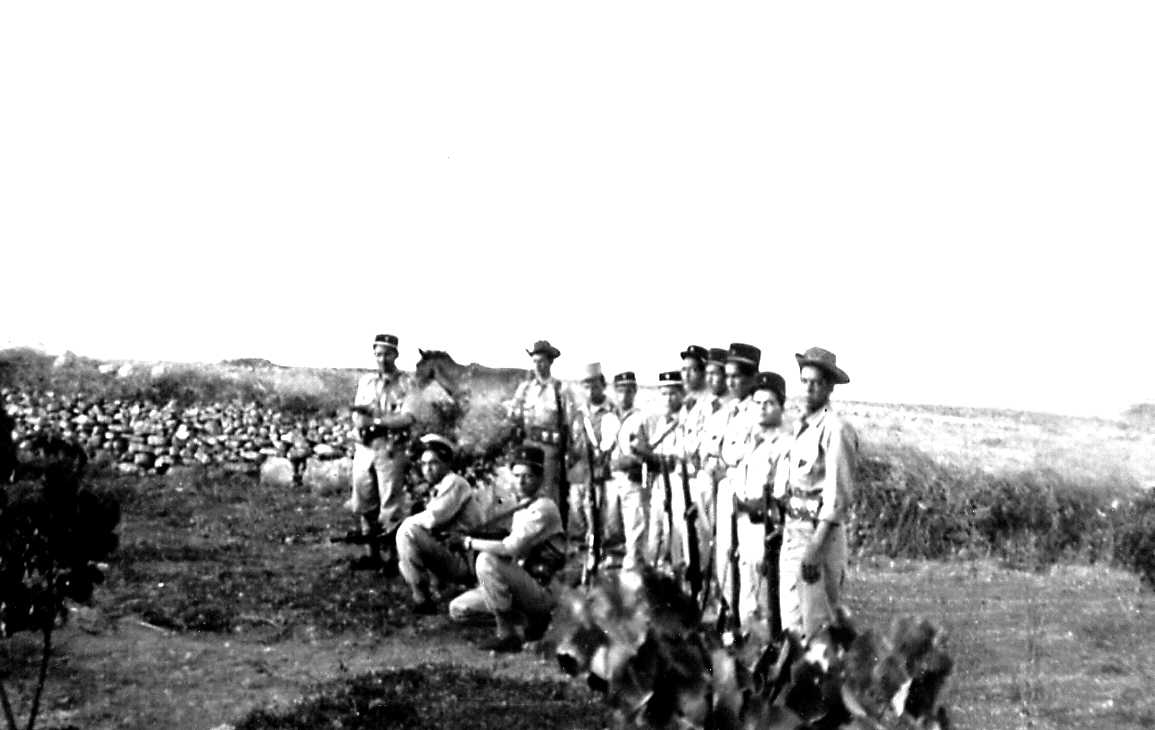
Group of gendarmes among the mujahideen of the fifth
sector
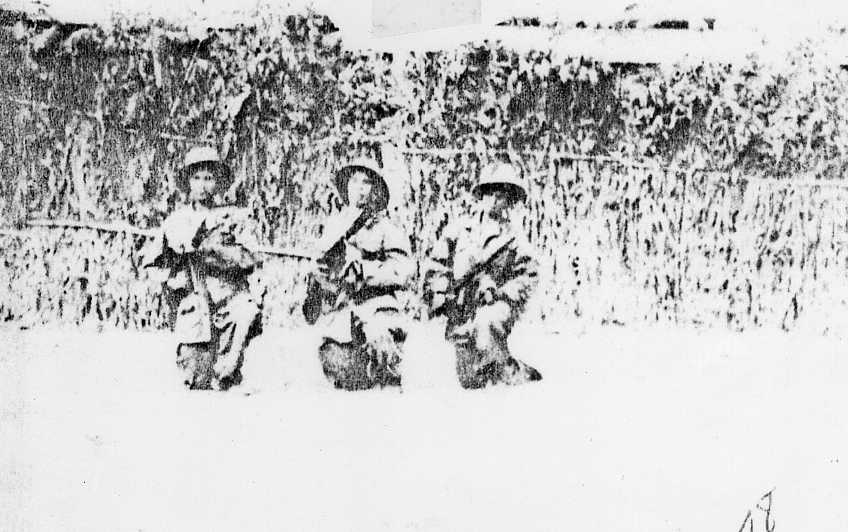
Women mujahideen within the organization of the fifth sector;
photograph taken in May 1956 in the Sabra region
It should be noted in this connection that the structures of the
“fifth sector” under the command of “Ogb-Ellil” did not limit themselves
to putting in place the structures prescribed by the system of the
Revolution during this period. They went beyond them. Two groups of
mujahideen were created in a bold and distinctive manner compared with
other regions of the country. One was devoted to men of the
“gendarmerie,” responsible for organization and coordination between the
military side and civilian life, an organization modeled on the system
of the colonial gendarmerie. The second was a special “shock” group made
up of a few mujahideen distinguished by their fighting abilities and
valiant revolutionary spirit. Each possessed qualities of courage
impossible to describe. Taken together, they formed the special group
that accompanied Ogb-Ellil almost permanently and with whom he
maintained close ties. The mujahideen in general also often relied on
them to carry out difficult or dangerous missions. In those
circumstances, many revolutionary missions demanded and required this
level of revolutionary performance. Among these valiant men I will
mention the martyr Maarouf Abderrazak, the martyr Bekhti Abderrazak, the
martyr El Habib known as “Abdelhamid,” the martyr Rachedi Ahmed known as
“Ahmed El Hadj,” the mujahid Ben Dahmane Mohamed and the mujahid
Belgharbi El Wahrani. In addition to all this, the “fifth sector” now
had principal centers or certain strategic sites that often served as
meeting places for the revolutionary leaderships of the entire western
region. They were also used as gathering places for mujahideen, who came
there from every direction.
Moutas Center
It was first established in the house of “El Mamoun,” located in a
region characterized by its heights, dense forest and difficult paths,
which made it relatively isolated from the reach of the colonial army.
This center was of very great importance. It became a destination for
all revolutionaries and mujahideen, as well as a headquarters for
meetings and encounters among revolutionary leaderships. It retained
this importance until the colonial army burned its dense forest in
1958.
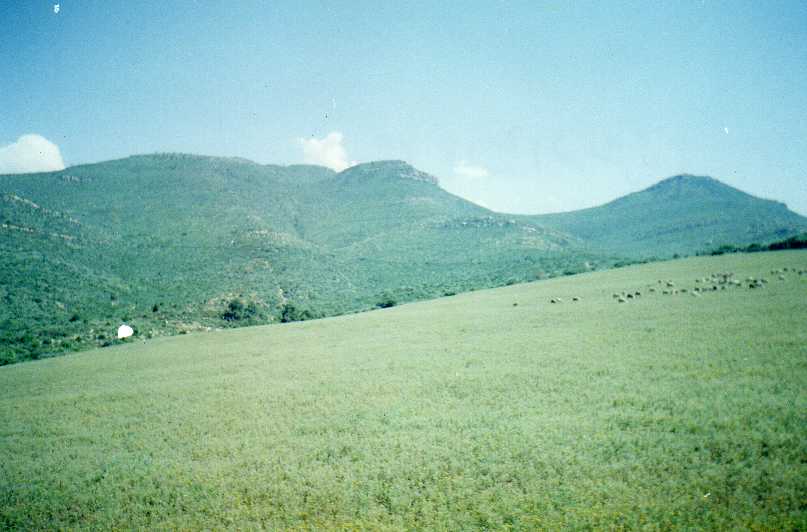
Mount Moutas
Zegdouna Center
This is an arid, clayey and isolated tract of land, almost
uninhabited. It lies north of the village of Sabra and extends to the
outskirts of Hammam Bougrara. It is crossed and cut through by several
deep ravines that formed natural hiding places for the mujahideen. The
same applied to certain rural dwellings isolated from one another and
scattered here and there. They served as refuges for the mujahideen, who
withdrew there from the mountainous areas whenever necessity required.34
Wassar Center
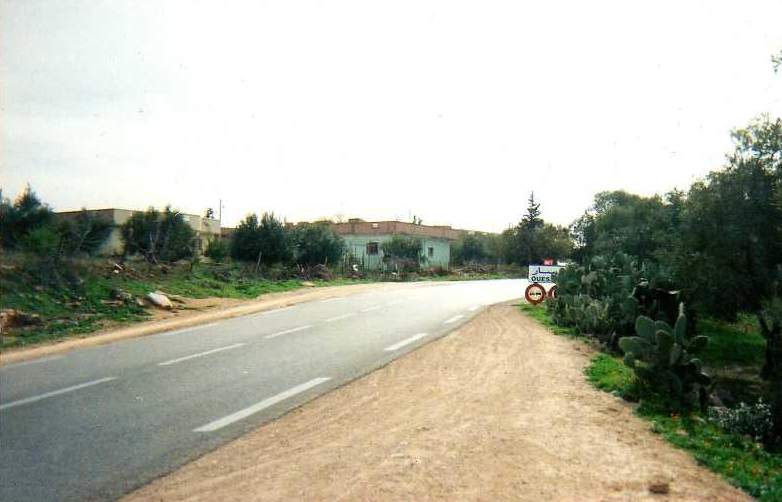
The “Wassar” center, located a few steps from the main
road
It is a small dechra made up of a few clustered rural dwellings,
situated between Sabra and Maghnia. The road linking Tlemcen to the
Moroccan border passes nearby; at the time it was the principal road
connecting the cities of western Algeria in the direction of Morocco.
Despite its immediate proximity to this road, traveled daily by patrols
and convoys of the French army, this “site” remained a “hidden” place to
which revolutionary leaderships and all the mujahideen often resorted.
It formed a crossing point from the mountainous zones toward the north,
and vice versa.
It can be said that the Arabic proverb “explaining what is obvious is
one of the most difficult problems” applies to this center. It would
never have occurred to the enemy army and its intelligence services
that, in this place visible to everyone, there was a headquarters of the
leadership of “Ogb-Ellil” and a place to which the mujahideen came from
time to time. And I do not exaggerate in saying on this occasion that
the convoys of the colonial army often passed this place and even
stopped there while “Ogb-Ellil,” whom they were searching for everywhere
and by every means, was only a few meters from their eyes.
It is perhaps necessary to point out here that these principal
centers of the organization of the “fifth sector” were often frequented
by various figures of the leadership of the Liberation Revolution,
especially during the period 1955-1957. Among the most important was
naturally the martyr Larbi Ben M’hidi, who knew these places directly.
It is also necessary to point out, on the other hand, that the centers
created by “Ogb-Ellil” were not limited to the presumed boundaries of
the fifth sector. He also took the initiative to establish the first
centers along the border strip, then within Moroccan territory. One may
cite as an example the general center of the Liberation Revolution
established on the farm of a Moroccan militant named “Miloud Ould El
Caïd.” This man joined the Revolution through the efforts of
“Ogb-Ellil,” placing at its disposal all the material and human means he
possessed and sparing nothing in support of the Revolution and the
mujahideen. This center, soon known as the “house of Miloud Ould El
Caïd,” filled with mujahideen, both for the care and 35treatment of the wounded and for the
organization and activation of communications and supply operations.
“Ogb-Ellil” used this site to gather the various revolutionary resources
– weapons, ammunition and clothing – in order to bring them into
Algerian territory whenever circumstances permitted.
It can be seen that after the martyrdom of “Ogb-Ellil,” this center
gradually began to lose its customary vitality and revolutionary
activity until its importance disappeared completely. This happened
after the leadership of the “Oujda group” tightened its grip around this
Moroccan militant and placed him under pressure to the point that he was
forced to abandon his assistance to the Revolution and devote himself
instead to trade. The reason was that they knew well the nature of the
revolutionary relationship linking him to “Ogb-Ellil,” as well as his
knowledge of the secrets of the assassination of this commander.
The revolutionary activity of this bold commander did not stop there.
He also designated two important centers of the Revolution inside the
Moroccan city of Oujda. The first was at the home of Khalil Mohamed and
his brothers. This family, originally from Tlemcen, had settled in Oujda
before the outbreak of the Liberation Revolution. This militant, Khalil
Mohamed, worked as a tailor, which often led him to provide “Ogb-Ellil”
with military clothing. In addition, this house was secretly used to
receive many wounded or sick men of the Revolution belonging to the
structures of the “fifth sector.” Mention must also be made of the
considerable assistance the “Khalil” family gave to many refugees who
had come to flee the misfortunes of war and the violence of
colonialism.
The second center was at the home of “Abderrahmane Ben Khadim.” He
was a militant from Ouled Sidi Cheikh. A special relationship and strong
friendship had been established between him and “Ogb-Ellil.” As a
result, his house became a place used for various revolutionary contacts
and services, especially meetings between revolutionary leaderships and
the holding of secret meetings.
It should be pointed out that the “fifth sector,” because of its
expansion within the revolutionary organization on the one hand and, on
the other, its advanced position in everything concerning revolutionary
action and its requirements, attracted mujahideen and militants from
different regions and areas. Between 1955 and 1957, several mujahideen
assumed various command responsibilities there, especially the
leadership of detachments and military groups. All were among the finest
men and most valiant heroes. Each had his own stories and field
exploits, to which it is impossible for me to give here all the
attention they deserve. To express the standing of these mujahid
commanders, it is enough to point out that the overwhelming majority of
them fell on the field of honor, which explains their large number
compared with the short period during which they held their
responsibilities. It was natural that whenever one commander fell on the
field of honor, another mujahid would come to replace him in his
mission. There is nothing surprising in this: they commanded the
mujahideen and placed themselves at their head in every battle and
during every revolutionary operation. In all of this, “Ogb-Ellil” was
for all of them the example and model to follow. Among the commanders
who assumed responsibility for detachments of mujahideen within the
“fifth sector” under the command of “Ogb-Ellil,” I will mention: the
martyr Heddadji Bachir, the martyr Ben Abderrahmane Mohamed (Brikci),
the martyr Maarouf Mohamed (Mohamed Moussa), the martyr Ben Azzouz
Mohamed, the martyr Bouzidi El Habib (Abdelhamid), the martyr Aouf
Mansour, the martyr Bouziane Lahcène, the martyr Bouazza Zitouni, the
martyr Ben Miloud Abdelkader, the martyr Essaïem Essaïem, the martyr Si
Rabah (Bekhti), the mujahid Negadi Ben Ziane and the mujahid Sahnoun
Mohamed (Antar). Three other mujahideen joined this constellation of
heroes: Arbaoui Abdallah, Ben Miloud and Inal Djaafar. They came from
the first and second sectors and had all deserted the French army. On
the occasion of their joining the fifth sector, “Ogb-Ellil” assembled
the different detachments of mujahideen in June 1956 in a region called
“Aïn El Ban,” near the mountains of “Moutas,” and presented them to the
mujahideen after praising their qualities and revolutionary standing. At
this same gathering, he appointed the 36mujahid Arbaoui Abdallah commander
of a section of mujahideen and gave him the name “Ahmed.” He later
became known as “Nehrou.” It goes without saying that this hero later
became famous for his repeated operations against the colonial army.
Among the best known and most daring was the attack on the enemy
barracks of Sidi El Abdelli in 1958, which he planned and led with
another valiant hero, the martyr “Zitouni.” This operation resulted in
the capture of about 23 French conscripts performing their military
service, the seizure of a 37large quantity of
weapons and military equipment, and the deaths of dozens of professional
soldiers inside the barracks.
There is therefore no doubt that the revolutionary organizations,
military and civilian structures, and various centers established by
“Ogb-Ellil” within the framework of the “fifth sector” and beyond
reached a level of importance and effectiveness that made it possible to
provide the mujahideen 38with various means of warfare and
organization. This made them masters of revolutionary operations and
made him one of the pioneers of the Revolution on the battlefield,
thereby strengthening his standing and increasing his fame within the
Revolution and among all the mujahideen.
Tlemcen, Stronghold of the Fedayeen Groups
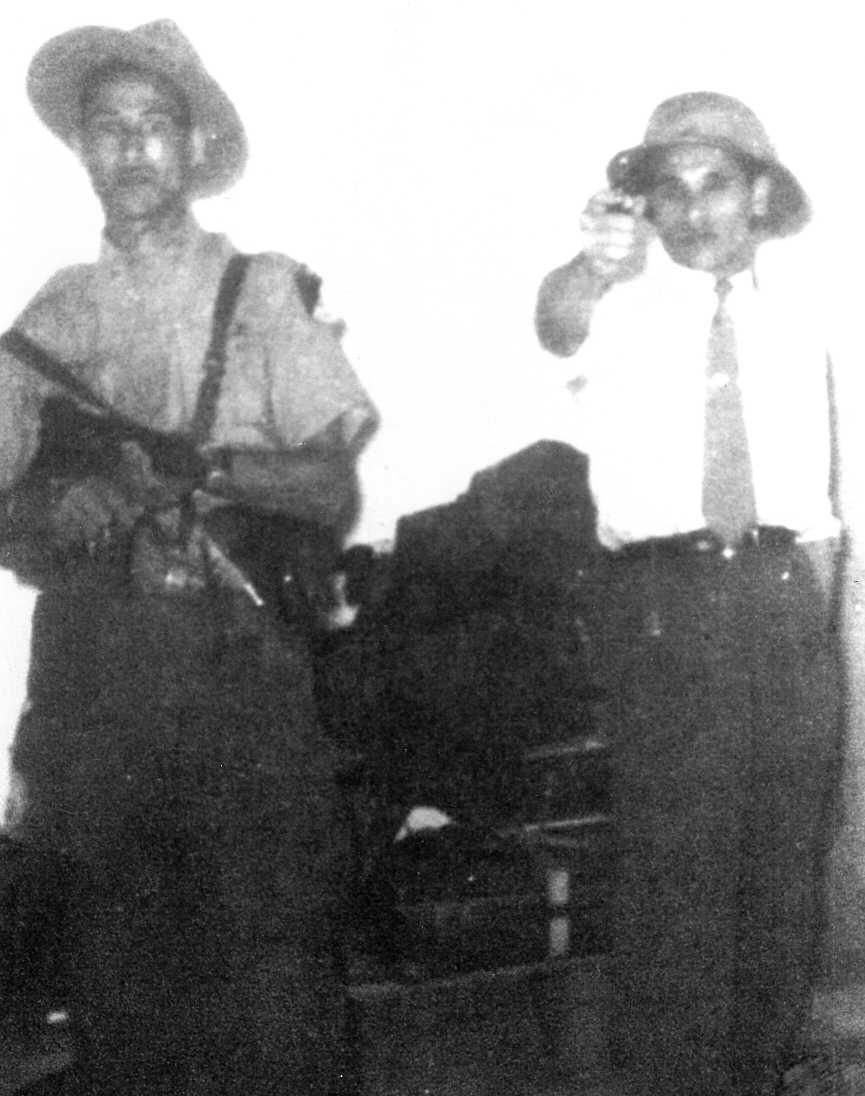
Ogb-Ellil, heavily armed; beside him, the fedai Mohamed Ben
Bekhti, known as “Mami,” who fell as a martyr in 1957. Photograph taken
in Tlemcen in 1956
The city of Tlemcen held a notable place in the organization of the
fedayeen, alongside the other revolutionary structures connected with
the “communications, intelligence and supply” network, especially during
the period of revolutionary organization into sectors (1955-1957). Since
this city was from the beginning a strategic location among the
positions of the “fifth sector,” “Ogb-Ellil” took the initiative to form
fedayeen groups there under the responsibility of three mujahideen known
for their boldness and dynamism: Bouskaya Abdelkader, El Houari and
Bouhamidi. At first, these three mujahideen succeeded in organizing
several fedayeen groups that established themselves in the city’s
working-class neighborhoods. A short 39time later, in 1956, the task of
organizing the fedayeen was entrusted to the mujahid “Mourad Rachid,”
known as “Mansour.” This man played an active role in energizing and
expanding the fedayeen network, with the help and support of young
elements belonging, for the most part, to families of the city that had
long maintained militant relations with Ogb-Ellil before the outbreak of
the Revolution, within the framework of the national movement and the
cells of the “People’s Party.” All this did not, however, prevent the
appearance of fedayeen groups attached to other revolutionary
structures, generally belonging to one sector or another within the
revolutionary organization of the western region. In addition, certain
clandestine fedayeen cells appeared in Tlemcen through local individual
initiatives led by young nationalists enthusiastic about the Revolution
who, despite their youth, were hostile to colonialism and wanted by
every means to join the mujahideen in the mountains. One may cite, by
way of example, the fedayeen cell led by the martyr “Lotfi Boudghen,”
alongside the martyr “Bekhti Abderrazak,” Djelloul Kellouche, Djamel
Bekhti, Tahar Gouar, Sid Ahmed Kahia Thani, Sid Ahmed Feïli and others.
This cell was formed after they made contact with another clandestine
fedayeen cell active in the region of “El Kalaa” within the fedayeen
system dependent on the “fifth sector.” After this cell – led by the
martyr Lotfi – was discovered by the colonial police in October 1955,
following daring attacks carried out by its members that had then spread
terror through Tlemcen, its leader Lotfi and several of his companions
were 40forced to flee and take refuge in
the region of “Ouled Riah.” They remained there for several days waiting
for contact with one of the 41structures of the
Revolution in order to join the ranks of the mujahideen. It is known
that immediately after the martyr Lotfi joined the mujahideen, a meeting
took place between him and “Ogb-Ellil” at a place called “Tidjdit,” west
of Oued Zitoun. Among those present was the mujahid “Wahrani Ahmed,” the
military deputy. During this meeting, Lotfi proposed, in the course of
his remarks about the role of Tlemcen and the strengthening of
revolutionary organization among its inhabitants, that the city and its
surroundings be turned into a special and independent sector instead of
remaining attached to the “fifth sector.” Ogb-Ellil listened to him very
attentively, then replied directly, as was his custom: “It seems that
you have come to Tlemcen thirsty and eager for responsibilities… while
you have no organizational status authorizing you to do so… More than
that, you and your companions are still under observation from the
standpoint of the Revolution… It would be better for you to show
thoughtfulness and patience; that is better for you… The important
thing is that I will send you to the leadership, and let them do what
they want…”
It is known that the city of Tlemcen was later transformed, after the
martyrdom of “Ogb-Ellil” and after the system of wilayas was introduced
at the beginning of 1957, into a special sector whose responsibility was
entrusted to the mujahid Moudjahid Boumediene, known as “Abdeljabbar,”
who had been one of the officers of the “fifth sector.”
Whatever the case, the organization of the fedayeen in Tlemcen, under
the revolutionary management of the “fifth sector,” took on various
dimensions and carried out varied revolutionary activities, ranging from
grenade attacks against colonial centers to threats, by different means
and methods, against persons collaborating with the colonial police, as
well as operations to kill traitorous elements and the smuggling of
weapons and ammunition. In this field, a fedayeen group of extreme
secrecy and precision was formed. Its members were certain Algerian
soldiers serving inside the barracks of the colonial army. “Ogb-Ellil”
gave them a particular mission, limited exclusively, among all possible
activities, to smuggling “ammunition” to the mujahideen. Tlemcen did in
fact witness an important operation in this field, perhaps unique in the
history of the Liberation Revolution. These clandestine elements within
the colonial army undertook regularly and secretly to remove a quantity
of “ammunition,” which was each time stored in a merchandise warehouse
belonging to a Jew near the “courthouse,” on the street today called
“Es-Silm.” All of this was done through Algerian workers at the
warehouse who were clandestine militants. This daring operation
continued for several months. After a substantial quantity of
“ammunition” had 42been collected in this warehouse, a
militant was charged with transporting it. He worked as the driver of a
Renault transport vehicle belonging to a member of a family known for
its closeness to the colonial administration. This militant transported
this load of cartridges,43 weighing close to
twenty-five quintals, in February 1956. He left Tlemcen for the village
of Sabra and then the dechra of “Wassar,” where “Ogb-Ellil” and several
mujahid companions 44were waiting for him.
If one examines the nature of this fedayeen plan from beginning to
end – the source of the smuggling being inside the colonial barracks
themselves, then the collection and storage in a warehouse belonging to
a “Jew” in a very busy and closely watched area near the courthouse, and
then transportation carried out in a vehicle belonging to a person
trusted by the colonial administration, along a main road traveled by
many military patrols – one undoubtedly understands the effectiveness of
the method that characterized “Ogb-Ellil” and his mujahid companions.
One also understands the extent of their boldness and determination to
penetrate enemy areas, whatever security measures and guard arrangements
had been put in place there. It can therefore be said that fedayeen
action in Tlemcen had its own method for carrying out operations and
withdrawing from them. By way of illustration, I will mention three
principal methods:
The fedai waits near the site of the operation and keeps watch,
especially when the operation is intended to throw a grenade or kill a
member of the enemy or one of the traitors. He waits until a transport
vehicle with a covered rear happens to pass. He then carries out the
operation and immediately jumps onto the back of the vehicle without
anyone noticing him, not even the driver, and gets off only once the
vehicle has moved away and left the area of the operation. In this way,
the fedai avoids fleeing among the citizens and also escapes pursuit by
the colonial police on the roads and streets.
The fedai arrives concealed in the rear of a covered transport
vehicle, the reverse of the first method. When he reaches the designated
place, he carries out the operation and remains hidden until he has
moved away from the dangerous location. He then jumps off in the same
discreet manner and disappears from view.
The fedai wears a military uniform similar to that of the enemy. The
disguise is thus perfectly mastered, and he can pass and approach the
soldiers and colonial police without attracting attention. It even often
happened that the fedai or group of fedayeen managed to penetrate inside
military centers and barracks when necessary. It is known that this
fedayeen method – disguising themselves in the enemy’s uniform –
characterized the city of Tlemcen more than any other. Among the most
famous fedayeen distinguished by this method of disguise as a means of
attacking enemy centers in depth was the martyr Bekhti Abderrazak.
Bekhti Abderrazak
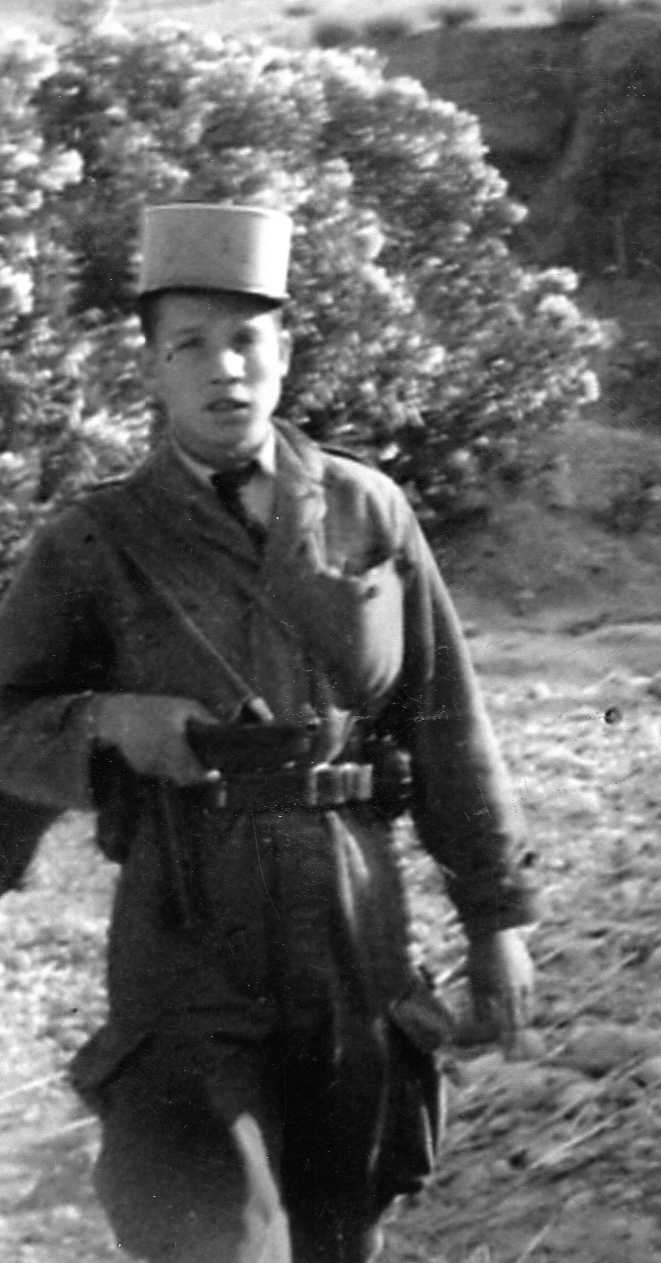
The martyr, fedai and mujahid, Bekhti Abderrazak in 1955
He was both a fedai and a mujahid. He was among the fedayeen who
excelled in this type of disguise and infiltration. Without doubt, his
fair skin, light-colored eyes and command of French helped him in this.
He joined the fedayeen organization in October 1955. Although he was
then among the youngest fedayeen in Tlemcen, he became one of the most
dangerous in attacks and operations against enemy elements. For this
reason, the colonial secret police, driven by revenge, abducted his
father, the martyr “Mohamed Sghir Bekhti,” then took him to the region
of El Ourit, east of Tlemcen, where they killed him with great brutality
and threw his body by the roadside. All this, as I have said, was in
retaliation against his son, the student fedai, who had carried out
several daring operations. Among the most astonishing accounts told
about his boldness in fedayeen action, it is said that he often managed
to enter and penetrate deep into colonial centers disguised in their
military uniform, without them discovering his true identity or
distinguishing him from colonial soldiers. This exceptional student
fedai joined the mujahideen immediately after his father’s martyrdom and
then found himself beside the commander of the “fifth sector.” From that
moment on, for “Ogb-Ellil” he became the beloved son, the combat
companion and the bold mujahid in all operations and battles against the
colonial army, until he accompanied him with the same determination and
the same pure intention in sacrifice and martyrdom.
It is perhaps necessary, in the context of discussing fedayeen action
in Tlemcen, to mention the sabotage and burning of the “Sebdou office.”
This daring operation was insistently ordered by “Ogb-Ellil”45 and carried out by one of the
fedayeen cells on 16 March 1956. The headquarters of this targeted
colonial administration was behind the central post office – it still
exists in the same place. This colonial administration supervised
several regions extending from “Aïn Nehala” in the east to the region of
“El Bouihi” in the west. After carrying out the operation with great
skill, this group of fedayeen took fifty rifles, fifteen submachine guns
and ten pistols, as well as a large quantity of ammunition, several
typewriters, a manual duplicator and all the “stamps” of the colonial
administration that were on the premises. The mujahid Ben Dahmane
Mohamed, an essential member of this fedayeen cell and the private
driver of the “governor,” transported all these items in the
“governor’s” own car and headed toward the dechra of “Mellilia,” west of
Hennaya, where a group of mujahideen was waiting for him. After the
mujahideen received this quantity of weapons and military equipment, the
mujahid drove the car back to the road linking Tlemcen and Hennaya, in
the area near “Sidi Kanoun,” where he burned it before joining the
mujahideen.
Following this fedayeen operation, which had a great impact in
colonial circles, colonial forces began moving in every direction in an
attempt to follow the tracks of the fedayeen and mujahideen. For this
purpose, they imposed a severe siege covering the entire mountainous
zone from the mountains of Terni and Beni Hediel to the mountains of
Sabra. This intensive military “sweep” then extended to the mountains of
Beni Bahdel. All of this was based on their conviction that the
mujahideen would take refuge in the mountainous and forested areas,
whereas the latter headed north, using the interconnected wadis and
ravines from west of “Mellilia” toward “Ouled Riah” and “Zegdouna.”
It should also be mentioned that the dechra of Mellilia was the scene
of several revolutionary operations. One of the most famous was the
episode in which Ogb-Ellil’s youngest brother fell as a martyr. It was
also during this episode that the colonial army gathered the inhabitants
of this dechra – men, women and children – inside the mosque and kept
them there for several days as collective punishment for having helped
and hidden the mujahideen.
The Martyr Bouzidi Ahmed
It is not pointless to tell briefly the story of the martyrdom of
this younger brother, who was no more than twenty years old, perhaps in
order to present Algerian youth with another image of sacrifice for the
homeland and thereby enable them to distinguish true heroes from others:
those whose names were mentioned neither in books nor in speeches nor at
commemorations, and who did not surrender to the enemy even when
surrounded in their hiding places, unlike many of those who surrendered
with their weapons raised and who are still alive while claiming jihad
and heroic exploits.
On 4 January 1958, the colonial army received information provided by
a traitor that four mujahideen, assigned to laying mines and cutting
barbed wire and led by “Bouzidi Ahmed,” were hiding in a house in the
dechra of Mellilia. Military forces 46supported by tanks and
armored vehicles rushed to the scene and surrounded the dechra on all
sides. The soldiers deployed and took up positions on every height, on
the ground itself and on the rooftops. The house whose courtyard
contained the mujahideen’s “hideout” was encircled very closely and
directly. The owner of the house, the martyr “Ferouani Yamna,” hurried
to 47approach the secret hideout in the
middle of the courtyard to whisper to them that they were now in danger:
the colonial army was everywhere and the house itself was surrounded by
a considerable force (… so see what you are going to do…).
The mujahideen were seized and disturbed by this sudden news: they
were now surrounded inside the “hideout.” A few moments later, they
heard the commander of the colonial army tell them over a loudspeaker:
“… You are surrounded… we know your number and the place where you
are… all that remains for you is to surrender… come out, your hands
above your heads…”
The mujahideen no longer had time to examine the situation. Some took
out their grenades, pulled the pins without thinking and stood ready to
detonate them on themselves for fear of surrendering and being captured.
Their other companions immediately imitated them and prepared to do the
same. Their leader, Bouzidi Ahmed, however, intervened with great
firmness and determination: “… How can you kill yourselves without
resisting?… What will people say?… They will say that we killed
ourselves out of fear of the enemy… And if you want to die, death is
in any case ‘outside’ and waiting for us…” He had scarcely finished
speaking when he shot outside like an arrow, in a manner that only God
and the companions who saw him could describe. He threw a grenade at a
group of soldiers surrounding the “hideout” in the middle of the
courtyard, then rushed at them, firing right, left and in every
direction. After spreading terror and disorder in their ranks and
killing eight of them, he managed to get past them, leave the courtyard,
break out of the siege of the house and then that of the dechra. As he
was about to throw himself into one of the ravines on the eastern side,
an enemy soldier posted to the rear with a heavy machine gun (“piassa”)
spotted him and fired a burst that struck him from behind in several
parts of the body. This hero then fell rolling in the dust, exactly as a
spirited horse falls, after avenging himself and his mujahid companions.
They followed in his footsteps, in turn attempting to force the
encirclement, and fell as martyrs one after another at the entrance to
the hideout.48
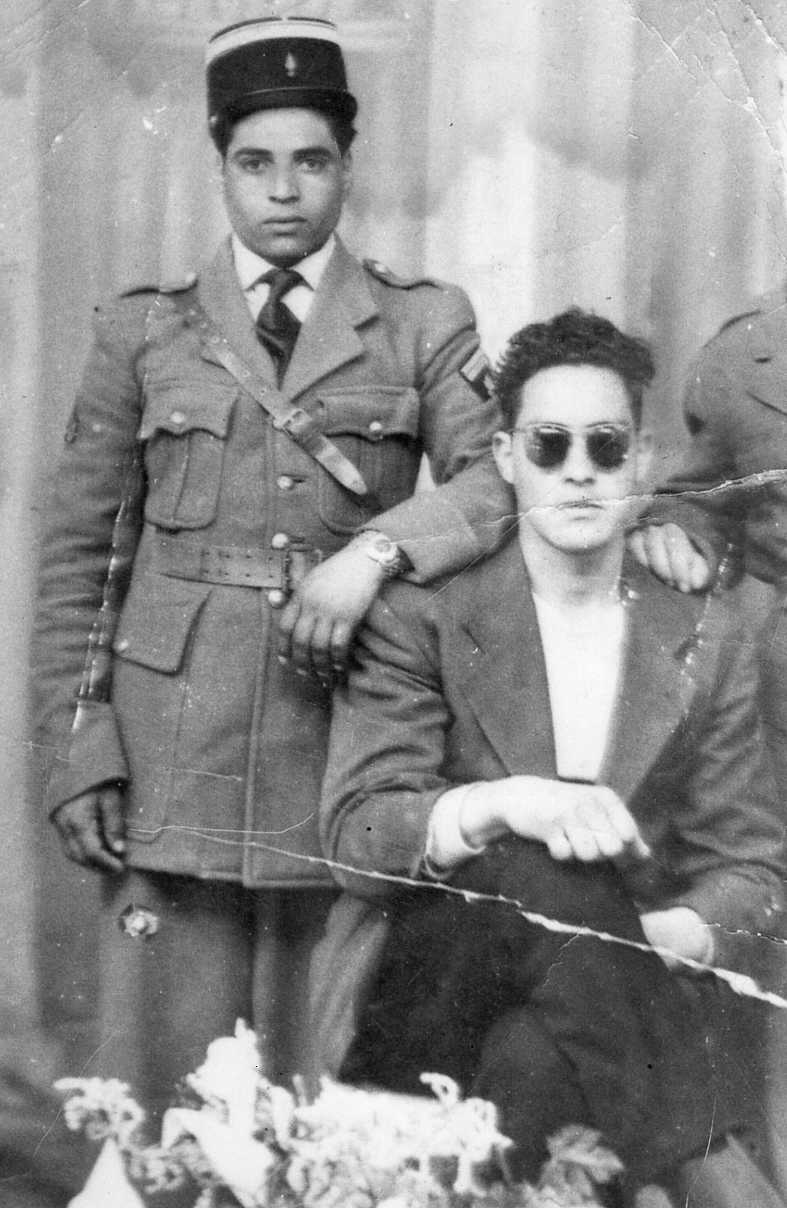
The martyr Bouzidi Ahmed, the younger brother, seated and wearing
glasses. In this photograph he is wearing the clothes of his brother
“Ogb-Ellil.” Beside him is the mujahid Ben Azzouzi El Hocine, a member
of the gendarmerie group of the fifth sector.
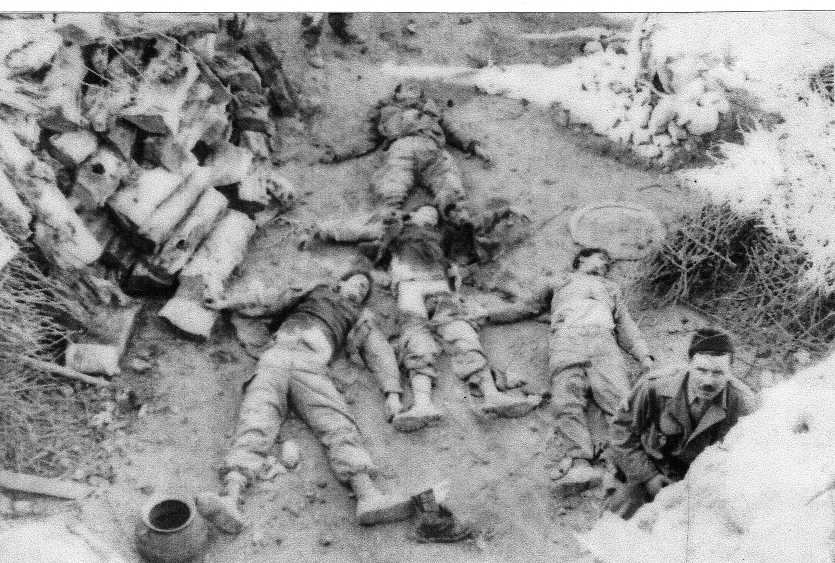
The four martyrs who fell on 4 January 1958 during the siege of
Mellilia (Hennaya), among them the martyr Bouzidi Ahmed. His body is at
the top of the photograph, forming what looks like an arrowhead; he was
indeed the “arrowhead” in his attack on the enemy army.
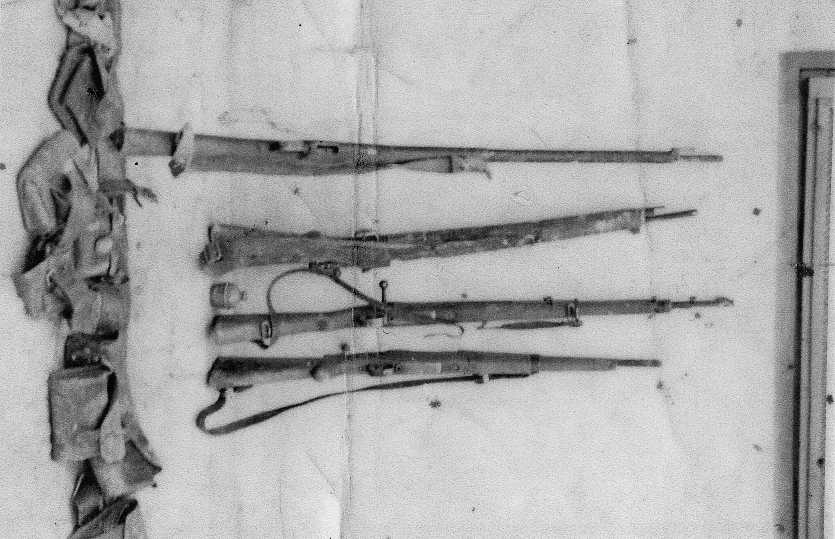
The weapons of the four martyrs
Battles and Exploits
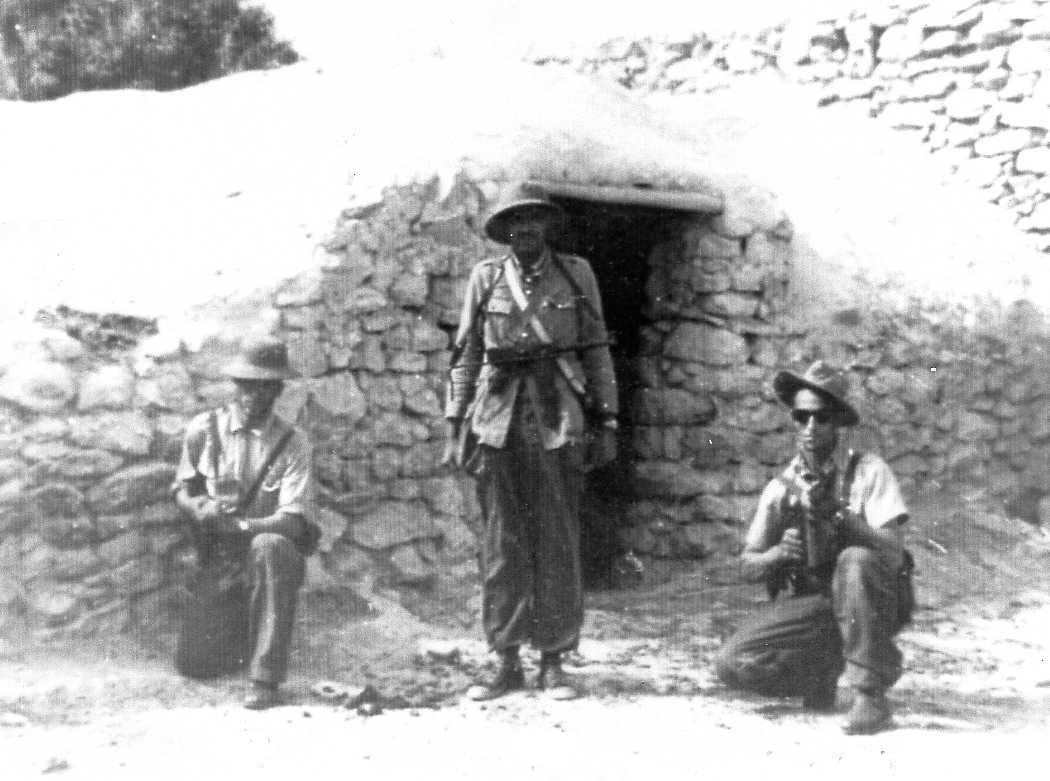
From right to left: the martyr “Ogb-Ellil,” the mujahid Ben
Dahmane Mohamed and the martyr Mohamed El Hadj
It is extremely difficult in this field to encompass all the
revolutionary operations, with their different types and details.
Numerous and varied were the operations carried out by the mujahideen
within the structures of the “fifth sector” under the command of
“Ogb-Ellil.” Some were genuine decisive battles in which the mujahideen
directly confronted the colonial forces. Others were attacks, surprise
ambushes, fedayeen operations or acts of sabotage against colonial
installations; they numbered in the dozens.
It is remarkable in this regard that all of this was accomplished
within a short period not exceeding the two years 1954-1956, a difficult
stage in the life of the Liberation Revolution. Its fate was then
closely tied to the degree of success of these operations and daring
attacks throughout the national territory. This is what made its general
and certain existence a reality and gave a clear impression of the
seriousness and effectiveness of its outbreak. Above all, it reflected
the degree to which the Revolution had mastery of all human and material
means. It thus became a tangible reality defying the colonial
presence.
At precisely this stage, the Liberation Revolution therefore had a
real and urgent need for such successful and influential military
operations, not only to disrupt French colonialism but also to win the
confidence of the Algerian people and encourage them to rally around it
and join its organization.
It is certain that in this field, that of combat, “Ogb-Ellil” was a
formidable fighter. His fame spread through all the battles he fought
with his mujahid brothers. He distinguished himself in the field as a
commanding personality, not like those leaders who withdrew and remained
behind every battle, fleeing every confrontation. On the contrary, he
was bold and courageous, seeking sacrifice and aspiring to martyrdom.
The best proof is that he was often wounded in one battle or another.
This fighter was distinguished by a particular method in revolutionary
operations, based on responding directly against the colonial army
whenever it carried out military operations targeting the mujahideen or
killed and mistreated civilians. Very often, his retaliatory responses
came while the colonial troops were still withdrawing from their
operations and had not yet returned to their positions. From the first
moment, this revolutionary man understood that the strength of the
Revolution lay in this method of warfare. It also constituted a concrete
expression of the degree of readiness of the mujahideen and of their
ability and means to retaliate in all circumstances and situations. He
also knew, without doubt, that this revolutionary method sent the
colonial system a clear message: it had to understand that it was facing
an organized and trained army, possessing strength, resources and a
capacity for initiative, and not merely – as the colonial regime
constantly repeated – a limited group of bands and outlaws, or, in the
terms it used to describe them, terrorists and bandits hidden in the
mountains.
To tell the truth, to my knowledge there did not exist, during this
precise period and across the Revolution in its national framework, an
army of mujahideen organized, trained and armed with different light and
heavy weapons comparable to the one “Ogb-Ellil” had prepared and readied
for combat, at the highest level of revolutionary techniques and with
the best means of warfare. From this rigorous preparation, the region
under the supervision of the “fifth sector” experienced a series of
revolutionary and military operations that disrupted the colonial army
and thus contributed effectively, alongside the other regions of the
country, to bringing the colonial administration – which resisted doing
so – to become aware of and recognize the reality of the armed
Revolution and its capacity for organization and combat. It is enough
here to present the most important of these operations, without entering
into a detailed account of other revolutionary attacks that occurred
frequently here and there and were many and varied. Here are a few
examples.
Sidi Yahia Operation (El Kef)
During this operation, the mujahideen destroyed several military
trucks and eliminated all the soldiers inside them. Deeply affected by
this operation, the colonial army did not hesitate, immediately
afterward, to kill about forty unarmed civilians, all from the same
region.
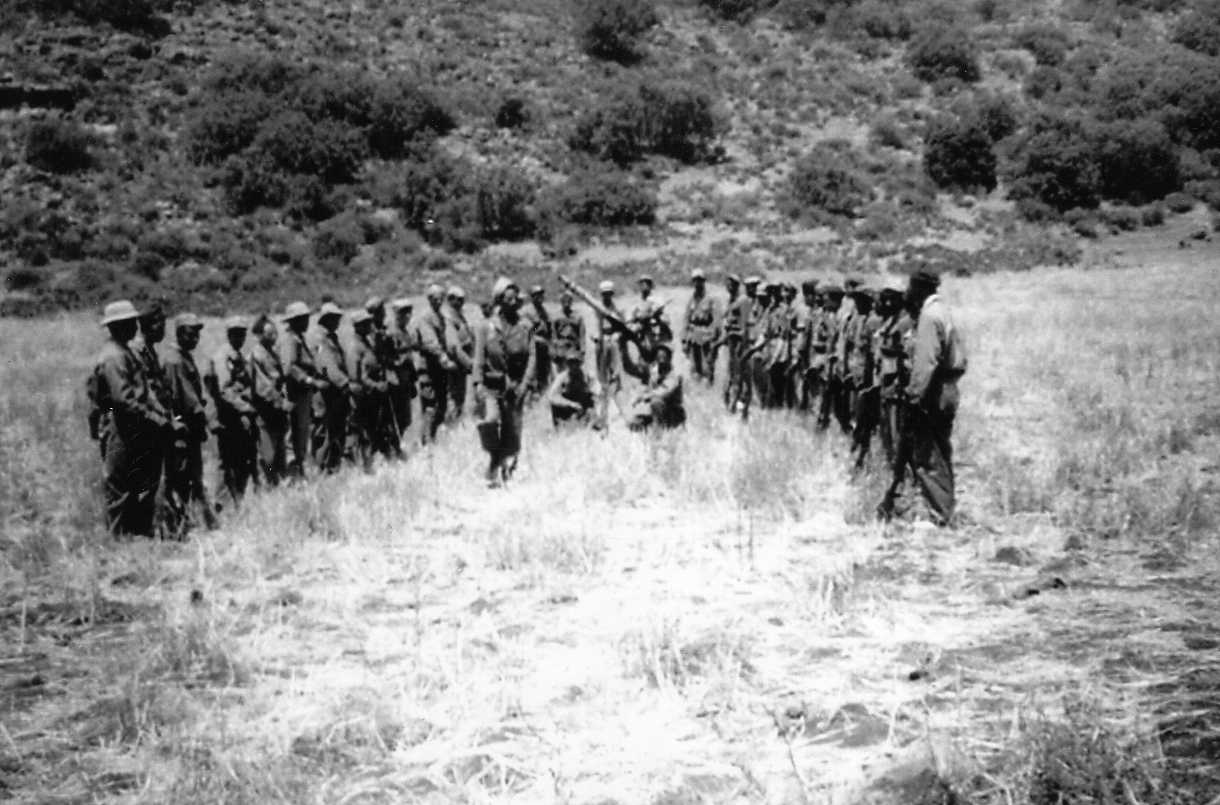
A group of mujahideen in the organization of the fifth sector
under the command of “Ogb-Ellil” in 1955
Wassar Attack
It resulted in the burning of a bus, a “GMC” military truck and a
“Jeep.” This led the enemy artillery, stationed at the military post of
the douar of “Tafna,” to intervene by shelling the area at random.
Es-Souiq Ambush
This is a place located between Sabra and Oued Zitoun, on the road
linking Tlemcen and Maghnia. A group of mujahideen stopped several
vehicles there carrying settlers and men enlisted in the enemy ranks.
They were abducted and then executed by the mujahideen after being taken
into the mountainous zone.
Train Sabotage Operation
It took place a few kilometers from the village of Sabra. The train
was heading toward Maghnia. A significant portion of its carriages was
destroyed and the railway track suffered serious damage.
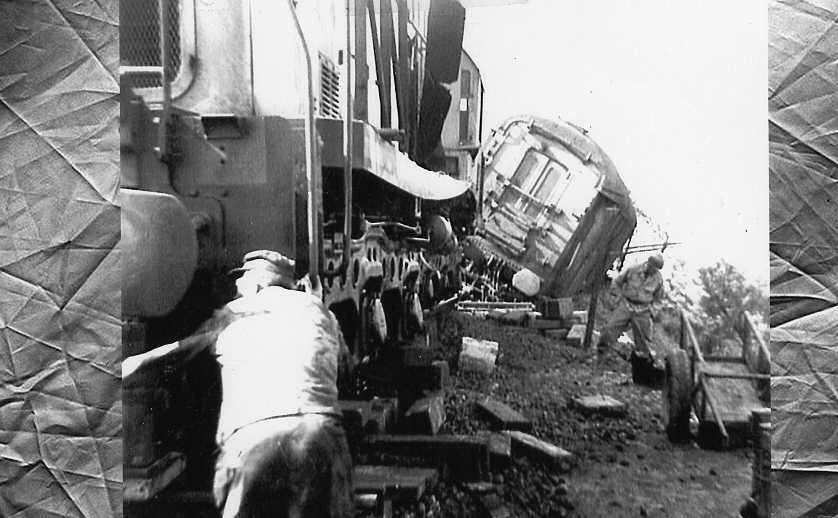
Train sabotage operation carried out by the mujahideen of the
fifth sector at the end of 1955
(Sabra region)
These are some of the operations and attacks carried out by the
mujahideen between 1955 and 1956. As for the major operations conducted
by the valiant mujahideen under the command of “Ogb-Ellil,” which
amounted to genuine wars against the colonial enemy army, four fierce
battles may be mentioned. All bore witness to the courage of this
commander and to the bravery and sacrifices of all his mujahid
companions, who were firmly convinced that victory was inevitable, that
Algeria had to become independent, and that its people had to be
liberated from French colonialism.
Battle of Sadd En-Nemr
In April 1956, on the orders of “Ogb-Ellil,” the mujahideen monitored
the movements of a military convoy of the colonial army that was
accustomed, from time to time, to entering the mountains of “Moutas” by
taking the mountain road linking Sabra to Moutas. The convoy’s mission
was reconnaissance and then surveillance of the mountainous zone,
characterized by its difficult paths and dense forests. This
surveillance lasted about twenty days, at the end of which the
mujahideen were able to determine precisely the convoy’s strength and
equipment. They also recorded its times of passage and return and
everything relating to the movements of the enemy army in this region.
This ultimately enabled them to set precisely the moment for laying an
ambush at a strategic location that favored surprise and made it
possible to paralyze the enemy’s movements during the attack, in order
to inflict the greatest possible material and human losses.
The attack on this military convoy did indeed take place according to
plan, at a place called “Sadd En-Nemr,” on a bend in the road, in a
ravine above Oued “El Aïrsa” toward the south. The place is
characterized by its slope, depth and dense forest, made up in
particular of oak, juniper and mastic trees. The mujahideen’s surprise
attack resulted in the destruction of three military trucks and the
deaths of twenty-five soldiers, while some of them fled through the
dense forest toward the village of Bouhlou, where the headquarters of
the colonial administration was located. The mujahideen also seized a
large number of weapons during this attack: submachine guns, American
rifles and grenades.
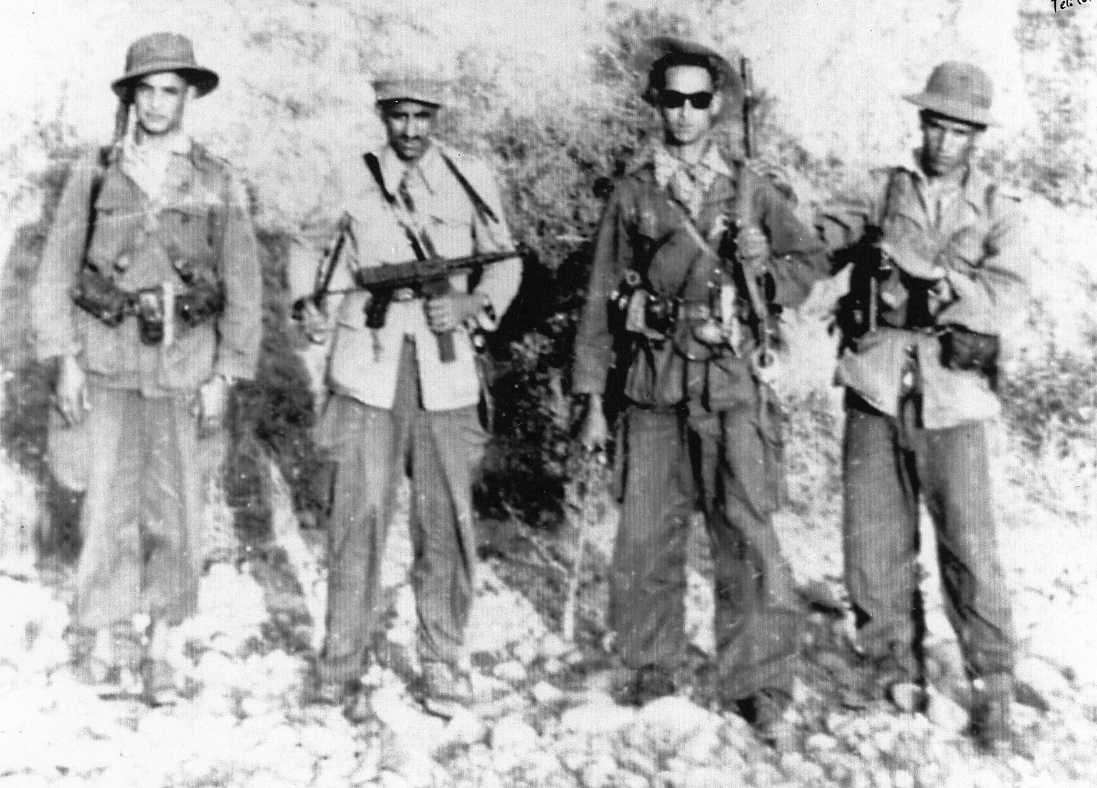
The martyr “Ogb-Ellil,” wearing glasses; to his right, the
mujahid Ben Dahmane Mohamed and the martyr Ben Maarouf Abderrazak; to
his left, the martyr Mohamed El Hadj
It is known that the “commander” Houari Boumediene, who at the time
was part of the leadership of the Revolution in the western region
before settling in Oujda, witnessed this military operation. He took up
a position far from the “adventure” and from there observed the course
of the fighting from beginning to end. While the mujahideen were busy
gathering the weapons and military equipment abandoned by the French
soldiers, “Ogb-Ellil” noticed, several dozen meters away, a fleeing
soldier who appeared to have fallen behind the group that had escaped
the inferno of the battle. He saw him taking a slope toward the north
from the site of the fighting, covered by dense forest that was
difficult to penetrate. He aimed his rifle at him and for several
moments followed the movements of the soldier, who was running with all
his strength in an attempt to disappear from the dangerous place. He
appeared and disappeared, and this continued until he was about to
vanish from sight. At that moment, a single bullet, no more, left
“Ogb-Ellil’s” rifle in his direction. He then approached a mujahid and
asked him to go into the brush at that exact place to check what had
happened. After disappearing for some time into the forest, the mujahid
returned to confirm the soldier’s death and brought back the weapon he
had been carrying.
Thanks to this precise plan, the mujahideen therefore mastered this
colonial patrol and left its soldiers no possibility of movement. They
killed the majority of them, while others managed to flee without
looking back.
“Ogb-Ellil” then withdrew toward the douar of “Temkessalet.” During
the pause, as always, he addressed them with a speech in which he
explained the meaning of this operation. He stressed that it constituted
a message to the enemy so that it would understand that the mujahideen
were present everywhere, especially in the mountainous zones, and that
it was henceforth no longer easy for the colonial army to enter these
places without paying a heavy price; rather, it must always expect
surprises of this kind from the mujahideen.
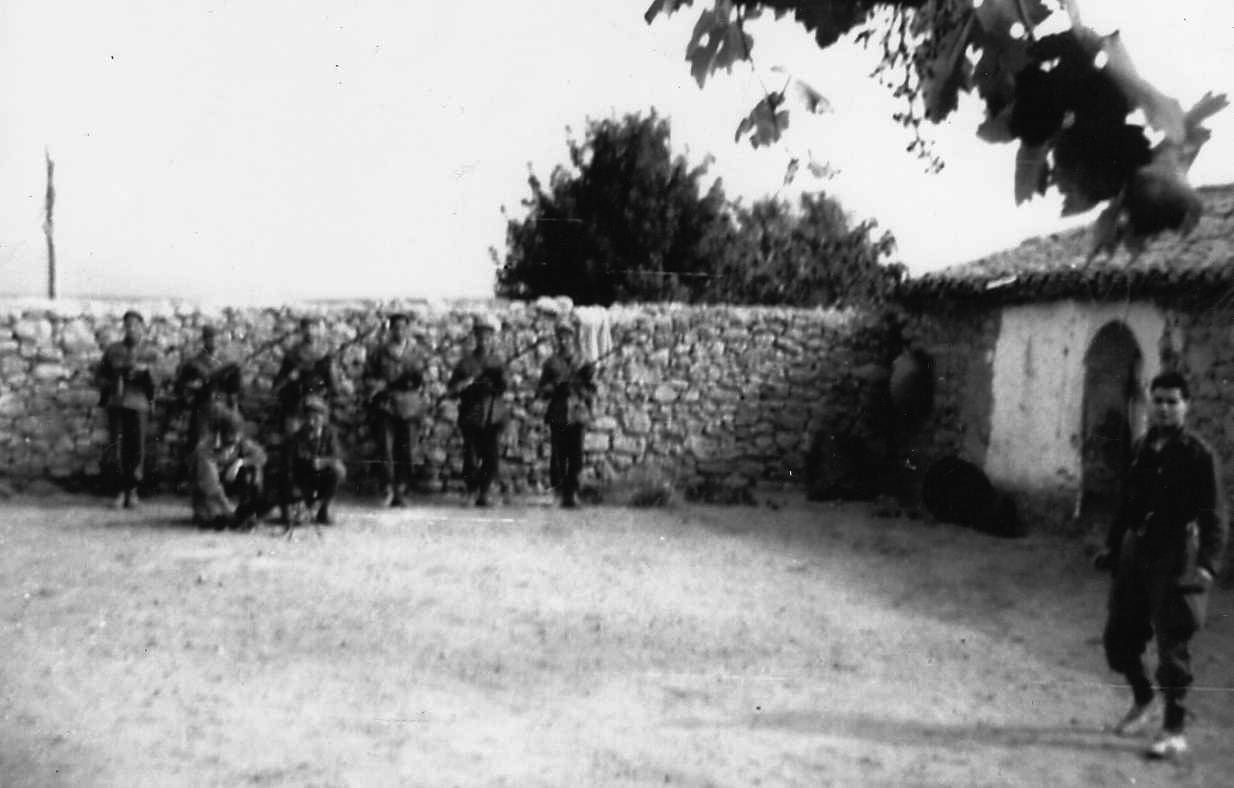
A group of mujahideen in the “Zegdouna” region (between Sabra and
Hammam Bougrara), at the house of “Ogb-Ellil,” in 1956, shortly before
its destruction by the French colonial army
Berbata Ambush and Siege of Sabra
On 22 June 1956, several groups of mujahideen from the fifth sector
took up positions on mountainous ground south of the village of “Sabra,”
near a place called “Moul Ed-Dechra.” At the same time, large forces of
the French army were advancing by night toward the southern mountainous
zones between the mountains of “Moutas” and those of “Ahfir” to the
west. These military forces came from Tlemcen and Maghnia in successive
convoys. At first they assembled on the sports field of the village of
“Sabra,” then, in a second stage, helicopters transported them to the
southern heights already mentioned. The following day, from there they
launched a vast sweeping operation. The mujahideen became aware of this
and began withdrawing from the zone in different directions away from
the encirclement. Some left toward the east in order to get beyond the
mountains of “Ahfir.” Two groups, for their part, headed behind the
heights of “El Brij,” known as “El Kalaa,” toward the south. The first
group was led by the martyr “Maarouf Abderrazak,” known as “Mohamed
Moussa,” a valiant mujahid who remained at the side of “Ogb-Ellil”
through every trial and difficulty. He fell as a martyr at the beginning
of 1957 in a clash with the enemy army on Mount “Boudjoudar,” north of
Oued Tafna.
The second group was led by “Bouzidi El Habib,” also known as
“Abdelhamid.” He too was a valiant hero and one of the permanent
companions of “Ogb-Ellil.” He fell as a martyr at the beginning of 1959
in the region of “Oum El Allou,” east of Tlemcen. The groups of
mujahideen withdrew in this way in order to regroup in the depression of
Oued Bouhdad. Despite this, certain small groups of mujahideen remained
behind here and there inside the encirclement, where the colonial army
surprised them after taking control of the entire region. Scattered
fighting and clashes broke out, resulting in the martyrdom of three
mujahideen,49 while eleven mousabiline were
captured with them. They were all later executed after being abused and
having their teeth broken. While the sweeping operation continued, one
valiant mujahid surprised the enemy soldiers with a burst from his
submachine gun and killed five of them on the spot. Since he was
surrounded on all sides by the enemy army, he fell as a martyr
immediately afterward. In summary, in this besieged zone, clashes and
exchanges of fire took place at different points between mujahideen,
most often hidden inside the encirclement, and the enemy army. This
caused deaths on both sides.
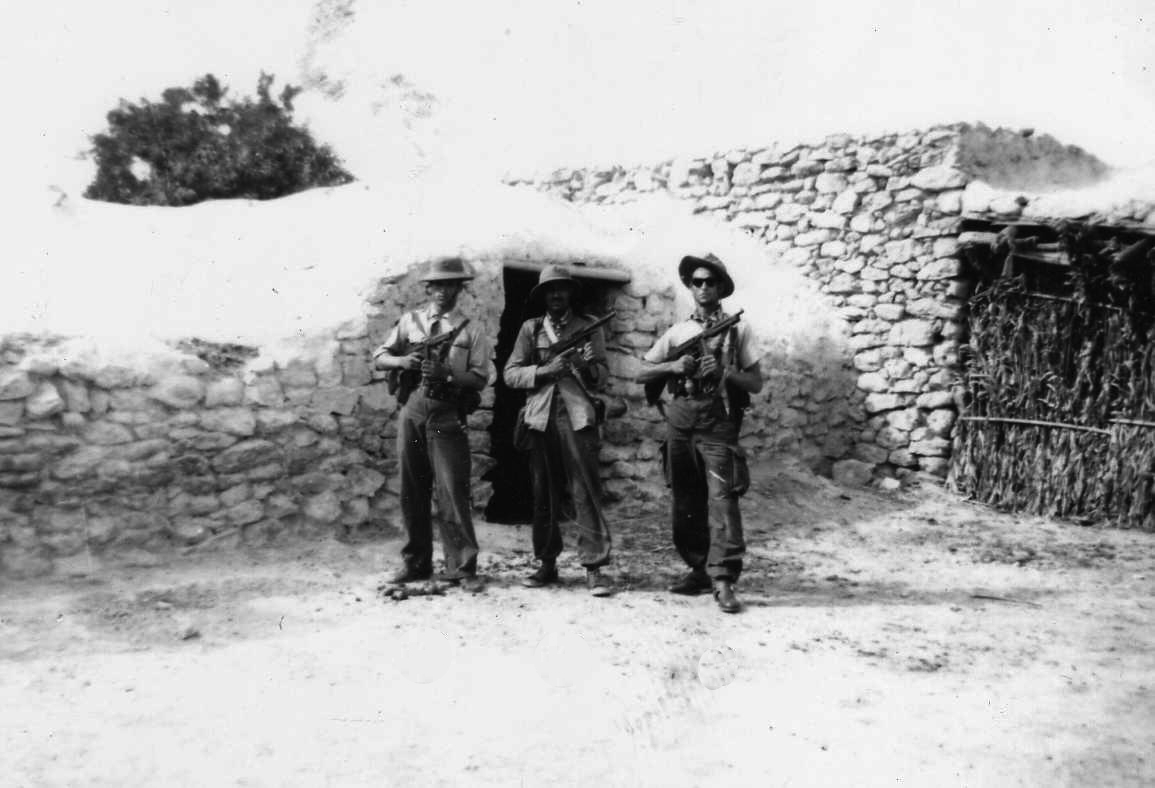
From right to left: the martyr Ogb-Ellil, the mujahid Ben Dahmane
Mohamed,
the martyr Mohamed El Hadj
But as the enemy army withdrew, it did not hesitate to kill several
unarmed civilians indiscriminately in revenge, bringing the number of
martyrs to about fifteen, including mujahideen and civilians. Meanwhile,
“Ogb-Ellil” and a small group of mujahideen belonging to the special
detachment – among them Bekhti Abderrazak, Ahmed El Hadj, Belarbi El
Wahrani, Ben Dahmane Mohamed and others – had arrived at “Zegdouna,” on
the side overlooking Hammam Bougrara from the south, coming from the
direction of Tlemcen. They eventually settled in one of the rural
houses. As the owner was serving them some food, a liaison agent rushed
in in a state of panic to inform “Ogb-Ellil” of the criminal acts
committed by the colonial army, especially against civilian citizens. At
the same time he told him that the colonial forces were beginning to
move in order to withdraw. As soon as “Ogb-Ellil” heard this news, he
sprang to his feet and addressed his mujahid companions, saying: “… I
swear by the pure blood of the martyrs that none of us will rest and
that we will eat nothing before avenging our martyrs and giving the
French soldiers a harsh lesson they will not forget…” Everyone then
prepared themselves and carefully checked their weapons with calm and
determination, aware of the seriousness of their commander in such
situations. They left the food behind without anyone touching it,
although naturally they were in pressing need of it. They moved at very
high speed from the territory of “Zegdouna,” north of Sabra, toward the
south, covering a distance of about eight kilometers through Oued
Berbata, where no one could notice their presence, until they reached a
crossroads. One road leads from there to Maghnia, the other toward the
village of Bouhlou and Sidi Moudjahid. The place is a depression near
the mausoleum of “Sidi Mohamed Ben Halilem.” The colonial forces had to
pass through this site on their return. The mujahideen laid a carefully
prepared ambush there for the soldiers returning from the sweeping
operation. The plan was to let the first elements of the convoy pass and
attack its rear.
At the beginning of their attack, the mujahideen used “Molotov”
cocktails, then began firing on the enemy soldiers from different
positions. A military truck was completely destroyed and twenty-one
soldiers were killed, most of them while trying to flee the flames.
Among them was a French army officer who jumped from his burning truck
with a heavy machine gun that he was trying by every means to carry away
so that it would not fall into the hands of the mujahideen, because of
its importance and military value. “Ogb-Ellil,” who was nearby, noticed
his attempt, threw himself upon him and engaged in hand-to-hand combat.
He soon knocked him to the ground, killed him and wrested the machine
gun from him, which was 50added to the large
quantity of weapons and ammunition seized during this attack.51
Although this daring operation was carried out by the mujahideen as
direct revenge against the French soldiers for the indiscriminate
killings committed against some mujahideen and civilians, the matter did
not end there. In the eyes of “Ogb-Ellil,” all of this was still not
enough to avenge the crimes of the colonial army.
After the successive withdrawal of the mujahideen and their dispersal
in different places in the region of “Zegdouna,” from which the
preceding attack had been launched, and after the arrival of all the
mujahideen who had managed to escape the encirclement, “Ogb-Ellil”
assembled the mujahideen of all the different detachments as the sun was
declining. He told them that the revenge operation against the French
soldiers must not stop there and that another revolutionary mission
remained to be accomplished in order to prove to the colonizer that the
Revolution possessed a military force and strong, trained men enabling
it, whatever the circumstances, in every place and at every time, to
take the initiative and attack in revenge. To put this idea into
practice, an urgent plan was drawn up with the objective of surrounding
the village of Sabra and then entering it, despite the still massive
presence in the region of a large army that had come from different
places, as previously indicated. It goes without saying that the aim of
this operation was above all to spread terror among the settlers and
demonstrate that the mujahideen were capable of attacking the enemy in
his own home and inside his own centers.
At the beginning of the execution of the plan, reconnaissance
aircraft were still flying over the region. The mujahideen therefore
decided to wear “djellabas” to conceal their military uniforms while
moving toward Oued “Bourdim,” the nearest to them, which was to form the
main route by which they would reach the outskirts of the village. The
encirclement plan led by “Ogb-Ellil” and his companions in the special
detachment thus consisted of surrounding the village of Sabra on its
four sides, each group of mujahideen taking position in a specific
direction.
The first group was led by the martyr Bouzidi El Habib (Abdelhamid),
the second by the martyr Maarouf Abderrazak (Mohamed Moussa), the third
by the mujahid Negadi Ben Ziane and the fourth by the mujahid Sahnoun
Mohamed (Antar). All these groups were placed under the authority of the
sector’s military official, the mujahid El Wahrani Ahmed (Si Lakhdar).
The commanders were ordered not to open fire, whatever the
circumstances, before hearing gunfire from inside the village. At the
same time, a special detachment under the command of the martyr Zitouni
Bouazza, dressed in military uniforms similar to those of the French
army and armed with the same type of weapons, was tasked, thanks to this
disguise, with entering the streets of the village and appearing to be
an enemy army patrol. After sunset, this detachment of mujahideen did in
fact succeed in entering and began moving through the village streets.
As it circulated, it crossed paths with a patrol of the colonial army. A
few moments later, the mujahideen suddenly opened fire on the enemy
soldiers. All were killed; they numbered about eleven. The mujahideen
seized their weapons and immediately withdrew. As soon as the mujahideen
surrounding the village heard the gunfire, they opened fire
simultaneously from every direction and detonated grenades at different
points in order to disrupt the enemy army, prevent it from moving freely
and spread panic through its ranks.
Shortly after the withdrawal of the groups of mujahideen, who had
carried out this revolutionary operation with complete success and at
the appointed time, searchlights were switched on, followed by a rain of
artillery fire in every direction and at random. The mujahideen,
however, had already begun implementing the final phase of the plan,
which consisted of completely clearing the region of their presence. As
usual, it was expected that the colonial army would conduct a
large-scale sweeping operation the following day, given the military
forces and material resources at its disposal. Two groups of mujahideen
accompanied by the sector commander therefore headed toward the
“Fellaoucen” mountains in the north. The third group headed toward the
mountains of Ouled Mimoun, while the fourth followed Oued Tafna
southward to establish itself in the mountains of Beni Hediel. As
expected, the colonial forces swept the entire region but were unable to
find any trace of the mujahideen.
Examination of this daring double revolutionary operation, carried
out within a short time as a direct and powerful response by the
mujahideen and costing the enemy 32 dead, undoubtedly leads us to
measure the sacrifices of the mujahideen and understand their degree of
readiness, both in training and combat capability and in devotion to the
Revolution and its liberation objectives. This is what the mujahideen of
the fifth-sector organization under the command of “Ogb-Ellil” embodied
in every revolutionary situation. This commander neglected nothing and
neither weakened nor hesitated within the framework of his
responsibility to make the Revolution a concrete reality whose national
objectives could under no circumstances be pursued with laxity or
failure.
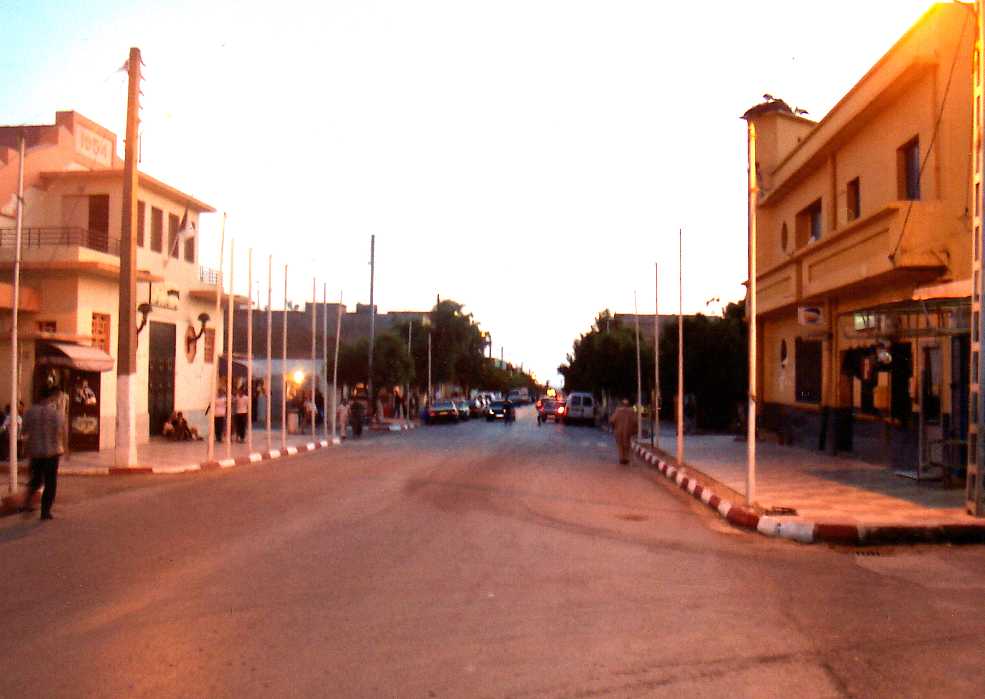
The road taken by a group of mujahideen, where it confronted a
patrol of colonial soldiers
Battle of Er-Raha
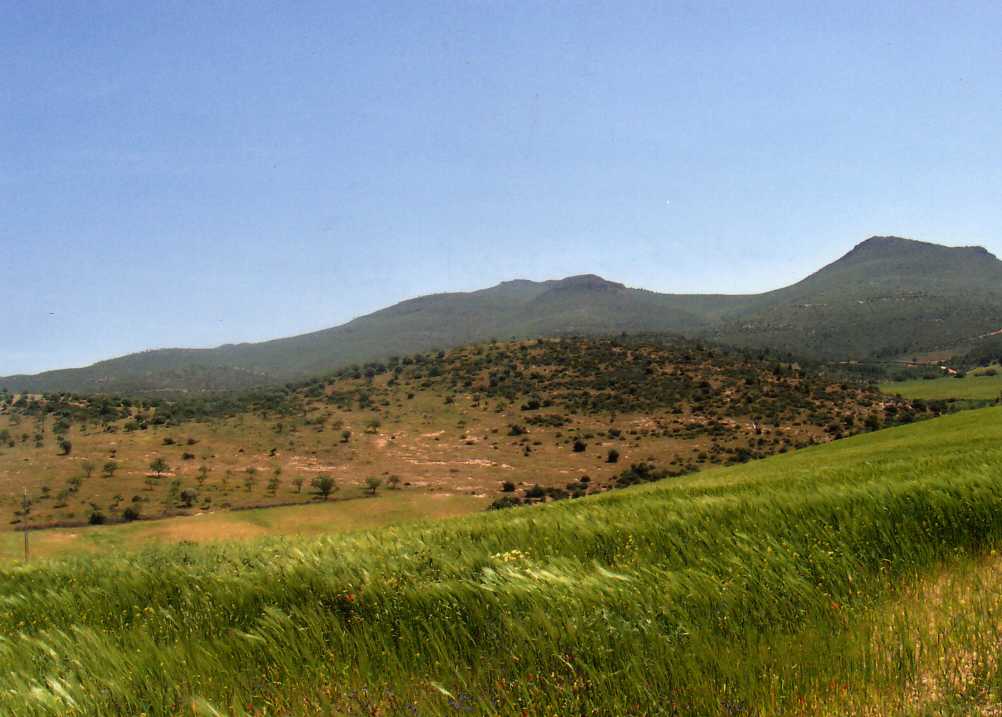
The mountains where the Battle of “Er-Raha” took place; their
forests were completely burned
This battle ranks among the fiercest and most decisive engagements of
this period in the life of the Revolution throughout the western region.
The mujahideen directly confronted the colonial army there for two full
days, 23 and 24 July 1956. Every means of warfare and combat was used,
from light weapons to heavy weapons, from artillery to aircraft. At
times the valiant mujahideen penetrated deeply into and crossed the
enemy ranks, turning the battle into hand-to-hand combat, man against
man, in which bladed weapons were used, that is, knife blows. Because of
the massive intervention of artillery fire and concentrated aerial
bombardment, which never ceased throughout the battle, the vast
battlefield, although in broad daylight, turned into something
resembling a black night. The matter did not stop there: the intensity
and interweaving of the fighting increased to the point that the groups
of fighting mujahideen became dispersed and found themselves scattered
everywhere and in every direction. Each became isolated and left to
himself, with no recourse, in the midst of an immense enemy army, other
than his own bravery and ferocity in combat. In this fierce battle, a
mujahid often had great difficulty distinguishing his companions from
enemy soldiers. To tell the truth, it frequently happened that one
bumped into another without warning, and the two would then engage in
physical combat with bladed weapons. In this battle, despite the extent
of the terrain, there was no longer any corner in which to take refuge
or any way out. There was no longer time, not even moments, to catch
one’s breath, calm the terror in the soul and master oneself in the face
of the horror of the battle, the gravity of the situation, the violence
of the fighting and the confrontation with death.
Such were the realities of the fierce Battle of Er-Raha. The colonial
administration did not fail to mention in its report the name of the
commander of the mujahideen who took part in it and to determine his
identity precisely: El Mokhtar Bouzidi, “Ogb-Ellil.” It is necessary in
this regard to present the colonial administration’s report as it
published it at the time in its press,52
without any change, except for the facts concerning the number of dead
in the enemy ranks and its losses during this battle, or the number of
martyrs among the mujahideen.
Text on the Battle of “Er-Raha” as published in the newspaper L’ÉCHO
D’ORAN
– Report of the colonial administration (translation):
– Outcome of the Battle of “53Turenne”: 64 rebels
killed.
– The battle was conducted by units of the French army and reached an
intensity extending to hand-to-hand combat, on extremely difficult
terrain.
– Tlemcen, 23 July 1956. The violent engagement took place yesterday
and the day before (21-22 July), in the Er-Raha forest located about
five kilometers southeast of “Turenne,” in the direction of the Ahfir
forest. It is a region ending in wild, deep, isolated and densely wooded
ravines that are difficult to penetrate. This zone has long been
regarded as one of the principal strongholds of the rebels. It is
crossed by a mountain passage linking the Tlemcen-Turenne national road
with the heavily traveled Road No. 54 linking Tlemcen to Beni Bahdel.
This passage rises through the region of “Ahl El Ghafer,” at the foot of
several mountain summits whose altitude exceeds 1,300 meters.
The precise information available, carefully gathered, finally
enabled the military forces to carry out effectively a surprise
operation prepared and directed by the colonel commanding this sector.
It should be emphasized that no information leaked about this operation,
which enabled our units to intervene rapidly while benefiting from the
element of surprise.
The rebel group was estimated at about 300 men. It was extremely well
armed and possessed a large number of automatic weapons. It was led by
the man named Mokhtar Bouzidi,54 a native of the region
itself.
This group was also composed of men from the same “douar,” which
constituted certain support for the “fellagas.” It must be acknowledged
that the command, aware of all the possible difficulties in this region,
was thus able to ensure an entirely concealed military deployment. The
young conscripts who had been mobilized had, for their part, adapted
particularly well to guerrilla warfare without difficulty. Their combat
experience had reached a level that aroused the admiration of their
commanders.
A Fierce Battle:
The clash was rapid and violent. Our forces surrounded the rebels,
who advanced with the greatest difficulty in a battle in which they were
surprised by a sudden advance. The outlaws took positions on all sides
on difficult terrain, sheltered behind rocks.
The Dragon unit of55 the Foreign Legion, reinforced by
military units of settlers, faced heavy fire from rifles, submachine
guns and heavy machine guns. There is no doubt that the outlaws employed
all the forces at their disposal, since it was impossible for them to
escape the tightening ring of the regular forces – at least during the
day. They therefore had no choice left: defend themselves or die. This
unavoidable conviction of the enemy constituted a natural stimulus. In
this situation, it became necessary to dislodge the outlaws from their
positions by forcing hand-to-hand combat under particularly tragic
conditions.
Machine-gun fire poured out at a distance of three or four meters.
One must imagine for a moment what this assault could have been like in
brush as tall as a man, allowing no visibility. There was only gunfire,
coming sometimes from the front and sometimes from the rear; the blast
of shots even came from every direction.
The nervous tension of the combatants in this fierce battle reached
its peak. The immediate intervention of heavy artillery and aircraft was
requested in order to relieve our valiant soldiers and allow them to
catch their breath. But night had already fallen, and the battle had to
be interrupted.
The Chance of Night: the outlaws understood that their chances of
escaping during the night through a very tight encirclement had become
impossible, despite their perfect knowledge of the battlefield and the
location of every tree.
The battle resumed at first light with all its violence and ferocity,
while fog was still present. The outlaws managed to establish a few
entrenched positions in order to secure their escape toward the “Ahfir”
forest and the douar of “Temkessalet.” The battle then came definitively
to an end.
The provisional toll communicated this evening reports 64 dead among
the outlaws, counted 56and identified during the sorting
operation. Many different and varied weapons were recovered. On the side
of the regular forces, we regret several dead and about 15 wounded.
(End.)
There is no doubt that this colonial report describing the Battle of
“Er-Raha” could not account for all aspects of the battle or the extent
of its ferocity. On the contrary, it worked to reverse and falsify many
facts because it was concerned above all with praising the power of the
colonial army and its combat capabilities. In this regard it made false
assertions and obvious untruths. Despite that, it gave a precise
description of the intensity and scale of the battle, a description
confirmed by the testimony of some mujahideen who took part in this
fierce battle and are still alive. They summed it up by saying that it
had been a day of hell. During the battle there was no distinction
between the hours of day and night. Artillery shells and aerial
bombardment had become like a roar of thunder that neither ceased nor
subsided. The mujahideen and French soldiers had become completely
intermingled. The confrontation was most often a fight in which each man
faced another. At every moment, the groans of men could be heard rising,
or cries coming from here or there, while the roar of submachine-gun
fire poured out without interruption and rifle shots deafened the ears.
Every bullet, as one of the mujahideen said, gave no indication where it
would end its course – in you or in someone else – so intertwined and
confused was the fighting. After the intervention of heavy artillery and
aircraft, called in as reinforcements by the “colonel,” commander of the
colonial army, because of the large number of losses in his ranks and
because he had understood that his forces were now under the domination
of the mujahideen, it became necessary for the latter to throw
themselves without hesitation into close contact and become intermingled
with the enemy ranks. This gave the battle another dimension of violence
and ferocity. The random bombardments, whether from artillery or
aircraft, then often struck enemy soldiers directly instead of the
mujahideen because of the large number of enemy soldiers and the small
number of mujahideen.
Although this fierce battle was unbalanced, since the forces of the
colonial army exceeded two thousand men while the mujahideen numbered
about three hundred – that is, the overwhelming majority of the
mujahideen making up the fifth sector – the number of dead in the enemy
army nevertheless exceeded 130 soldiers, while the wounded numbered in
the dozens. This is confirmed by the long time taken by military
ambulances to evacuate the dead and wounded from the battlefield after
the fighting ended: they continued this operation for three consecutive
days without interruption. By contrast, the army of “Ogb-Ellil” counted
twenty-four martyrs and about fifteen wounded of varying severity.
Battle of Aïn El Ban (9-11 August 1956)
Since the beginning of August 1956, groups of the Liberation Army
belonging to the structures of the “fifth sector” had established
themselves in the mountainous zone comprising the heights of “Moutas”
and “Aïn El Ban.” These two neighboring zones lie about thirty
kilometers west of the Tlemcen mountains and are covered by dense
forest. The entire region is also crossed by numerous wadis and ravines,
in addition to deep slopes. This made it a difficult-to-reach center
that the different detachments of the Liberation Army were accustomed to
frequent, either to meet and communicate with one another or for the
needs of concealment and protection from colonial surveillance
arrangements. Despite this, after monitoring the region for several
successive days, the latter discovered the presence of certain groups of
mujahideen. The colonial enemy then mobilized two thousand (2,000)
soldiers and quickly launched a vast sweeping operation covering all the
zones as far west as the mountains of Beni Bahdel overlooking the
village of “Kadara.” Since this operation had begun at night, the
mujahideen did not notice it until one of their groups encountered some
of the forward lines of the enemy army units. This happened at dawn on
13 August and caused a sudden clash, sufficient to warn all the groups
of mujahideen scattered in different locations that a broad advance of
the colonial army forces had covered the entire region. From that
moment, the different groups of mujahideen engaged in scattered clashes
with the enemy while trying to cross its ranks and break out of the
encirclement. This situation of clashes continued until nightfall, which
made it easier for the mujahideen to break through the encirclement by
means of difficult-to-reach wadis and ravines. Overall, these clashes
caused ten (10) deaths and some wounded in the enemy ranks, and five (5)
martyrs in the Liberation Army.
The next day, 14 August, at around ten in the morning, the enemy
discovered, west of “Aïn El Ban,” the presence of “Ogb-Ellil” and three
mujahideen from his special detachment: Bekhti Abderrazak, Maarouf
Abderrazak and Rachedi Ahmed. This occurred following new clashes
between certain mujahid units and the enemy army in an area near them.
The colonial forces then concentrated their efforts on tightening the
encirclement. A short time later, they had surrounded them on all sides,
equipped with various deadly weapons. While these forces advanced on the
ground firing in every direction, thirteen (13) warplanes covered the
sky above them and took turns bombing them. In these trying
circumstances, “Ogb-Ellil” and his mujahid companions concentrated their
efforts in particular on their determined attempts to protect the
Egyptian journalist Si Hocine, who was 57accompanying them and witnessed this
battle. Despite this, they fought bravely to confront and resist the
colonial army. They forced it to halt its advance toward them, leaving
the field to the raids and random bombardment of the aircraft. This gave
the mujahideen the opportunity to escape the enemy’s grip and leave the
dangerous zone after dispersing and taking narrow ravines and
slopes.
But the reconnaissance aircraft once again succeeded in discovering
“Ogb-Ellil.” This time he was alone and moving through the dense forest
extending to the farthest heights overlooking the village of “Kadara”
from the east – “Aïn Boudaou” – mountainous terrain located between
“Beni Bahdel” and “El Kef.” The warplanes then concentrated their action
on “Ogb-Ellil” alone and began pursuing him, bombing in front of him,
behind him and on every side. He was wounded and burned in several
places. One fragment penetrated his ear in particular and another struck
his hand. The aircraft continued pursuing him, as though they had
recognized his identity, until he disappeared from their surveillance
and they completely lost his trail. They then intensified their
bombardment in every direction, in vain. The scale of the bombing
frightened the inhabitants of the village of “Kadara,” who were
witnessing this terrifying scene in their mountainous region. When all
of this drew close to their village, they fled with their women and
children toward Oued Kadara and hid in the Yellow Cave. This prehistoric
cave can shelter dozens of people. While they were crowded together
there in terror, “Ogb-Ellil” suddenly entered among them, exhausted, his
clothes torn and blood flowing from several parts of his body. He
immediately told them: “… Do not worry and do not be afraid. The
aircraft have lost my trail… They do not know that I came in this
direction… It is better for you to stay here until things calm down
and the aircraft leave.”
“Ogb-Ellil” immediately left this place in the direction of the
“Boussedra” mountains and later reached the Moroccan city of “Oujda,”
where the Oujda group lived and rested under the leadership of Boussouf
Abdelhafid and Houari Boumediene. These two men, in these same difficult
circumstances of confrontation with the colonial army, had, I say, the
time and a broad space of safety and stability to devote themselves to
and immerse themselves in preparing a treacherous plot. It was this vile
plot as a result of which “Ogb-Ellil” fell as a martyr. If “Ogb-Ellil”
confronted the colonial forces in fierce battles without their being
able to reach him, despite the intelligence and destructive means at
their disposal, it was because it was above all a confrontation of men
against men, where victory went to the one who showed courage and
heroism and whose cause rested on sincere principles and just
objectives. The confrontation of Boussouf and Boumediene against him,
for its part, could rest only on plots, intrigues and blows struck in
the back. These were base characteristics that continued to distinguish
them during the Revolution in Oujda, and then after the Revolution in
independent Algeria.
The report that “Ogb-Ellil” wrote about the Battle of “Aïn El Ban”
and sent to the leadership of the Revolution perhaps indicates and
directly contains the nature of the plot being prepared against him. It
also alludes to the vile means they adopted and established as a method
and procedure of conspiracy and betrayal.
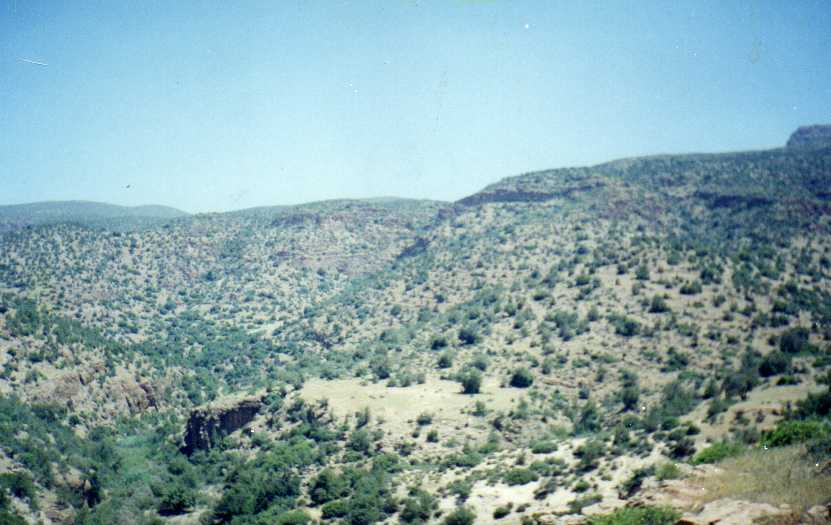
The wadi taken by “Ogb-Ellil” in the direction of the Boussedra
mountains
Site of the Battle of “Aïn El Ban”
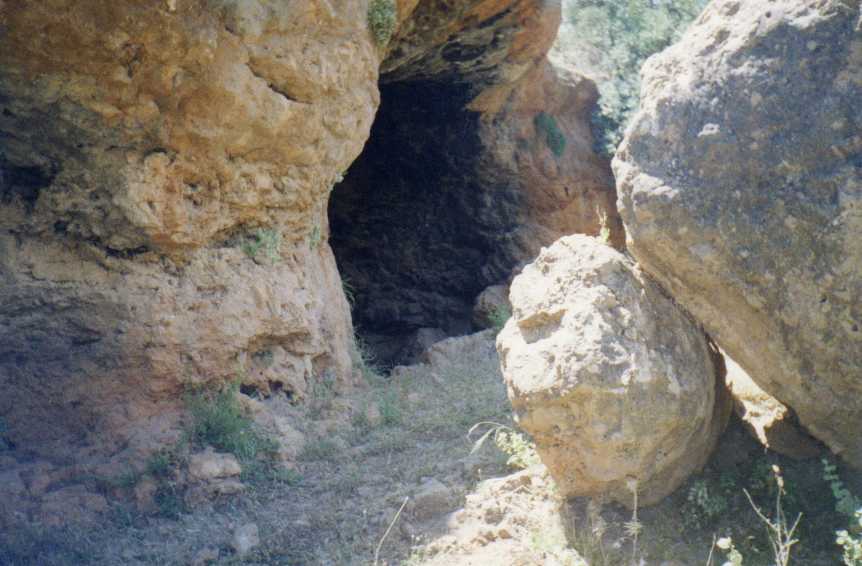
The Yellow Cave where the inhabitants of the village of Kadara
hid because of the terror caused by enemy aircraft pursuing “Ogb-Ellil”
during the Battle of “Aïn El Ban”
Report by “Ogb-Ellil” on the Battle of Aïn El Ban (11-8-1956)58
National Liberation Front
Fifth Sector
Subject: Report of the Sector Commander
– Sunday, 11 August 1956, I entered the fifth sector accompanied by
Si Hocine, an Egyptian journalist.
– On 13 August, we moved with him toward Aïn “Boudaou.” Si Hocine
could not continue walking and, after great difficulties that nearly
cost us our lives, we managed to break free of the encirclement around
midday.
In the evening, I sent the journalist to the leadership because he
was hindering us in carrying out our work, since he could no longer
continue walking; he therefore rejoined the leadership.
The next day, 14 August, we were again surrounded at Beni Bahdel
after a brief clash that took place a few kilometers from us with one of
our groups.
An enemy aircraft spotted us at around ten in the morning and we were
tightly surrounded. Then the fighter aircraft, thirteen in number, began
bombing us directly. I was wounded during one of the clashes, when we
were four (4) mujahideen against about 200 enemy soldiers.
Bullets from the fighter aircraft passed through my cap and my
trousers. In the evening, we succeeded in breaking free of this
encirclement, and we were like dead men.
I reached the place toward which I was heading (Morocco) and informed
the leadership of my presence there; they received my report.
I waited to be summoned in order to report on my state of health, but
I received no summons. On the contrary, they did nothing but question
the sector militants about me. Their concern was to know whether Si
Mokhtar had left or not. They asked questions about me as though I had
come for a stroll.
Situation in Oujda: when I entered Oujda, they assigned people to
watch me and follow my movements in order to know my activities and
movements.
In Oujda, many militants from the cells who were present were beaten,
such as Dali Youcef Redouane, and this has been going on for about three
months.
– Didouh: he had to sell his wife’s jewelry in order to feed his
children, who were dying of hunger, then he was arrested and beaten on
20 August 1956.
– Attar: he was arrested and beaten on 28 August 1956.
(End.)
FRONT AND ARMY OF LIBERATION
ALGERIAN NATIONAL
5th sector
Subject: Report of the commander of the 5th sector
1-On Sunday 11 August 1956 I returned to the 5th sector in the
company of Si Hocine, Egyptian journalist
On 13 August we were with the reporter at Aïn Boudaoud
Si Hocine could not walk. After several hardships that nearly cost us
our lives, we were freed from this encirclement toward the afternoon. In
the evening I sent the journalist to the command because he was
hindering us in our actions; he could not walk. He joined the command.
The next day, 14 August, we were again surrounded at Beni-Bahdel. After
a brief clash by one of our sections a few kilometers from us, we were
spotted at about 10 in the morning by aircraft. We were tightly
surrounded and bombed by fighter aircraft, which numbered 13. I was
wounded after a clash because we were 4 against 200 enemy soldiers.
My hat was riddled with bullets by the bombers, as were my trousers.
Toward evening we were freed from this encirclement. We were half dead.
I returned to Morocco. Arriving at my destination, I reported my
presence in this region to the command, which received my report. I
waited, thinking they were going to summon me to assess my state of
health. I received no summons; instead, they did nothing but question
the militants about me. They were charged with finding out whether
Mokhtar had left or not.
They asked about me as though I had come for a stroll.
II- The situation in Oujda: When I entered Oujda they assigned
sentries to shadow me in order to observe my behavior and my work.
III- In Oujda: They beat several members of my cells:
Dali Youcef Redouane, about three months ago
Didouh: was going to sell his wife’s jewelry to feed his children who
were dying of hunger; he was arrested and then beaten on 20/08/1956.
Attar: was arrested and then beaten on 28/08/1956.
All
IV-Stop…
-
Photograph of the report
The Plot and the Martyrdom
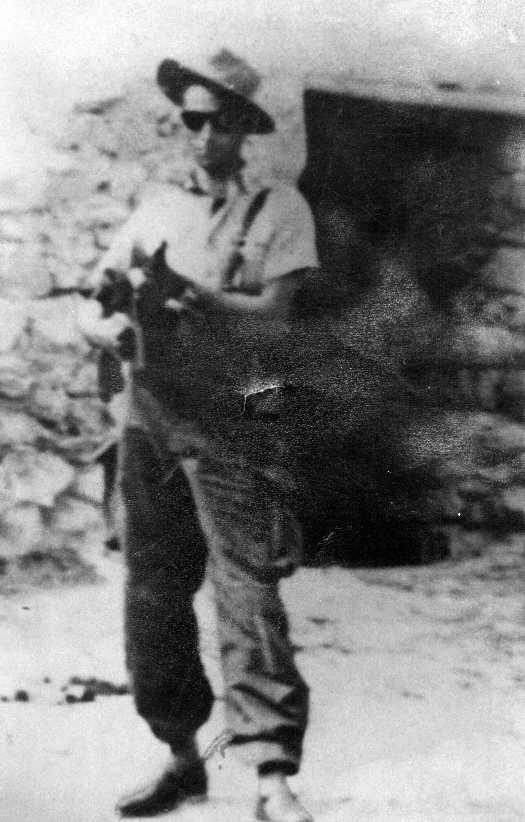
The martyr “Ogb-Ellil” – Si Mokhtar, in 1955
After managing, with great difficulty, to escape the grip of the
colonial army during the Battle of “Aïn El Ban,” “Ogb-Ellil” reached
Oujda suffering from several wounds. In these precise circumstances, the
Oujda group, led by Boussouf (Si Mabrouk) and Boumediene, was lying in
wait, as indicated earlier. It is known that this group, after
establishing itself in this city away from the horrors and dangers of
the Revolution, after transferring the leadership of the Revolution in
western Algeria there at the beginning of 1956, had only to put in place
a police intelligence system guaranteeing that it could remain and
establish itself in this city and charged with carrying out the
intrigues and plots it devised, as well as the methods of betrayal and
blows in the back that it planned against any mujahid who opposed it or
challenged its flight from the hell of the Revolution, who confronted
its leadership and criticized its suspicious behavior and actions:
avoiding through indirect means effective participation on the ground of
the Revolution, tampering with the Revolution’s money and using it for
personal purposes, or denouncing manifestations of idleness and
debauchery in the streets of the city, especially since all of this was
done in the name of the Revolution and under the slogan of applying the
“legitimacy of the Revolution.” Naturally, this suspicious and falsified
legitimacy did not come from inside the Revolution, as one might
spontaneously think or as some imagine and claim, but from outside, far
from its field. Now “Ogb-Ellil,” proceeding from his revolutionary
principles and national qualities, could not accept the existence of a
military revolutionary leadership that distinguished itself from all the
mujahideen and, far from the dangers of the Revolution and the hell of
battle, immersed itself in office life, debauchery and plots while
pushing others into combat and death. Whatever the case, the conflict
that reached its peak between “Ogb-Ellil” on the one hand and the
leadership of the Oujda group on the other had its circumstances and
real causes, especially those connected with their manner of
participating in revolutionary action and the need to make this
participation concrete on the ground. It was also a conflict that
revealed from the outset divergent and contradictory positions on many
questions concerning the requirements of conducting the Revolution in
the western border region: for example, attempts to distinguish a ruling
category monopolizing revolutionary power, whose mission was limited to
giving orders and which kept itself apart from any real or direct
participation in revolutionary actions; not to mention disagreements
over the problems of armament, communications and supply, which
“Ogb-Ellil” believed had to be dealt with directly at the sector level
rather than through the supposed ruling category. It became clear that
the leadership of the Oujda group sought, by various means and methods –
such as the arbitrary use of the authority of the Revolution – to
establish as a fait accompli that it alone would henceforth manage the
affairs of the Revolution from Oujda. This was a deficient
“administrative” management, opposed and contradictory to the
revolutionary realities of the field, because the orientations of this
kind of management focused essentially on monopolizing command
responsibilities and retaining them without the slightest competition,
risk or confrontation with the dangers of the Revolution. Yet this
confrontation and risk-taking constituted, according to the positions of
“Ogb-Ellil,” the foundation of the Revolution’s success. Every
revolutionary, especially if he was a military man like the members of
the Oujda group, therefore had to display it and commit himself to it.
Only in this way could the true men of the Revolution be distinguished
from those cowardly and failing elements.
The essential point in all this is that, faced with this opposition
and criticism that “Ogb-Ellil” was now raising from his firm
revolutionary positions, the Oujda leadership became convinced that this
man represented an imminent danger to it: first, to the continuation of
its existence as a leadership installed in Oujda; second, to everything
concerning its plots and plans to seize the centers of strength within
the system of the Revolution, in preparation for taking control of power
and the regime in independent Algeria in 59the future.
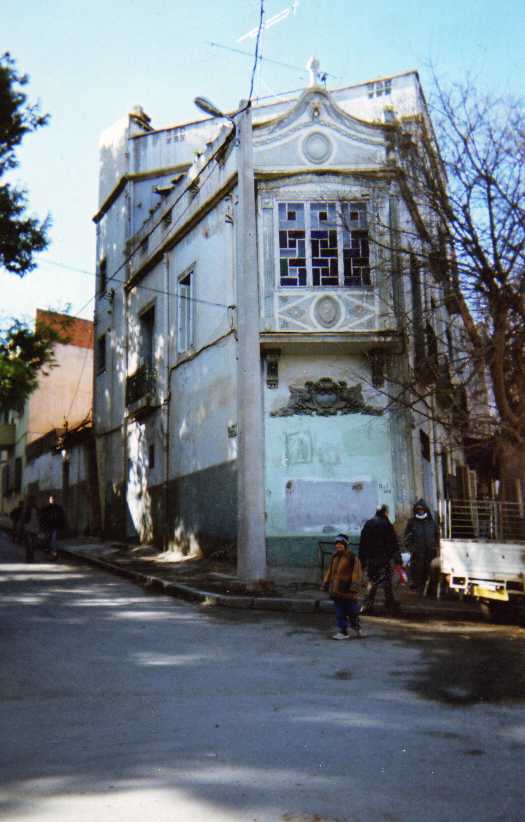
Dar El Melhaoui in Oujda, center of the Oujda leadership
Their growing sense of the danger that his positions represented to
all these plans and plots rested on two realities:
The increase in his revolutionary standing and the growth of his fame
among all the mujahideen and militants, and even among the population as
a whole. Wherever he went and wherever he stayed, he occupied a place of
importance and enjoyed prestige because of his successive successes in
operations in which he led the mujahideen against the colonial army.
His confrontation with them as a leadership established in Oujda and
his constant demand that they enter the land of the Revolution and
combat. It is known that “Ogb-Ellil” was the only one among the
revolutionary leaders of the region and among all the sector commanders
of the time to oppose this group and insist that it participate
effectively in the Revolution, where the wadis and mountains of Algeria
sheltered it, and not through this illusory participation from Oujda,
where their lives were dominated by debauchery, idleness and the
squandering of the Revolution’s funds.
It can be said in this connection that “Ogb-Ellil’s” opposition to
the leadership of this group reached such a level of tension and
severity that he no longer maintained any direct relationship with it.
In his eyes, this group had become a source of suspicion and a center of
laxity and manipulation of the Revolution and its principles. Its
shameful actions and, at times, its obscure positions harmed the morale
of the mujahideen and had a negative influence on the ardor of their
revolutionary enthusiasm. This tension increased further, especially
after two obscure incidents:
The first incident concerns the collective killing of a group of
young men from Tlemcen under60 obscure circumstances.
Until shortly before, they had been militants in the “Movement for the
Triumph of Democratic Liberties,” then “Ogb-Ellil” recruited them into
the ranks of the Revolution. Since they possessed a certain level of
education and training, they were sent to the Oujda leadership so that
it could consider how to integrate them into one of the structures of
the Revolution. But that leadership decided to kill them all, for
reasons that remain unknown.
The second incident was the letter that “Boussouf” sent to
“Ogb-Ellil” through liaison agents in April 1956. Its content called on
him to cease and definitively halt military and revolutionary operations
against the enemy army. He wrote to him that the leadership, then
established in Oujda, had decided to assume complete supervision of this
type of operation itself: its planning and preparation, up to
determining the place and time, that is, fixing in advance the location
and date of every revolutionary operation.
Naturally, the inevitable consequence of such obscure decisions – as
“Ogb-Ellil” understood them – was that the revolutionary organizations
in the field, that is the sector system, would find themselves in a
position of waiting and watching for orders that would reach them from
time to time. From then on, sector commanders and mujahideen in general,
inside the national territory, would have nothing left to do but remain
in their positions and wait for orders and directives coming from Oujda.
Although such a message was undoubtedly received by all sector
commanders – and constituted a first test of their willingness to submit
and bow before the Oujda leadership – they raised no objection or
noteworthy reaction, even though such orders contradicted the reality of
guerrilla warfare. “Ogb-Ellil,” on the contrary, became deeply angry and
rejected these instructions entirely. He saw in them the expression of
base designs and a tendency toward conspiracy and blows in the back,
especially the desire to impose as a fait accompli an Oujda leadership
that had organized its circumstances so as to remain removed from all
the dangers of the Revolution. He also understood, before others, the
paths of betrayal and the dangerous consequences that could result, and
which were perhaps precisely what was sought by the measures set out in
Boussouf’s letter. All the more so because “Ogb-Ellil” had long harbored
suspicions that certain secret communications were being sent from Oujda
by “radio” and reaching, either by mistake or intentionally, the
colonial post located at Sidi Moudjahid. All 61of
this drove him to reply in a letter addressed to “Abdelhafid Boussouf,”
severe in tone and harsh in its terms. In substance, it said in
particular: “… If you want to plan operations against the enemy army
and then determine how they are to be carried out, at the time and place
you want, then all that remains for you is to come to the battlefield
and lead them yourself, instead of withdrawing to Oujda and immersing
yourself in plots… As for me and the mujahideen, we live on the
battlefield and know better which revolutionary operations should be
carried out against the enemy army and which ones suit the
situation…”
It was with this clarity and firm position that “Ogb-Ellil”
confronted the Oujda leadership. From that moment onward, it no longer
hesitated to prepare intrigues and devise plot after plot in order to
assassinate him. His revolutionary positions were now causing it a great
deal of embarrassment and difficulty, especially because he continued to
demand that it enter and remain on the land of the Revolution, where the
battle of liberation was taking place. This matter grew and reached the
ears of people near and far, becoming at the same time a source of
awakening of the conscience of all the mujahideen in the different
sectors concerning the reality of their failure and flight abroad.
In the way it dealt with the demands of “Ogb-Ellil,” this leadership
sometimes resorted to obscure and tortuous behavior, and at other times
to base methods laden with betrayal, consisting of trying to isolate him
and ceasing to supply his soldiers with weapons and military
equipment, then attempting to kill him. His reaction to these plots –
as is known – was one of great revolutionary firmness. He began by
refusing to hand over to them the funds of the Revolution, which were
collected through contributions in different ways. On the other 62hand, he established a highly
effective secret network charged with bringing military equipment
through the Moroccan city of Nador. He himself went to this city several
times for this purpose, where he made contact 63with clandestine individuals
connected to this network. From time to time it began transferring to
the internal front, within the structures of the “fifth sector,”
substantial quantities of equipment and means of war.
In addition to all this, the Oujda leadership attempted to
assassinate “Ogb-Ellil” directly when it assigned one of its elements to
this64 mission. The man lay in wait for
him and fired at him as he was about to leave “Lesto” hospital in Oujda
at the beginning of August 1956, but failed to hit him. This
revolutionary man was accustomed to visiting Algerian patients and
wounded mujahideen in this hospital whenever he came to the city for one
reason or another. He was known for often providing them with whatever
they needed – clothing, money and other things. This was one of his good
qualities, while the leadership of the Oujda group took no interest in
their fate despite being permanently established in the city. After all
these events marked by betrayal, intrigues and blows in the back, for
which Boussouf and Boumediene had mobilized all the elements of
intelligence and secret police – this police apparatus established by
Boussouf in Oujda whose mission, as is known, was limited to abductions,
killings, terror and threats against any officer or leader of the
Revolution who dared to criticize the Oujda leadership, refuse to follow
it or submit to its decisions – after all these events, I say, and
despite the use of all these terrorist means under the cover of applying
revolutionary legitimacy from Oujda, located beyond the Algerian borders
far from the field of the Revolution where “revolutionary legitimacy”
truly existed, they still did not succeed in assassinating “Ogb-Ellil.”
The man was among those revolutionary heroes whom it was difficult to
confront directly. They therefore had no choice left but to resort to
the deception of summoning him to the supposed “meeting,” under the
supervision and guarantee of Si “Tayeb El Watani,” that is Mohamed
Boudiaf. It is known that the preparation of this plot was based
essentially on a secret letter that “Ogb-Ellil” had sent, in the midst
of these events, directly to the national leadership of the Revolution,
which had become known as the Coordination and Execution Committee.
Since “Mohamed Boudiaf” was then in Morocco, he received this letter,
which described the deteriorated state of the Revolution in the western
border region, criticized the Oujda leadership, its authoritarianism and
its persistence in remaining in that city, as well as its squandering of
the Revolution’s funds on private matters. It also pointed to certain
crimes of abduction, mistreatment and killing that had affected many
militants in obscure circumstances. The essential point is that
“Ogb-Ellil” requested in this letter that a meeting be held under the
supervision of a member of the national leadership of the Revolution and
in the presence of all parties. He hoped there to confront the Oujda
leadership, expose its plots and its obscure and tortuous behavior and,
before anything else, make it reverse its position and compel it to join
the Revolution inside Algeria. He explained that this abnormal situation
now represented a danger to the progress of the Revolution in this
region of the country, especially the orientations and practices of the
intelligence system established by “Boussouf,” whose essential basis did
not consist in fighting and pursuing colonialism but in pursuing other
objectives: carrying out plots, fabricating betrayal and manufacturing
accusations by base means in order to eliminate anyone tempted to oppose
the Oujda leadership or confront it on one question or another.
What perhaps raises the greatest questions in this entire matter is
that “Boudiaf’s” position and reaction to this issue were not equal to
his national revolutionary responsibility in terms of integrity,
clear-sightedness and assumption of responsibility. Instead of adhering
to sincerity and honesty in dealing with the causes of these conflicts
and disagreements, whatever their nature and intensity, he allowed
himself from the first moment to be carried away by extreme subjectivity
and placed himself as a party to and partisan in the conflict, instead
of remaining, by virtue of his responsibility, neutral and upright. This
position may perhaps have formed in him from his feeling that such
criticisms contained in “Ogb-Ellil’s” letter could, in one way or
another, also apply to him. Reality confirmed that his ambitions and
appetites did not differ from those of the Oujda leadership, especially
the unbridled desire to occupy by any means the first exclusive
positions in the system of the Revolution, despite his frequent
affirmation – like everyone else – of the slogan of collective
leadership. Or perhaps his position was merely the expression of a
detestable regionalist tendency that had long65
nourished and concealed behind it most of the conflicts and plots
erupting among the various leading elements within the revolutionary
systems, and which also remained present in the system of power after
the Revolution. Or perhaps he was driven by his desire to obtain the
backing and support of the Oujda group, especially through “Boussouf”
and his standing, against his enemies and competitors at the levels of
responsibility, such as Ahmed Ben Bella, Abane Ramdane and others, even
if this had to involve participation and implication in a plot that led
to an odious crime against a hero of the Revolution whose strength of
resistance and courage the colonial army itself had attested to, and
whom it had failed to reach despite the number of confrontations and the
violence of the battles.
It was therefore in this hideous manner and by this method of
betrayal that “Boudiaf” dealt with this matter. He hastened to contact
the Oujda leadership and informed it of the content of the letter. They
then all agreed to prepare the plot to assassinate “Ogb-Ellil” and get
rid of him. Its stages were, first, to let him know that “Boudiaf” and
the Oujda leadership agreed to hold the “meeting” he had requested and
wanted; second, to transform this apparent “meeting” into a sham trial;
and finally, to lead events toward assassination in the presence and
under the witness of many leading elements of the Revolution.
All of this was organized in a context of conspiracy to which the
saying of Imam Ali applies: “A truth by which falsehood is intended.”
Thus “Ogb-Ellil” was deceived and accepted this meeting-plot. They took
extreme care that everything be organized and take place in a natural,
familiar and expected setting, so as to arouse no doubt or suspicion.
“Si Mabrouk” took particular care that the stages of this trap be
designed and carried out according to extremely precise procedures. He
was unrivaled in experience and skill in preparing and conducting plots,
especially since he knew perfectly the nature of “Ogb-Ellil,” his
courage and the violence of his reactions.
It was precisely for this reason, so as not to arouse any suspicion
in him, that they fixed the meeting place in the house belonging to one
of his dearest and most loyal friends, “Abderrahmane Belkhadim.” He was
a militant who possessed support and standing in revolutionary activity,
to the point that he was the first militant whom “Ogb-Ellil” visited and
met each time he came to Oujda. This bears witness to the strength of
the bond that united the two men.
House of Abderrahim Belkhadim, where the plot was prepared;
photograph taken after the reconstruction of this house
This was therefore the first deception that reassured him about the
place to which they had drawn him. It must, however, be noted here that
it is established that after being informed of the place and date of the
supposed “meeting” – in mid-August 1956, only a few days after his
arrival in Oujda following the wounds and burns received during the
Battle of “Aïn El Ban,” as indicated previously – “Ogb-Ellil”
immediately contacted, through the liaison system, his military deputy
“El Wahrani Ahmed.” The latter was then in the “Moutas” region. He asked
him to join him immediately and to bring with him the young mujahid “Ben
Bilal Ali.” When they arrived in Oujda, they found him 66waiting for them in the house of the
militant “Khalil Mohamed,” in the presence of the latter and another
person. After asking his military deputy about the situation on the
battlefield, he introduced the person who was with them, saying: “…
This man is a Moroccan officer. He is here to help, and we need him for
certain matters…” I think he was alluding to the question of
assistance in bringing in weapons and military equipment. A short time
later, when only “Ogb-Ellil,” El Wahrani Ahmed and Khalil Mohamed
remained there, he pulled a large suitcase from under the bed on which
he was sitting, then opened it so that everyone could see that it was
filled with money. He then said, word for word: “… This money belongs
to the Algerian people. No one knows of its existence except God and the
three of us. Since I am going in a moment to a meeting with Si Tayeb El
Watani (Mohamed Boudiaf), if something happens and I do not return, this
money, which is the deposit of the Algerian people, will remain under
your responsibility… 67”
Through this clear attitude and from the allusions and intentions of
these words by which he gave his recommendations to his companions, it
appears clearly that “Ogb-Ellil” harbored a certain doubt within himself
and inwardly sensed the existence of deception in this “meeting.” The
reason may have been his experience with these men and what he knew of
their plots and betrayals. Despite all this, “Ogb-Ellil” went to attend
this meeting-plot without hesitation or retreat. This is one of the
striking – and fatal – characteristics of all heroes, men of courage and
boldness: they may experience a powerful feeling and an inner intuition
that there is deception or betrayal in what they are approaching, and
yet they neither turn back nor withdraw. It is known that he took with
him his companion in jihad “Bekhti Abderrazak,” who no longer left his
side, especially in the final months and whatever the circumstances. No
sooner had he taken the first steps to enter than a surprise attack fell
upon him. Elements of the intelligence organization emerged from every
direction. This was a group formed and trained by “Boussouf” in Oujda to
carry out such base actions. Naturally, they left him no possibility of
defending himself. Their priority in this surprise attack was
undoubtedly to seize his weapon, which he was always accustomed to
hiding beneath his djellaba, something they knew perfectly well. Despite
this, he managed to throw himself on one member of the group and almost
strangled him to death, had blows not struck him from behind and then
from every side. The blows were violent and hard on his shoulders and
head, and he finally fell unconscious. In the midst of this
confrontation, his companion “Abderrazak” had managed to draw his pistol
and kill one of the attackers before they threw themselves savagely on
him from every side. When they succeeded in overpowering him, they tied
him from behind, binding his hands to his feet, while they placed
“Ogb-Ellil,” still unconscious, on a chair and tied him with a rope
wound all around him from his feet to his neck.
Thus, in this manner that reached the extreme degree of betrayal,
began the “meeting” that had come to be presided over by “Si Tayeb El
Watani” and whose plot had been conceived and directed by “Si Mabrouk”
and “Boumediene.” A group of men of the Revolution in western Algeria
took part in the staging of this scene or witnessed it.
After overpowering “Ogb-Ellil,” they carried him in this state, while
his blood was still flowing, to the place where everyone was waiting.
Those present who knew nothing of the intrigues and threads of the plot
were surprised and stunned by the scene, while those who had planned and
conspired breathed a sigh of relief. In order to leave no room for
anyone to take the initiative by asking questions or demanding
explanations, they hurried, without restraint and without preamble, to
accuse him of a series of charges and lies based on fabrication and
falsehood, then began asking him question after question. Their
intention was to make everyone understand that they were not there
merely to attend a meeting intended to examine disagreements within an
important gathering of the leaderships of the Revolution in western
Algeria, as they had imagined or expected, but that their presence
amounted to participation in a fabricated and falsified trial.
According to the testimony of the mujahid “Chenouf Mohamed,” 68commander of the second sector and
present during this plot, everything had been prepared and planned
without the knowledge of all those present. “Boussouf” and “Boumediene”
began asking him questions that had no relation or connection to the
subject of the “meeting” as those present had understood it, namely
resolving the conflict between the two parties and clarifying certain
positions concerning armament and the use of the Revolution’s funds.
The questions included the following: why did “Ogb-Ellil” not
recognize and obey the orders of their leadership, the Oujda leadership?
Why had he stopped handing over to them the funds of the Revolution that
he collected within the framework of his responsibility for the fifth
sector? What was he doing when he went to Nador? Had he met “Ahmed Ben
Bella” there? How had one of his groups of mujahideen killed
such-and-such a harki without referring to their leadership? And why did
he call Si Mabrouk, its principal official, a “blind dog”?
After finishing these questions, “Boussouf” turned to the mujahid
“Ahmed El Wahrani,” who 69was the military deputy
in the organization of the fifth sector as indicated previously, and
said to him: “You worked with El Mokhtar (Ogb-Ellil). What do you think
of him?” His intention was to lead him to give testimony against his
commander. He merely replied, in a state of great confusion: “… You
all know very well who El Mokhtar is; you know his courage and his
actions against colonialism… All the mujahideen bear witness to his
courage and heroism… What more could I say?…”
“Boussouf” then cut him off sharply, saying: “… Yes, we know all
that, and we also know that he used to fill his pockets with sweets and
then distribute them to you like children…”70
“Ogb-Ellil” remained silent throughout this “meeting,” this plot,
because he was almost unconscious and his condition had deteriorated
severely under the effect of the deadly blows he had received. Despite
this, at one point everyone heard him say that he did not recognize this
leadership established in the city of Oujda and that he would not speak
about anything before this gang except in the presence of “Larbi Ben
M’hidi.” Then he directed his gaze toward “Boudiaf,” who had asked him
why he had described “Boussouf” in that way, and said to him: “You must
ask him that question; he knows very well why!”
With these few words, he showed everyone his position, his refusal to
recognize this leadership, and his indifference to their claims and
fabricated lies.
Following these words, some voices began to rise here and there. They
all converged on the same position: this disagreement and conflict
should be settled by transferring Si Mokhtar (Ogb-Ellil) to another
region, for example to the South (the Sahara region). This idea had
already circulated among them even before this plot was prepared. The
Oujda gang often proposed it to him whenever he insisted that they had
to join the Revolution inside Algeria.
Faced with this confusion, which signaled a dispersal of opinions and
divisions among those present and was thus beginning to take the course
of events away from what had been prepared and planned behind this
suspicious gathering, “Houari Boumediene” could not contain himself. He
stood up, highly nervous, and insisted to everyone that there was no
possibility of agreement. He immediately took out a blank sheet of paper
and began 71passing it from one person to
another at great speed, ordering each to write his name and then sign.
The sheet thus circulated among all those present even though the
purpose or reason for the signature had not yet been stated on it. It
should be pointed out that, among those present, only one man, “Si
Bousseif,” commander of the third sector, had the ability and courage to
announce his refusal and refrain from signing. When Boumediene presented
the sheet to him, he said: “… Get away from me, you and your sheet. I
will not take part in this farce… and I will not involve myself in
this plot aimed at killing a hero of the Revolution. I am innocent of
all this…”
At that moment, “Ogb-Ellil” once again drew everyone’s attention by
uttering his final words: “… I have understood what you want, you
people…”
He then proposed something that no one had thought of and that
surprised them all: he asked to be transferred to the border zone where
there was a colonial army post that he knew well, near the “Lafil” farm.
He wanted to attack it, kill as many enemy elements as he could, and
then fall as a martyr in the manner of courageous heroes. This was the
goal he had always sought and asked for in all his battles against the
enemy. Everyone was stunned and exchanged looks. At that moment Houari
Boumediene stood up a second time and said: “… He must not be allowed
to do what he wants… We cannot trust him under any circumstances; you
all know how dangerous this man is… 72”
Thus, “Ogb-Ellil,” in the final moments of his life, expressed his
heroic revolutionary position and his readiness to sacrifice himself in
any way for Algeria. For its part, the Oujda leadership expressed its
true conspiratorial nature and its blind desire to take revenge on a
revolutionary hero who had placed it in an extremely embarrassing
situation by pursuing it and calling on it to enter Algeria, land of the
Revolution and battle, instead of fleeing and hiding like children and
women in the houses of Oujda.
He was killed by strangulation while in the same state and position,
tied to the chair, by the man known as “Bouchkour” and his group,
members of the execution unit belonging to “Boussouf.” Although in his
final position he had asked to be buried on Algerian territory, these
criminal terrorists merely threw his body and that of “Abdelrazak
Bakhti,” whom they had killed in the same way, on the border strip near
the Lafil farm (ferma). They savagely mutilated the two bodies so that
no one could identify them. A few days later, a Moroccan citizen living
in the “Halanqad” region discovered the two bodies and buried them at
the same place.
After the execution of this odious crime, through deception and
betrayal, against a valiant revolutionary hero whom the colonial army
had long tried in vain to reach and who, from the beginning, had offered
his own person, the members of his family one by one and all the men of
his clan as sacrifices for the liberation of the Algerian people; and
then against another valiant hero (Bakhti Abdelrazak), who was among the
youngest mujahideen to join the Algerian Revolution at an early age and
fought the colonial army in several battles; immediately afterward, the
intelligence services and men of “Boussouf” began to move and spread
among the people, militants and all the mujahideen various forms of
propaganda and various lies in order to conceal the reality of the plot.
They then undertook, through intimidation and threats, to push people to
believe them and then spread them. The group of conspirators knew this
revolutionary man’s standing and his influence among militants and
mujahideen. They were certain that the slightest leak of information
about this plot would provoke general reactions among the mujahideen
whose course would be difficult to control. Among the propaganda and
lies they spread insistently was the claim that “Ogb-Ellil” had asked
the leadership to transfer him to the Sahara region, that he had
obtained this transfer and that he had taken his companion “Bakhti
Abdelrazak” with him. To reinforce this propaganda and make people
believe it,73 they wrote in his name a forged
letter that they sent to his brother. They perfected the falsification
of this letter, which announced his transfer to the Sahara. It even
claimed that he had written it in haste while on his way to his new
command. They took particular care to mention in it certain hadiths and
Quranic verses that he was accustomed to citing before the mujahideen in
certain situations and on certain occasions. Nor did the conspirators
forget to repeat in this forged letter the beautiful phrase he so often
said to the mujahideen when they thought of their children in difficult
moments: “On the first day, we did not make a commitment to our
children; we committed ourselves to the Algerian people in order to
liberate them.”
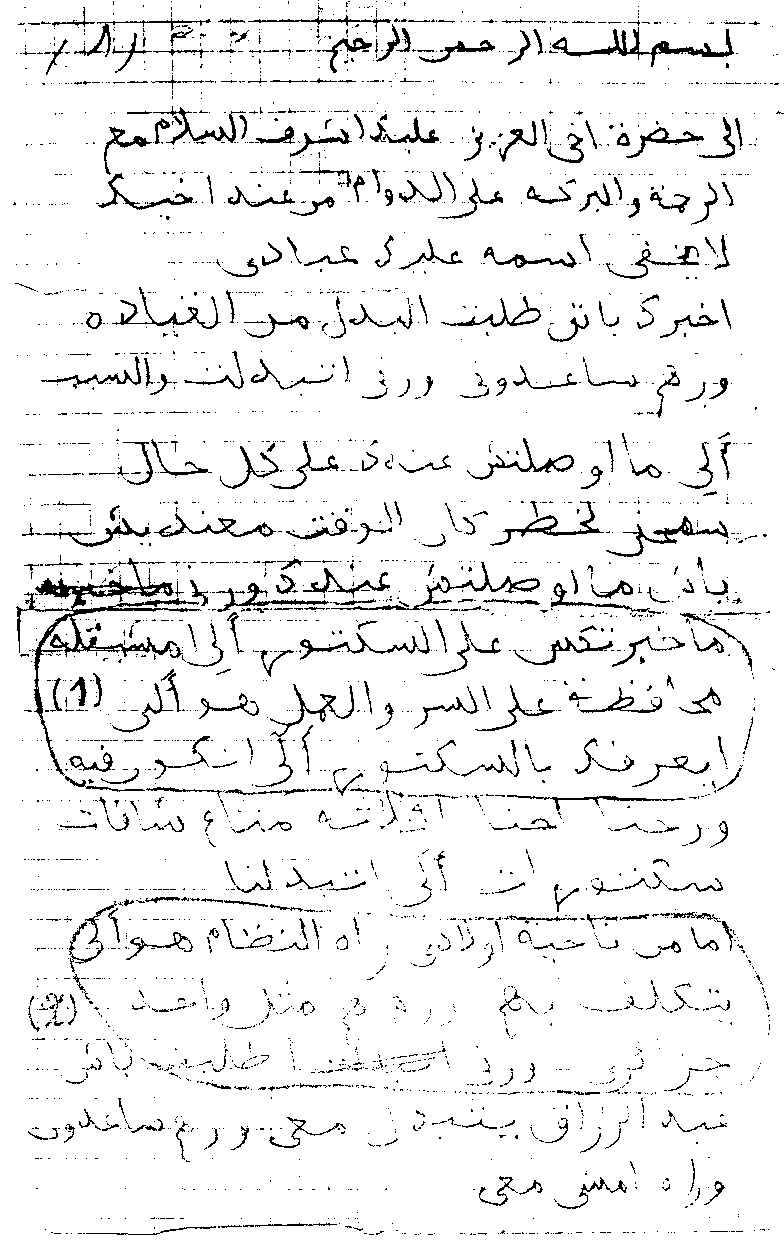
First page of the forged letter
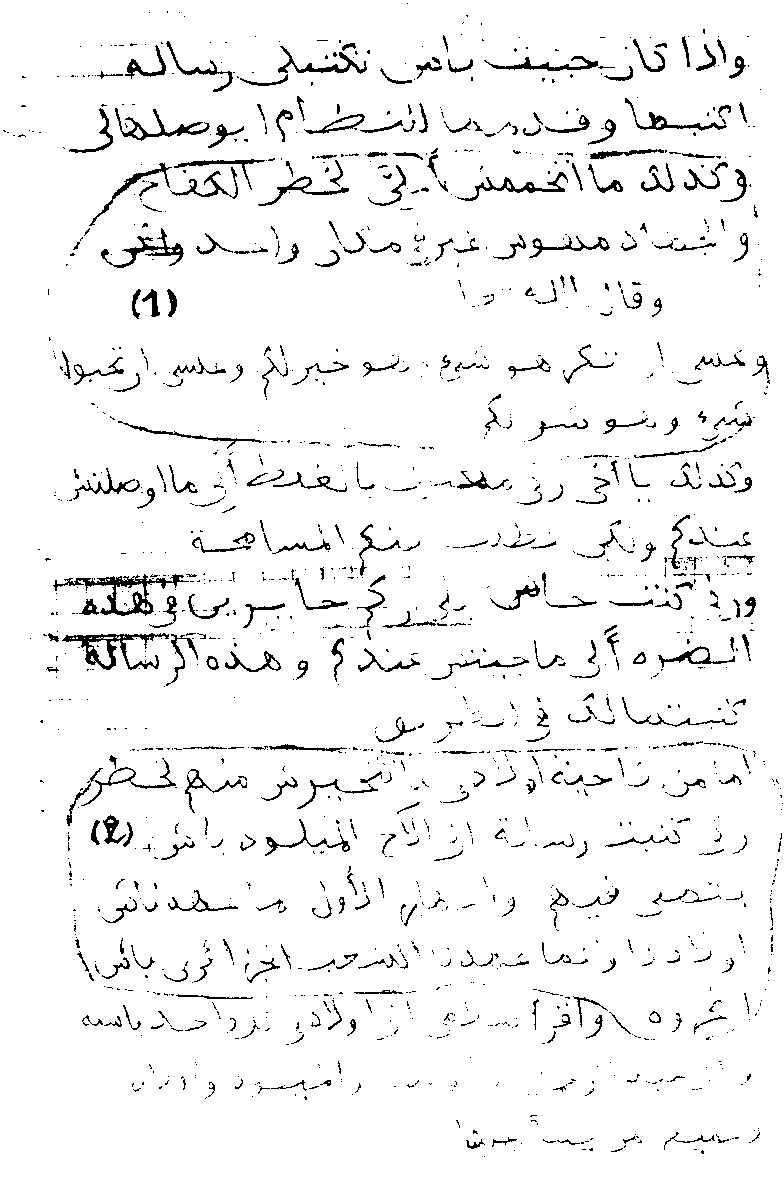
Second page of the forged letter
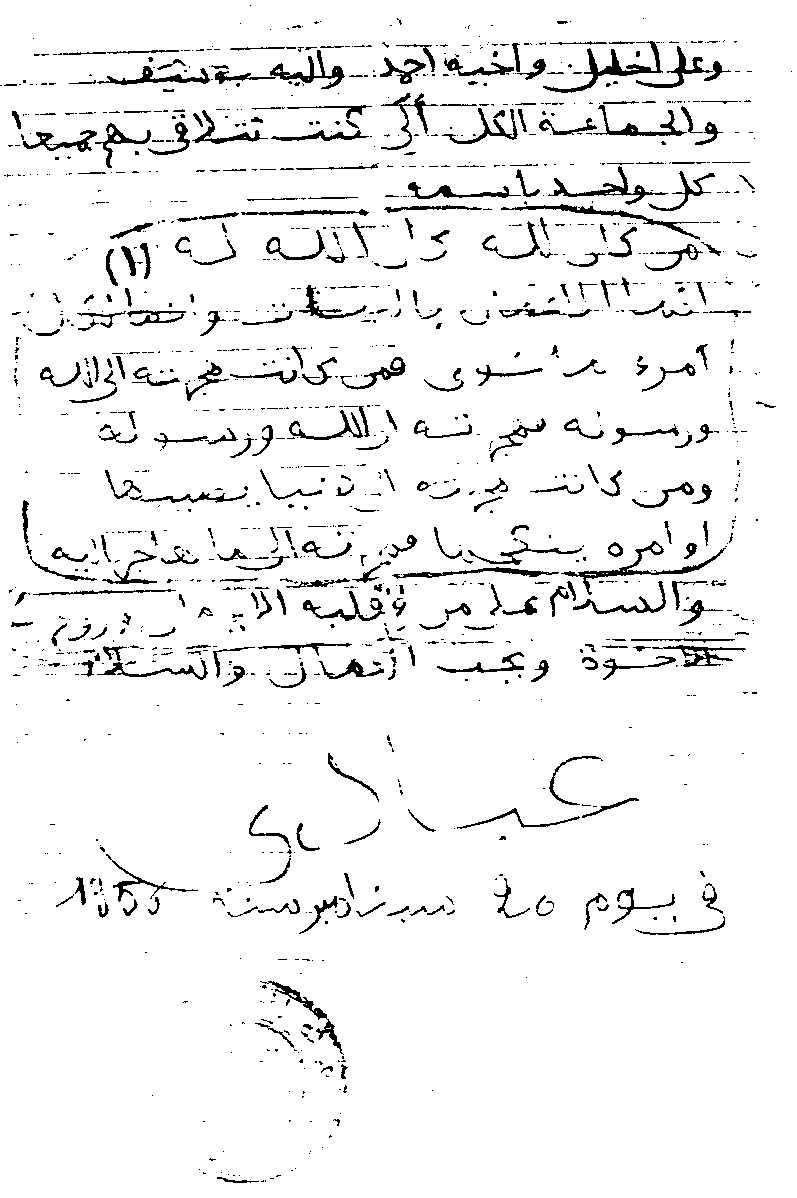
Third page of the forged letter
The forged letter transposed from the dialect into
Arabic
“In the name of God, the Compassionate, the Merciful”
To my dear brother, may the most honorable greetings be upon you,
with mercy and blessing always, from your brother whose name you know:
“Abbadi.”74
I inform you that I asked the leadership to replace me and that they
agreed. I have indeed been transferred and I could not come to you
because I did not have time; I therefore ask you to forgive me.
I have not told you the sector to which I have gone in order to
preserve secrecy; action will make it known to you. Three of us sector
commanders have been transferred. As for my children, the organization
will take care of them; they are like every Algerian.
I asked for Abdelrazak to be transferred with me75;
they agreed and he left with me.
If you wish to write to me, write the letter and hand it to the
organization; it will get it to me. Do not worry about that, because
struggle and jihad do not take place in only one place. God, Most High,
said: “It may be that you dislike a thing while it is good for you, and
it may be that you love a thing while it is bad for you…”
I ask your forgiveness, my brother, for not having seen you before my
departure. I sense how perplexed you are that you did not see me come to
you this time. I wrote you this letter while I was on the road.
As for my children, do not worry about them. I wrote a letter to
brother “Miloud” asking him to look after them. On the first day, we did
not make a commitment to our children; we made a commitment to the
Algerian people in order to liberate them.
Convey my greetings to my children, each by name, to Abderrahmane and
his children, to Miloud and his children, as well as to all those who
ask about us; to “Khalil” and his brother Ahmed, to Bousseif, and to all
the members of the group whom you used to meet, each by name.
He who belongs to God, God is with him… Actions are judged only by
intentions, and each person shall have only what he intended. He whose
emigration is toward God and His Messenger, his emigration is toward God
and His Messenger; and he whose emigration is toward a worldly good he
obtains, or toward a woman he marries, his emigration is toward that for
which he emigrated.
And peace be upon the one whose heart bears faith and the spirit of
brotherhood, and who loves good deeds. Peace.
“Abbadi, 20 September 1956”
This hysteria of lies intended to conceal the plot did not stop
there. On several occasions, they began introducing among the people
individuals who falsely and deceitfully claimed to have seen “Ogb-Ellil”
with their own eyes, or to have met him here or there. At the same time,
alongside all this, they began pursuing and tracking many of his
militants, especially those who had ties of struggle or close relations
with him. Some were subjected to terror, others mistreated, others
killed; some yielded to the fait accompli and joined their group out of
fear or for a reason of their own. More seriously, after its heinous
crime, the Oujda group became so unsettled that it forbade anyone,
whatever the reason, from uttering the name “Ogb-Ellil” or Si Mokhtar
under any circumstances. To that end, they spied on the militants and
the mujahideen and terrorized them in the most intense manner.
As for his soldiers in the Fifth Sector, after the failure of the
mission of the new chief appointed by the Oujda group to replace him,
Bouaizem Mokhtar, known as “Nasser,” who met with strong rejection and
was unable to remain in their area for more than a month, the Oujda
leadership then resorted to transferring and dispersing them—whether
officers, mujahideen, or militants—among the different sectors and
regions. It should be noted here that the overwhelming majority of these
mujahideen fell as martyrs in their battles against the enemy army. Some
carried out recognized heroic deeds, such as Si Abdelhamid Bouzidi,
Ahmed El Hadj, Maarouf Abdelrazak, Zeitouni, and others who were no
doubt numerous.
It can be said after this that the personality of “Ogb-Ellil,” or Si
Mokhtar, nevertheless remained alive among the people throughout the
years of the Revolution and then after the Revolution. Everyone
continued to wonder and seek to learn something about the secrets of his
mysterious and unknown disappearance. From then on, various stories and
accounts were woven around him, most of them created by the people or
born of the imagination. This was all the more so because the Oujda
leadership spared no effort to hide the truth and conceal the plot and
the crime. His personality thus became something resembling a popular
legend. 76Women sang about him, children were
given his name, and adults passed his story on to the young. Thus this
revolutionary personality was destined to endure, and the name El
Mokhtar or “Ogb-Ellil” continued to be mentioned over the long years,
despite the determination of the Oujda leadership, particularly
“Boussouf” and “Boumediene,” to erase the heroic deeds and sacrifices of
this authentic revolutionary whose worth was recognized by enemies
before friends. The colonial army recognized his importance from the
beginning of the Liberation Revolution. He also remained a symbol and a
subject of conversation among the people, the militants, and the
mujahideen for his courage and bravery, during the Revolution as well as
in the period of independence. Then came the turn of the official
authorities to recognize him, but only after decades. Under the
presidency of Chadli Bendjedid, in 1985, he was rehabilitated and his
revolutionary standing was recognized. His remains and those of his
companion, the martyr Bakhti Abdelrazak, were transferred and reburied
in El Alia Cemetery in Algiers, pursuant to a presidential decree
ordering the reburial of all officers and leaders of the Liberation
Revolution who had fallen as martyrs in circumstances of “plots and
betrayal.” More than that, this symbolic martyr received renewed
tribute, honor, and distinction when Mr. Abdelaziz Bouteflika, President
of the Republic, saluted and praised his remarkable revolutionary
personality in the course of his address to the Algerian public from the
city of Tlemcen in 1999. At the same time, he awarded him the Athir
Medal of the National Order of Merit, pursuant to Presidential Decree
No. 99-136, dated
4 July 1999.
At the time when “Ogb-Ellil” was waging a continuous battle on the
field of the Revolution, surrounded by every danger, and working to
consolidate the Liberation Revolution in the region for which he was
responsible, using all the means available to the mujahideen, so that
his army scarcely finished one clash before beginning another, the
conspirators—those who had fled to the rear lines to devote themselves
to the project of power and government, their real and true project
which they had brought with them and adopted in an obscure manner since
the outbreak of the Liberation Revolution—instead of taking part in the
Revolution with the mujahideen and confronting its dangers and terrors,
were, I say, on Moroccan soil preparing and arranging the vilest methods
of betrayal and treachery and weaving the threads of an ignoble plot.
For this, as is known, they resorted to methods of extreme cunning and
great perfidy which even the colonial army had been unable to employ,
although “Ogb-Ellil” had become for it the most dangerous man and the
most wanted, dead or alive, at any price. There is nothing surprising in
this: this rebellious rural man had become a target and a common enemy
of both sides—the colonial army and the Oujda leadership. Just as he
confronted the colonial army and inflicted loss after loss upon it, he
also confronted and denounced the Oujda leadership after its flight and
settlement in the land of exile, far from the field of the Revolution
and combat.
Mohamed Boudiaf
During the national movement, this man was known for his political
participation in the ranks of the Algerian People’s Party, and later in
the Movement for the Triumph of Democratic Liberties. In particular, he
figured prominently in the dissension and political conflict that led to
the collapse of the latter party. On the other hand, he was accused of
having been chiefly responsible for the discovery by the colonial
police, in the Constantine region in 1950, of the cells of the
clandestine Special Organization that were preparing armed resistance
within the structures of the People’s Party. This led to the death and
arrest of some members of that clandestine organization. Mr. Abdelhamid
Mehri, Secretary-General of the National Liberation Front party,
confronted him with this fact—as is known—during a confrontation
organized by Algerian television in 1992.
He contributed to the founding of the Revolutionary Committee of
Unity and Action, then to the birth of the National Liberation Front and
the outbreak of the Liberation Revolution in 1954. In addition, he held
leadership positions in the Liberation Revolution as a member of the
National Council of the Algerian Revolution in 1956, then as a member of
the Coordination and Executive Committee, then as Minister of State in
the Provisional Government, before later becoming its
Vice-President.
Immediately after independence, he took part, with those who engaged
in it, in a fierce struggle to seize power. He had no success in this
regard. The Oujda group, alongside the Tunis group, dominated the arena
of conflict. As a result, in 1963 he founded his party, which he called
the Party of the Socialist Revolution, with the great hope of thereby
obtaining the support and backing of the Communist International. But
for some time it had already chosen to support and strengthen one of its
own, more believing in its principles and more enthusiastic: “Houari
Boumediene.” By founding this party, he declared his opposition to the
existing regime and its men. Shortly thereafter, he went abroad, having
become convinced that he had become a target for assassination and
liquidation by the same elements with whom he had long participated or
become involved in assassination plots during the Liberation Revolution.
The regime of the time did not hesitate to sentence him to death in
absentia in 1964.
After a period spent moving between France and Morocco, he settled in
the Moroccan city of Kenitra. That city, despite its small size, at the
time attracted various elements of international intelligence services.
Mohamed Boudiaf was brought to Algeria in 1992 after being enticed by
the realization of the dream that had accompanied him since the time of
the national movement: to hold the position of first man of the regime.
This was achieved after a long period, but only for a short time, while
Algeria was reeling under three evils: a political system produced by
military power and a sterile and detestable intelligence apparatus, a
detestable military regime; a barbaric religious extremism clothed in
the garb of medieval Christianity; and the domination of an
administration of Francized people, heirs to the legacy of the defunct
colonial order. After taking power in Algeria under these turbulent and
obscure circumstances, he found no important decision with which to
begin his rule other than his suspect decision to freeze the
implementation of the law on the Arabic language. This decision opened
wide the way—and the door remains open down to our time—for the colonial
language and its culture to spread once again over the land of the
Revolution, after they had been in their death throes and on the way to
disappearance. It was a fanatical act and behavior characteristic of the
Francophone categories, legitimate heirs to the demands of the
assimilationists—assimilation into French society and culture—during the
period of the national movement. This decision undoubtedly belied and
contradicted the name by which he had been known during the Liberation
Revolution, “Si Tayeb El Watani.” And I wonder: what nationality can a
man have who despises—hates—and scorns the language of his homeland,
whatever the weakness, backwardness, and humiliation prevailing among
its speakers?
Mohamed Boudiaf was assassinated on 29 June 1992 while standing at
the rostrum, delivering a speech in which he explained the paths of
growth and development. The whole of Algerian society witnessed this
assassination live.
Abdelhafid Boussouf
He held the position of second deputy to Larbi Ben M’hidi, while Hadj
Ben Alla was the first deputy within the leadership of the Revolution in
western Algeria, from its outbreak on 1 November 1954. He continued to
exercise leadership in the western region, moving from one border area
to another, until he made his suspect decision to transfer his
leadership to the Moroccan city of Oujda at the beginning of 1956.
There, the “Oujda group” formed around him and remained under his
direct leadership, alongside Houari Boumediene, throughout the years of
the Liberation Revolution. In the same city, he also created an
intelligence and secret-police system, as well as another clandestine
group known among the people as “Jamaat Ech-Chkara,” meaning the bag
group. This group consisted of a limited number of very well-trained
elements. They abducted their victims by a method that consisted of
putting the victim’s head into a bag (chkara), then pushing the victim
into a car to transport him to an unknown place where he would meet his
fate.
It should be noted in this connection that, in the way he organized
intelligence and the secret police, Abdelhafid Boussouf followed the
method of the Communist International leader “Trotsky” when the latter
proceeded in this way in reorganizing the Soviet Red Army, as he set out
in his book “Defense of Terrorism,” published in 1920.
He also adopted his method and imitated his approach, which
consisted—as is known—of practicing terror, fomenting plots, and
carrying out physical liquidation in order to defeat and crush
opponents, under the maxim: the end justifies the means.
Thus, this man was known not to hesitate to resort to cunning and
deception, and to do so in the greatest secrecy. For example, he used to
begin by fabricating false accusations, inventing rumors against his
adversaries and opponents. He would also take the initiative in
compiling fabricated files against them, which he kept in order to
brandish them when needed. If he made decisions to plot in an obscure
and secret manner, he implemented them only by involving and
compromising all the members of his group. He also continually spied on
the leaders of the Revolution and collected the smallest details about
their personalities and secrets, especially those who were active and
distinguished by their dynamism. For this purpose, he recruited young
elements whom he trained in intelligence work, devoid of discernment and
awareness. He made everyone believe that he acted in this way only under
constraint and driven by defense of the interests of the Revolution—from
the city of Oujda—and in accordance with what its legitimacy
required.
It is important, in this connection, to point out certain aspects of
his obscure personality and suspect behavior, as all the mujahideen knew
them when he was on the territory of the Revolution in the western
border zone, that is, before his departure for the city of Oujda. He
took the greatest care to ensure that his true personality remained
unknown and obscure, even to the closest mujahideen. None of them knew
where he came from or where he was going. He continued moving from one
place to another without settling anywhere. As for the liaison agents of
the Revolution’s organization who transported him—mounted on the back of
a mule or a donkey—not one of them knew who this man was. More than
that, he did not allow himself to spend two nights in the same place
unless it was impossible to do otherwise. He trusted no one, even among
those close to him. He appeared kind and simple and dealt with each
official of the Revolution with a different face, claiming to give him
absolute support. As he quickly understood that he could not continue
hiding his personality and concealing his reality by this tortuous
method, in this state of concealment, fear, and flight or avoidance of
dangers, without arousing suspicion and doubt around him, especially
among mujahideen endowed with discernment and revolutionary experience,
he soon found a way out that spared him the burden of this extreme
caution, affectation, and permanent anxiety: he decided to transfer his
leadership to Oujda, where he finally settled, reassured and removed
from all causes of fright and fear. That on the one hand. On the other
hand, if one considers the organizational and technical level at which
he had constituted intelligence cells within the Oujda group, a level
that reached that of international intelligence services, one can only
wonder about the source of this precise expertise in intelligence work,
the time when he acquired it, and the body that stood behind it. This
question undoubtedly becomes more pressing and more objective when one
knows that this intelligence system he created in the city of Oujda was
never—because of the terrorist nature of its organization—intended to
spy on colonialism or to handle its secret files, as one might think. On
the contrary, throughout the Liberation Revolution this system remained
directly oriented toward the fabrication of plots and assassinations
that struck a number of pioneers of the Revolution in western
Algeria.
After all this, it is perhaps also important to point out that this
man, despite his leadership position in the Revolution in western
Algeria and later at the level of the Revolution nationally,
nevertheless had neither confidence nor trust in his organizations or
his men. This is confirmed by the fact that, at the end of the
Revolution—as he himself told me shortly before his death—he transferred
his personal file concerning the Liberation Revolution from Oujda
abroad. He deposited it in his own name in a bank in Italy. This file
contains the accounts of assassinations whose events he had fabricated
and whose plots he had organized as he wished and planned, without
anyone challenging him or calling him to account. There is nothing
surprising in that: he had implicated all the members of the Oujda
leadership in them. In my view, this file still remains buried where it
is, in the depths of oblivion.
From this, it can be said that this obscure and suspect behavior may
also suggest that the man had deposited in his own personal name a
“quantity” of the Revolution’s funds in the same Italian bank. Perhaps
these were the same funds he began investing during the first years
after independence, both in Algeria and abroad, despite his assertion
and insistence that he had created these projects and investments only
with special assistance received from some of his wealthy friends in
Arab governments.77
Who, then, could this man have been, who calmly entrusted to a
foreign bank the secrets of the Liberation Revolution, though they were
of the utmost gravity, instead of resorting to the organizations and
apparatuses of the Revolution, which were many and varied? And what
could his true personality have been, especially if one knows that,
during the final months before his death in 1979, he devoted himself
entirely to preparing a precise and detailed study of the general
situation of the Algerian people as it prevailed at that time: a
situation of social, economic, and political decline. According to his
hypothesis, these were the same general conditions that prevailed on the
eve of French colonization in 1830 and that were the cause of the
weakness of the Algerian people and their falling prey to colonialism.
To my knowledge, the subject falls as much within the competence and
interest of academic scientific research and studies—a field with which
this man had no connection and to which he did not belong—as it also
lies at the heart of the competence of advanced international
intelligence services. These services resort to carrying out such
studies, especially when the objective is to prepare and organize
radical changes or upheavals within a people, and to move them from a
troubled and degraded situation to a more extreme and lower one, so that
it then becomes easier to plan for them and direct them toward certain
situations that impose submission and absolute obedience upon them. What
intelligence body, then, had commissioned him to carry out this study
and this mission?
Houari Boumediene
He joined the Liberation Revolution in April 1955 in the western
Algerian border zone, after arriving from the Republic of Egypt with a
group of young Algerians: Chenoufi Abdelkader (who became known as “Si
Abdelkader”), Arfaoui Mohamed Salah (whose revolutionary name became “Si
Bousseif”), and Mengaoui Ali (known as “Cheikh 78Senoussi”). They all arrived aboard
the ship “Dina,” loaded with arms, which docked on a small stretch of
coast near the Moroccan city of Nador in March 1955. This operation was
supervised—as is known—and organized in Cairo by Mr. Ahmed Ben
Bella.
The leadership of the Revolution, represented by chief Larbi Ben
M’hidi and his deputy Abdelhafid Boussouf, then proceeded to appoint
these young men who had joined the Revolution as sector chiefs in
different regions of western Algeria.79
Houari Boumediene was excluded from these appointments. He soon
disappeared from view for more than a month, then reappeared in the
region. Larbi Ben M’hidi then entrusted his case to Abdelhafid Boussouf,
saying to him: “… I have not found what to do with this man… You
take care of his case…” Boussouf then hastened to appoint him general
instructor of the army. It is certain that he exercised this function on
the revolutionary field only for a short period, then quickly went with
Abdelhafid Boussouf to the city of Oujda, where their leadership
actually settled. There, he began to rise through military ranks and
responsibilities in the environment of the “Larbi Ben M’hidi” barracks
in that same city, until he reached the highest responsibility in the
army of the Liberation Revolution: Chief of Staff. It is obvious that
all these responsibilities and military ranks resulted neither from his
engagement on the field of the Revolution nor from repeated
confrontation with its dangers, nor from participation in battles and
distinction in them. It is truly remarkable that this man “reaped,” or
was covered with, all the heroic exploits of the Liberation Revolution
and then, from there, monopolized the “leadership” in the period of
independence, although he was never80 one of its true
heroes. How could he have been, when he never took part in any of its
battles and no bullet ever left his weapon in the direction of the enemy
army, despite his presence on certain occasions—before his departure for
the city of Oujda—in the surroundings of those battles and nearby?
Perhaps he took care—as some mujahideen whom I questioned on this
subject said—to confine himself solely to his responsibility as an
observer, from a safe and protected position. Naturally, he had a plan
and personal calculations in this, something that did not occur to the
fighting mujahideen when they confronted the enemy army in a spirit of
jihad filled with the spirit of national sacrifice. But, in complete
contrast to this, in another sphere—that of treachery and plots—he had a
decisive role in the killing and assassination of many true heroes of
the Revolution, whether during the Revolution, such as “Ogb-Ellil,”
Bousseif, El Yemeni, and Zoubir, or in the period of independence, such
as Khider, Krim Belkacem, Chaabani, and many others.
After independence, he held the post of Minister of National Defense
while Ahmed Ben Bella was President of the Republic. Shortly thereafter,
he carried out a military coup against him on 19 June 1965.
Surprisingly, the Algerian people continued to celebrate this military
coup as a victory added to the victories of the Liberation Revolution.
In reality, it was like the first violent shock suffered by the Algerian
people in their unity and harmony. Houari Boumediene was thus the first
to establish a political system based, first, on military power and
domination; second, on a Francophone bureaucratic administration that
inherited the methods of colonialism—repression, prohibitions,
obstacles, and impediments; and third, on the orientations and
approaches of the Communist International. Thus, this repressive
political system, which mistreated and did not hesitate even to
assassinate any opponent or anyone who disagreed with the regime in the
name of the Revolution and patriotism, led, I say, to shaking Algerian
society and causing great disturbance in its identity and cultural
personality. This system and this repressive political method, which
concealed the Communist International while displaying “Arabism and
Islam” throughout the period 1965–1978, constituted the degraded social
and psychological environment favorable to the birth and emergence of
another kind of extremism—as a reaction—namely religious extremism,
whose features, meanings, and dimensions manifested themselves in the
phenomenon of “terrorism” in 1992.
Houari Boumediene died while serving as President of the Algerian
state, following a rare cerebral accident, in 1978.
CONCLUSION — The Revolution and the Criminals of the Revolution
The criminals during the Liberation Revolution (1954–1962), who
committed the most abominable forms of terror and killing, publicly or
secretly, outside the places of combat, the field of battles and direct
clashes, and outside every human and moral consideration, formed, I say,
different and varied gangs, both in their nature and identity and in the
causes and circumstances of their crimes. Nevertheless, it can be said
that these gangs that practiced the trade of killing resembled one
another to a large extent, particularly in their barbaric and aggressive
tendency and in their methods of betrayal, intrigue, and conspiracy.
There were the soldiers and officers of the French army, then the
mercenaries, the hateful and the racists among the settlers. They
practiced terror and killing relentlessly, using the most deadly, vile,
and barbaric techniques of war. They therefore waged, with certainty, a
crusading war aimed at eliminating an entire people from history, indeed
from existence, in addition to destroying nature and burning the land
and the mountains.
There were other criminals, drawn from the group of traitors and
harkis. They were Algerians who had not contented themselves with
submitting to the colonial regime and integrating into it, but had
chosen to bind their existence and destiny to colonial France. They
began killing men, women, and children under the influence of rancor and
hatred, imbued with a spirit of vengeance and lying in wait for every
patriotic Algerian who refused to submit to the authority and power of
colonialism.
There were also criminals and killers who came from within the ranks
of the Liberation Revolution. They made their way into the Liberation
Revolution by adopting physical liquidation and assassination as a
method and course of conduct. This terrorist method remained concealed
within the events of the Revolution, hidden behind its slogans and
clothed in its principles and objectives. The project of these elements
of the leadership of the Revolution—whether as individuals or
groups—went beyond, in its aims, the Liberation Revolution and its ideal
objectives, and projected itself toward the horizons of the future,
where for them lay the true awaited objectives: the seizure of power and
the political system that would result from it when Algeria became free
and independent. This group of leaders possessed acute awareness and
took the greatest care not to venture or throw themselves directly into
the terrors of the Revolution under the mere impulse of national
sacrifice. Some of them, in western Algeria, therefore did not hesitate
to transfer their leadership to the Moroccan city of Oujda—that is, to
transfer outside the borders of the Revolution the military leadership
of the Revolution in western Algeria—and from then on devoted themselves
to fomenting intrigues and plots. For this mission and this purpose,
they established an intelligence and secret-police system, as has
already been indicated. They thus struck from behind and betrayed every
revolutionary or hero who asked them to return to the battlefield and
participate directly in the Revolution, instead of positioning
themselves outside Algeria’s borders and directing the mujahideen from
there; or who criticized and opposed their obscure and tortuous
behavior; or who tried to ask questions and inquire about the use of the
Revolution’s funds or their waste for personal purposes and interests;
or any person who denounced the actions of certain members of this
suspect leadership in the city of Oujda, or uncovered the secrets and
plans it concealed that had no connection with the requirements and
orientations of the Revolution. For all this, and for other reasons that
still remain hidden, they struck from behind and betrayed every
authentic revolutionary leader who was firm in his positions, or whose
revolutionary personality, through field work and struggle, revealed
certain traits of leadership, determination, audacity, and initiative.
These qualities constituted for them an obstacle and a direct threat,
whether to the execution of their apparent or hidden objectives in the
present or the future, or with regard to their flight, the continuation
of their concealment, and their avoidance of the terrors of the
Revolution.
It was thus, and for all these reasons, that the leadership of the
Oujda group did not hesitate to assassinate the finest men of the
Revolution and its eminent heroes in the western border zone, such as
“Ogb-Ellil,” Bousseif, El 81Yemeni, and Zoubir.82 In truth,83
each of these martyrs constituted, to varying degrees, a source of
concern for this group, particularly on matters related to monopolizing
power and the funds of the Revolution and to remaining in the city of
Oujda, as well as to revealing its secrets and plots before all the
mujahideen.
Astonishing and surprising—and, I say, a matter of cunning and
deception—this conspiratorial leadership carried out its crimes against
this elite of heroes of the Revolution, as against other men of the
Revolution who opposed it, under the cover of “the interest of the
Revolution.” This interest which, according to their lies and claims,
was absent and did not exist in the minds or actions of these
revolutionary heroes while they fought battle after battle on the ground
against the colonial enemy army, inside the land of the Revolution;
while the interest of the Revolution was present and embodied in their
own persons as they led lives of tourism and debauchery, slept soundly
each day in beds in Oujda, and woke each time safe and at peace?
From all that precedes, I conclude that there is an immense
difference between the revolution of these conspirators, who remained
concealed in the rear lines in the Moroccan city of Oujda, and the
revolution of Ogb-Ellil and the mujahideen like him: an authentic and
sincere revolution that bore within it the deepest meanings of sacrifice
to liberate the homeland from the grip of colonialism. Was it not he who
said: “How much it hurt and pained me when circumstances forced me to
spend last night in a bed in the city of Oujda. And how great is the
peace of mind I feel today as I sleep leaning on a stick in this wild
ravine on the land of Algeria. I swear by God, the Most High, that I
will never again spend a night in a bed as long as the Revolution is
under way; otherwise I will not be that man who deserves to be called
‘Ogb-Ellil.’84”
-
The martyr Bousseif is “Arafoui Mohamed Salah,” chief of
the Third Sector.↩︎ -
The mujahid “Antar” is Sahnoun Mohamed. Having become
one of the elderly mujahideen, he resides in the village of Hennaya,
wilaya of Tlemcen.↩︎ -
Zegdouna: a village situated between Hammam Bougrara and
the village of Sabra.↩︎ -
L’ECHO D’ORAN↩︎
-
To defend them.↩︎
-
Perhaps the mujahideen who knew “Boumediene” during the
Revolution and after the Revolution recognized such qualities in him.↩︎ -
This phrase was the slogan of the first generation of
heroes of the Revolution and of the mujahideen.↩︎ -
Most of them arrived at the douar “El Hsainat,” a
territory situated on the southern outskirts of Sabra. The inhabitants
of “El Hsainat” welcomed them with great enthusiasm, then distributed
them among the different families. It was one of the greatest
manifestations of solidarity that characterized Algerian society during
the Liberation Revolution.↩︎ -
These men belong to different families whose lineage all
goes back to “Sidi Bouzid”: the Ben Malek, Ben Ghlima, Essaïm, Ben Ammar
families, as well as the Bouzidi family. It goes without saying that the
number of martyrs from the Bouzidi family amounts to 67; they
constituted all of its young men and men at that time.↩︎ -
Socomat: at the time it attracted many Algerian workers
who worked on digging the water conduit linking the “Beni Bahdel” dam to
the city of Oran.↩︎ -
The O.S.↩︎
-
Turenne↩︎
-
The O.S.↩︎
-
The appointment of the first chiefs and the sectors
will be discussed in the part devoted to the organization of the Fifth
Sector.↩︎ -
It is known that Si Ahmed Bouzidi was the one who gave
the martyr Ferraj the name “Abdelmoumen.”↩︎ -
This hero fell as a martyr in the Aflou region in
1959.↩︎ -
Like Tayeb Larbi.↩︎
-
He carried out this mission in different areas, such as
Bouhlou, Sidi Moudjahid, and Taghalimet.↩︎ -
Such is the image of the man called “El Mamoun,” as it
was formed in my mind after I saw him for the first time, when I was no
more than nine years old and was accompanying my father “Ogb-Ellil” on
one of his visits to him, in the territory of “Moutas,” during the few
days preceding the outbreak of the Liberation Revolution.↩︎ -
The political movements and parties of the national
movement were divided, in terms of their orientations and demands, into
one category that aspired to integration into French society and another
whose orientations were based on social and religious reform. The first
category included the Algerian Communist Party, the Muslim elected
representatives, the Union of Deputies, and the Manifesto Party. The
second included the Association of Algerian Muslim Ulema, while the
Algerian People’s Party demanded independence and freedom.↩︎ -
The leader of the national movement is “Messali Hadj,”
who at the time led the Movement for the Triumph of Democratic
Liberties.↩︎ -
El Khemis: a village of the Beni Snous, situated west
of the city of Tlemcen.↩︎ -
The O.S.↩︎
-
It is not excluded that this operation and the choice
of its location were decided at the meeting that brought together this
elite of mujahideen on 15 October 1954 in the village of Beni Snous.↩︎ -
The O.S.↩︎
-
Ahmed El Wahrani, who became the military deputy within
the leadership of the Fifth Sector.↩︎ -
Mohand Lahcen “Ogb-Ellil.”↩︎
-
The O.S.↩︎
-
The sectors.↩︎
-
The sectors.↩︎
-
This refers to the Bouzidi family.↩︎
-
The groups of emigrants and moussebiline: these are the
civilian elements, or “militants,” who accompany the mujahideen in order
to be prepared and trained before subsequently joining the ranks of the
mujahideen.↩︎ -
“Ogb-Ellil” gave this mujahid, who came from the Rif,
the name “Brixi,” after one of the urban families residing in the city
of Tlemcen. His aim—as he explained to his mujahideen companions—was to
make the colonial police understand that the men of the Revolution did
not come only, as it imagined, from the countryside and rural world
where suffering and poverty prevailed, but also from the cities and
well-to-do families. It was a comprehensive and general Liberation
Revolution.↩︎ -
On this isolated land of “Zegdouna,” devoid of
inhabitants, a house was built for the family of “Ogb-Ellil” after
colonialism destroyed the mechta of “Timexsalet,” where their original
residence was located, at the end of 1955. Barely a few months passed
before the colonial army discovered this new house through the
“sellers.” It then completely blew it up with everything it contained,
after taking the wife of “Ogb-Ellil” and his children outside and
forcing them to move away and leave the place.↩︎ -
The post of Dar Miloud Ould El Caïd is separated from
the border strip by only a short distance. It lies on the southern side
of the beginning of the road linking the Algerian and Moroccan
borders.↩︎ -
Arbaoui Abdallah Nahrou: after independence, during the
period 1973–1978, this heroic mujahid held the Ministry of Water and
Irrigation. After his removal from the ministry, he came under strong
pressure, to the point that he was forced to leave Algeria. He later
returned to the city of Tiaret, where he lived as an ordinary citizen
until his death in September 2001.↩︎ -
Among them were some Algerian conscripts, including the
martyr Krib Ahmed, known as “Ahmed Ould Lm’qadem,” who was in
clandestine contact with the organization of the Revolution. This
enabled him to prepare and organize the attack from inside the military
barracks, which played a decisive role in the complete success of this
operation.↩︎ -
In the various other sectors, the mujahideen referred
to the mujahideen of the Fifth Sector as the soldiers of Ogb-Ellil.↩︎ -
The popular neighborhoods, such as El Kalaa, El
Medress, Sidi El Haloui, and Agadir.↩︎ -
The attack on the textile factory (M.T.U), then the
attack on the restaurant “L’Auberge,” inside which was a group of
officers of the French army and its police.↩︎ -
Only a short time passed before news of this group
established in the “Ouled Riyah” region reached “Boussouf,” who in turn
hastened to contact “Ogb-Ellil,” asking him to arrest this “group,” or
to kill its members if he doubted them. “Ogb-Ellil” entrusted this
mission to the mujahid “Ben Ziane,” leader of a group. He found them in
the house of “Ben Touat,” where they were hidden and waiting to make
contact with the mujahideen. After making inquiries about them, he found
that they were young men, among them “Lotfi,” wearing military clothes
and armed, who wished to join the organization of the Revolution. The
mujahid “Ben Ziane” then returned to his chief, convinced of the reality
of their situation, which led him to carry out none of the orders that
had come from the leadership in the city of Oujda.↩︎ -
This militant, who joined the mujahideen after this
operation, is Dahmani Ben Omar.↩︎ -
25ق↩︎
-
The meeting took place in the house of the “Mezouar”
family, where this quantity of “ammunition” was organized and prepared
in order to be distributed in different directions across the sectors.↩︎ -
A group of fedai elements took part in this fedayeen
operation because of its difficulty and importance. The principal person
was the mujahid “Ben Dahmane Mohamed,” since he was the “governor’s”
driver, then the audacious fedai called “Mami,” as well as Boujemaa, El
Ayouni Ben Dahmane, Rachid Ben Demrad, Mohamed Bakhti, Hamadi Bousseif,
Larbi, Rachid Ben Bilal, Boudkhil, and Mohamed Triki, the pharmacist who
supplied the fedayeen unit with “rolls” used to set fire to and burn the
colonial administration.↩︎ -
The mechta of Melilia is situated west of the village
of Hennaya, wilaya of Tlemcen.↩︎ -
The martyr Ferouani Yamna: colonial soldiers killed her
in the same place after she denied the presence of the mujahideen,
although they knew everything. They also killed the martyr Mostefaoui
Fatma for the same reason.↩︎ -
The mujahid Hedjadji Ahmed survived among this group
although he had been counted among the dead. A member of the enemy army
discovered that the man was still breathing; he was taken to hospital
and life was granted to him down to our time. It was this mujahid who
kindly communicated to me the content of the conversation that had taken
place among them inside the “hideout,” and who also gave me the
photographs of the martyrs.↩︎ -
The moussebiline: these are militants who accompany the
mujahideen in order to be trained and prepared to join the mujahideen.↩︎ -
Mr. Abdelkrim Hassani mentioned this machine gun and
its value in his book Guerrilla Without Faces, p. 46.↩︎ -
“And Tlemcen, with Sabra, its patience; El Mokhtar came
there, advancing proudly. And Barbata, pearl of its West; a river comes
to it from the south, roaring.” These verses were composed in Serkadji
Prison, in the capital, when one of them learned what “Ogb-Ellil” El
Mokhtar had done to the colonial army in Oued Barbata, at Sabra.↩︎ -
L’ECHO D’ORAN↩︎
-
Turenne: today it is Sabra.↩︎
-
El Mokhtar Bouzidi: this is Ogb-Ellil.↩︎
-
Dragon↩︎
-
“Outlaws,” “rebels,” and “fellagas”: these are
synonymous names by which French colonialism referred to the
revolutionaries and the mujahideen.↩︎ -
Si Hocine: an Egyptian journalist whose real name is
Jamil Aref, an editor at Akher Saa magazine. He entered Algeria through
Tunisia in order to conduct an investigation into the Algerian
Revolution. He continued this mission through the Revolution’s liaison
networks until he reached the western border zone. He then found himself
in the Fifth Sector, led by “Ogb-Ellil.” He even found himself in the
middle of a battle in which he nearly was killed, had it not been for
the fierce resistance of the mujahideen and the intensity of their
resistance; he was evacuated with extreme difficulty. The important
point is that this courageous Egyptian journalist crossed the Revolution
from east to west and had no opportunity to witness a battle directly
between the mujahideen and the French army except when he was
accompanying “Ogb-Ellil.”↩︎ -
This is the translation of the report that was
typewritten in Latin characters (French language).↩︎ -
It is precisely from this point that one can explain
how the Oujda group, immediately after independence—under the leadership
of “Boussouf” in the shadows and “Boumediene” openly—managed to
eliminate all the other centers of power of the Revolution, and
subsequently to monopolize government and power.↩︎ -
These young men are: Abou Mediene Abou Bakr, Abdelhamid
Cherif Ben Moussa, Mustapha El Hassar, Djellali Kara Slimane, known as
“Djelloul.”↩︎ -
“Ogb-Ellil” became aware of such secret contacts
through information transmitted to him by some of his elements who had
joined the ranks of the enemy inside the colonial post of Sidi Moudjahid
while remaining in contact with the organization of the Revolution. It
is known that this post was among the most dangerous colonial posts in
the region, whether for gathering information, secret assassinations, or
torture. It may be useful to point out here that the martyr Hamidi
Tahar, known as “Zoubir,” an eminent revolutionary hero and leader, also
discovered the existence of these unknown radio communications and
accused the Oujda leadership of being behind their fabrication and
direction toward enemy posts, for the purpose of conspiring and
indirectly killing certain leaders of the Revolution who opposed it. He
also accused it of conspiracy and murder against many heroes of the
Revolution. In addition, he considered the Oujda leadership illegitimate
and outside the framework of the revolutionary organization. For this
reason, that leadership prepared a major plot against him that ended in
his assassination in 1961.↩︎ -
It is known that “Ogb-Ellil” excelled at collecting
considerable sums for the Revolution, going very far in this operation
when he secretly imposed on many settlers the payment of monthly
contributions to the Revolution, after threatening to burn and destroy
their farms and property.↩︎ -
A militant named Mohamed El Bouri transported him to
the city of Nador.↩︎ -
It later emerged that the person charged by the Oujda
leadership with assassinating “Ogb-Ellil” was Commander “Abdelwahab,” a
man from that group known for drunkenness and debauchery in the city of
Oujda. This man remained in permanent contact with President Boumediene
after the coup d’état of 19 June 1965.↩︎ -
Regionalism: this is the feeling and perception by
which individuals link their destiny to a particular region of the
homeland and attach themselves to it fanatically. It is a remnant of the
tribal spirit and primitive life.↩︎ -
The father of this mujahid, “Ben Bilal Ali,” resided in
the city of Oujda and was seriously ill. This led him to contact
“Ogb-Ellil” to express his desire to meet and see his son after having
been separated from him for a long time. It is known that life was
granted to this young mujahid, who joined the ranks of the Revolution at
an early age and took part in several battles during it. After
independence, he held the position of head of the daïra of Oran, then
president of the bar association in that same city.↩︎ -
The Oujda leadership subsequently seized these funds.
One of the persons to whom they had been entrusted revealed their
location, out of fear, a desire to satisfy this leadership, or to
protect himself from its harm.↩︎ -
The mujahid Chenouf Mohamed, known as “Si Abdelkader,”
arrived from Egypt aboard the ship “Dina,” loaded with arms. He was
accompanied by Houari Boumediene, Arafoui Mohamed, known as “Si
Bousseif,” from Oued Zenati, and Mengari Ali, known as “Cheikh
Senoussi,” from Lakhdaria. It is known that this ship docked in March
1955 at a small anchorage near the Moroccan coast of Nador, not far from
the Algerian coast.↩︎ -
Elements of “Boussouf’s” intelligence services brought
him to the plot session after blocking his way in a street and forcing
him to get into the car with them, making him believe that the
leadership was waiting for him concerning a grave and important
matter.↩︎ -
It was a habit of “Ogb-Ellil,” before and during the
Revolution, to begin by giving a sweet to every person he met before
speaking, as a sign of affection and purity of soul. It is obvious that
“Boussouf” mentioned this information at that moment and before everyone
in order to draw their attention to the fact that he was the man who
knew the smallest details concerning people and that nothing escaped
him, however insignificant it might be. This is a method of intelligence
work intended to frighten others and, at the same time, threaten them.↩︎ -
Perhaps this sheet bearing the names of those who were
implicated by their signatures is still preserved among the private
documents that “Boussouf” deposited in his personal name in a bank in
Italy during the final years of the Revolution.↩︎ -
I expressed, as far as possible, in the Arabic
language, by words and terms whose meaning corresponds or comes close to
the dialectal language they used during the plot and which I myself
heard from the mujahid Chenouf Abdelkader.↩︎ -
This refers to Bouzidi Kaddour, a disabled mujahid who
is still alive. He suffered epileptic seizures and nervous-system
disorders after the plot against his brother.↩︎ -
Abbadi: this is Ogb-Ellil.↩︎
-
Abdelrazak Bakhti, who fell as a martyr with him in the
plot.↩︎ -
Among the words sung by the women of the region in the
“saff” songs after the disappearance of “Ogb-Ellil” were these: “Hana,
hana ya El Mokhtar, where are you, while the gunpowder resounds behind
you?” That is: how can there be battles in the mountains when you are
not present with the mujahideen?↩︎ -
This is what he told me during an interview shortly
before his death in 1979. He said this from time to time to all his
visitors, seeking thereby to dispel suspicions about the origin of his
fortune, especially abroad. This method is the one that characterized
his intelligence work during the Liberation Revolution: launching a
rumor by spreading it among the people, then waiting for it to circulate
so that it would subsequently turn into a “truth” passed spontaneously
from person to person.↩︎ -
The author of the book “Houari Boumediene, the
President-Chief” falsely claimed that, among these young men who arrived
aboard the ship “Dina,” Houari Boumediene was the supervisor and the
person principally responsible for this ship loaded with arms. The truth
is different: he was the youngest of his companions and the one whose
position and importance were the least. Elsewhere, the author of the
book also claimed that Houari Boumediene was the deputy of chief Larbi
Ben M’hidi in the leadership of the Revolution in western Algeria. It is
known and certain that this chief had two deputies: Hadj Ben Alla and
Abdelhafid Boussouf, even before Boumediene entered the Revolution.↩︎ -
This completed the system of sector leadership in
western Algeria. An elite of these chiefs—sector chiefs—had already been
appointed several months earlier. It consisted of Bouzidi Ahmed (Si
Ahmed), Bouzidi Mohamed (Ogb-Ellil), Essaïm Abdelkader (Si Abdelkader),
and Metaïch Abdelkader (Jaber). The one called “Ferraj” was added to
them later.↩︎ -
If one considers that the quality of revolutionary hero
is forged and acquired on the battlefield and through intense engagement
in revolutionary actions.↩︎ -
Bousseif: this is the martyr Arafoui Mohamed Salah,
chief of the Third Sector. An assassination plot was prepared against
him in 1957, after Abane Ramdane convinced him to enter the city of
Oujda to meet Boumediene and El Hansali concerning the exchange of
positions of responsibility between the interior and the exterior. He
was then liquidated, while an unjust accusation was fabricated against
him, namely that he had maintained a relationship with a female
soldier.↩︎ -
El Yemeni: this is the martyr Zahdour Abdelkhalek. He
came into conflict with the Oujda leadership after learning some of its
secrets. Boumediene summoned him to attend a “meeting” at a place south
of Oujda, where he was deceived and assassinated in 1959. It was then
rumored that the martyr El Yemeni had instructed his wife to inform the
Moroccan police if he did not return from this “meeting.” She did so,
and the Moroccan police in Oujda questioned Boumediene about the reason
for this martyr’s disappearance.↩︎ -
Zoubir: this is the martyr Hamidi Tahar. He was a
regional chief and announced his break with the Oujda leadership,
demanding the removal of that leadership and its replacement by another
coming from the interior. He also demanded that they account for all the
assassination plots they had prepared against the heroes of the
Revolution and opposed this leadership on everything concerning the
waste of the Revolution’s funds and the manner of purchasing arms. The
gravest point raised by this martyred chief, and of which he accused the
Oujda leadership, was the matter of the unknown communications that
originated in Oujda and reached the posts of the colonial army,
informing them of the days and times of his passage or movements with
units of his soldiers in the border zone. This martyr was assassinated
in 1961 in a plot that took on serious dimensions in the “Aounia”
region, south of Oujda.↩︎ -
He complained in these terms to one of the mujahideen
when the latter approached to wake him while he was sleeping in that
condition, in one of the ravines near Wassar.↩︎
Legal deposit: 2010-3677
ISBN: 978-9961-54-915-5
Dar El Gharb for Publishing and Distribution
55 Bouzeboudja Ahmed Street
El Othmania, Maraval – Oran – Algeria
Tel.: 52 85 58 041 / 66 08 29 041